Best Baits for Smallmouth Bass on Lake Champlain
Few fishing challenges are as exhilarating, or at times as frustrating, as trying to consistently hook into smallmouth bass on a massive, diverse body of water like Lake Champlain. This sprawling lake presents so many variables – from clear, deep rock structures to shallow, weedy bays – that choosing the right bait can feel like a guessing game. This guide is here to cut through the confusion, offering a deep dive into the most effective baits and strategies to help you land those hard-fighting smallmouth in Vermont's majestic Lake Champlain.
Understanding Lake Champlain Smallmouth Bass Behavior
Before we even talk about specific baits, it’s crucial to understand the smallmouth bass themselves, especially how they behave and where they live in a lake as grand as Lake Champlain. These fish are creatures of habit, yet incredibly adaptable, making them a captivating target for any angler. Knowing their seasonal routines and preferred hangouts will make your bait choices infinitely more strategic.
Seasonal Movements and Forage
Smallmouth bass aren't static; their movements across Lake Champlain are largely dictated by water temperature, spawning cycles, and the availability of their favorite meals. Understanding these shifts is like having a secret roadmap to their hideouts.
In the spring, as the ice recedes and water temperatures begin to climb into the 40s and 50s Fahrenheit, smallmouth start moving from their deeper wintering grounds toward shallower, rocky areas. These pre-spawn fish are looking to bulk up, and they'll often feed on cold-water tolerant baitfish like emerald shiners, juvenile yellow perch, and, crucially, crayfish. You’ll find them congregating around rocky points, transitional areas leading to spawning flats, and often on the sunny sides of islands that warm up first. This is a critical time for anglers to intercept them before they fully commit to nesting.
As summer fully sets in and water temperatures soar into the 60s and 70s, smallmouth bass transition to a post-spawn and then deep-water summer pattern. They'll often move to deeper structure – ledges, humps, offshore shoals, and current breaks – where cooler water and abundant forage are found. Here, they feast on a wider variety of prey, including alewives (an invasive species that has become a primary food source), round gobies (another introduced species that smallmouth absolutely gorge on), yellow perch, and, of course, crayfish. This is when understanding contour lines on your fish finder becomes paramount for locating those submerged sweet spots.
By fall, as the water cools back down, smallmouth enter an aggressive pre-winter feeding frenzy. They're trying to pack on calories for the lean months ahead, and they can be found in a range of depths, often transitioning between shallower feeding flats and deeper staging areas. They become incredibly active, chasing baitfish relentlessly, making for some of the most exciting fishing of the year. This is also a good time to review your Vermont Fishing Seasons by Month to see how smallmouth fit into the larger fishing calendar.
Key Lake Champlain Habitats
Lake Champlain offers an incredible diversity of structure, and smallmouth bass utilize almost all of it at some point. However, certain areas consistently hold more fish than others due to their unique features that provide both ambush points and access to food.
Rocky points and shoals are classic smallmouth magnets. These underwater structures provide current breaks, ambush points, and often harbor crayfish and baitfish. The sheer abundance of rocky terrain throughout Lake Champlain, especially around the Champlain Islands, makes these spots prime targets. Imagine a boulder field that gradually slopes into deeper water – that's smallmouth heaven.
Ledges and drop-offs are equally important, especially during the warmer months. These sudden changes in depth act like highways for baitfish and provide excellent cover for smallmouth to lie in wait. A smallmouth will often sit just over the edge of a drop-off, looking up into shallower water for unsuspecting prey. Learning to identify these contours on your sonar is key to finding bigger fish.
Current breaks, whether caused by a point deflecting current, a submerged hump, or even the flow from a tributary, are highly productive. Smallmouth will position themselves just out of the main current, expending minimal energy while waiting for food to be swept past them. Even subtle current can be a major factor in fish location. If you’re interested in exploring various smallmouth habitats, you’ll find our guide on Best Smallmouth Bass Spots on Lake Champlain helpful for specific locations.
Finally, submerged timber and weed lines, while not as prevalent in smallmouth habitat as in largemouth territory, can still hold fish, especially younger ones or those in transitional periods. Patches of deep water weeds, particularly milfoil, can attract baitfish and thus smallmouth. The overall clarity of Lake Champlain's water, particularly in the northern and central sections, also means smallmouth often prefer more natural, subtle colors in their baits, although exceptions certainly exist, especially in stained water after a big rain. For more specific insights into their daily routines, check out our piece on Smallmouth Bass Habits on Lake Champlain.
Top Soft Plastic Baits for Lake Champlain Smallmouth
Soft plastics are, without a doubt, a cornerstone of any successful smallmouth angler’s tackle box on Lake Champlain. Their versatility, realistic feel, and ability to imitate a wide range of forage make them incredibly effective in various situations, from deep-water finesse to aggressive shallow-water presentations.
Tubes and Grubs: The All-Rounders
When it comes to soft plastics for Lake Champlain smallmouth, tube jigs and grubs are in a league of their own. They are remarkably versatile and consistently fool smallmouth throughout the seasons.
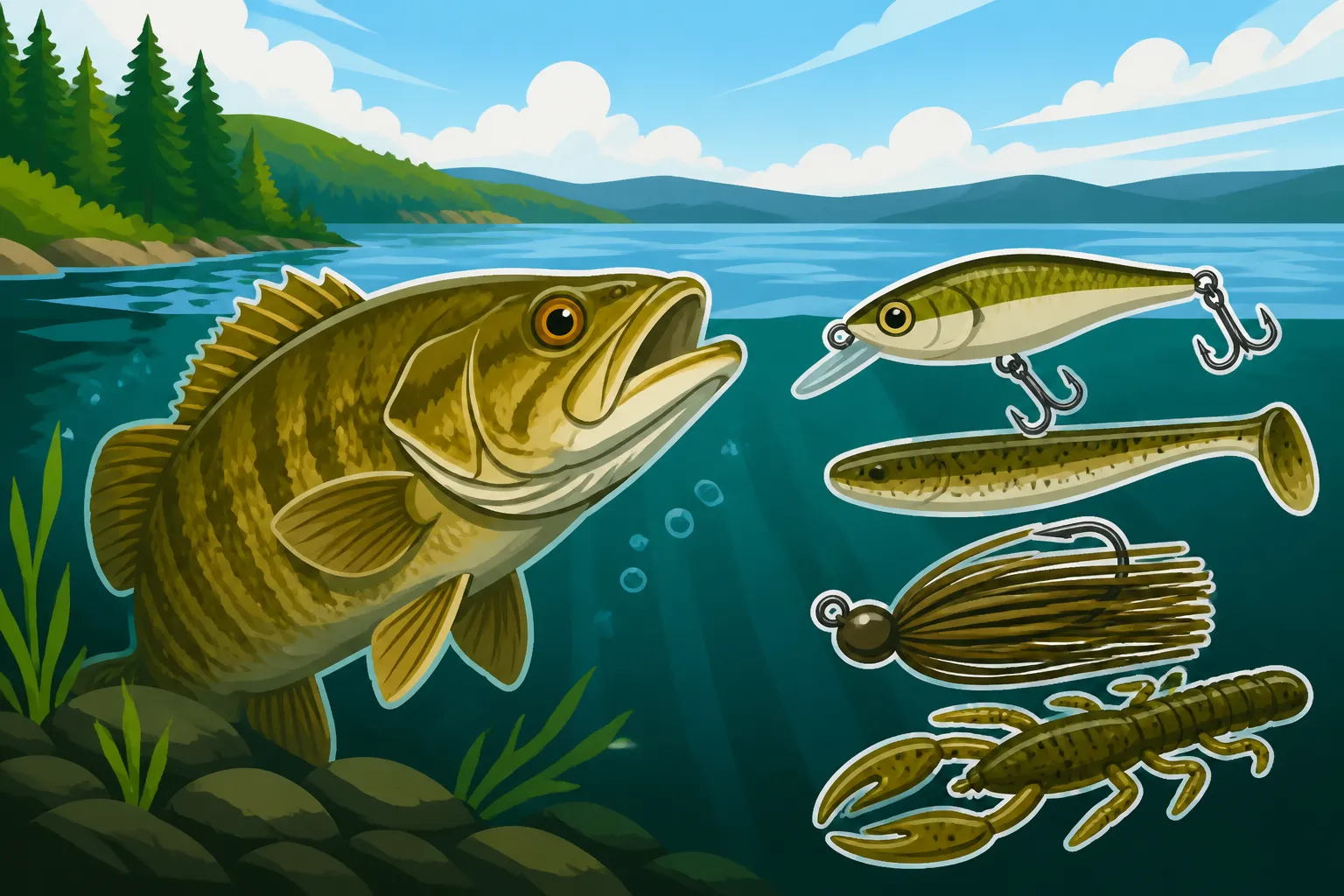
Tube jigs are perhaps the most iconic smallmouth bait, and for good reason. Their hollow body and tentacles perfectly mimic crayfish, which are a primary food source for smallmouth. Colors like green pumpkin, watermelon, and smoke with various glitter flakes are perennial favorites, closely matching the natural hues of Lake Champlain's crayfish and gobies. You can find a fantastic selection of these on Amazon, often in bulk packs which is great because smallmouth can tear them up. The beauty of a tube is its subtle darting and spiraling action as it falls or is dragged along the bottom.
To fish a tube, you’ll want to thread it onto an internal lead head jig. The weight of the jig head will depend on depth and current – lighter for shallow water, heavier for deep ledges or strong currents. Popular techniques include drifting and dragging where you let the boat drift over structure, keeping the tube in contact with the bottom. A slight hopping or shaking retrieve can also trigger strikes, mimicking a fleeing crayfish. On clear days, when fish are a bit wary, a slowly dragged tube can be absolutely deadly.
Grubs, whether single-tail or double-tail, on a jig head are another incredibly effective option, particularly for imitating baitfish. A simple curly-tail grub in white, pearl, or a natural baitfish color like shiner or perch can be retrieved with a steady swim, mimicking a cruising baitfish. A double-tail grub provides more bulk and vibration, making it a good choice for slightly murkier water or when you want a stronger presence. These are excellent for fan-casting shallower flats or working along gradual drop-offs. The subtle pulse of the tail is often all it takes to entice a strike.
Senkos and Drop Shots: Finesse Powerhouses
When the bite gets tough, or when smallmouth are heavily pressured or suspended, finesse presentations with Senkos and drop shots can be the ultimate game-changers. These techniques are designed for subtle action and precise placement.
The Senko-style worm (or its many imitations) is a thick, cylindrical stick bait that has a unique fall rate due to its salt content. Rigged wacky style (hooked through the middle) or Neko rigged (hooked through one end with a nail weight in the other), it creates an enticing, wiggling descent that smallmouth often can't resist. The lack of external appendages makes it appear incredibly natural and "alive" in the water. This is particularly effective in relatively calm conditions around isolated cover or when fish are holding tight to structure. Cast it out, let it sink on a slack line, and watch for that subtle twitch that signals a bite. Many anglers consider these a must-have, and you can stock up on various brands and colors from online retailers.
The drop shot rig is a true deep-water and suspended-fish specialist. It involves tying a hook directly to the main line, with a weight tied to the tag end of the line below the hook. This allows your soft plastic bait – typically a small, straight-tail worm, minnow imitation, or finesse worm – to be suspended at a precise depth above the bottom, where it can be wiggled and presented with minimal movement of the boat or weight. This is deadly for fish found on your sonar holding off the bottom over humps or ledges. Colors usually lean towards natural greens, browns, and whites. This technique is also fantastic for when you’re fishing for smallmouth bass in current, as the weight holds bottom while the bait dances freely. If you want to refine your approach, consider learning more about Best Bass Fishing Techniques for Lake Champlain.
Swimbaits and Flukes: Imitating Baitfish
For anglers looking to mimic the prolific baitfish populations in Lake Champlain, swimbaits and flukes are indispensable. They offer realistic profiles and actions that predatory smallmouth find impossible to ignore.
Paddle tail swimbaits, like those from Keitech or the venerable Zoom Fat Albert, rigged on a plain jig head or an Owner Beast Hook, provide a remarkably natural swimming action. The paddle tail kicks and vibrates, creating a lifelike illusion of a fleeing or injured baitfish. These are excellent for covering water, working along weed lines, or retrieving over submerged humps. Colors should generally match the local forage – silver, pearl, chartreuse back, or patterns mimicking perch and alewives. Experiment with different jig head weights to control your depth and retrieve speed.
Flukes, such as the Zoom Super Fluke, are soft plastic jerkbaits designed to imitate a dying or erratic baitfish. Rigged weightless on an EWG (Extra Wide Gap) hook, they can be twitched, paused, and ripped through the water column, creating an incredibly erratic, side-to-side darting motion. This imitates a frantic baitfish trying to escape or a disoriented one struggling near the surface. They are highly effective when fish are aggressive and chasing bait. They can also be rigged with a small weight inserted into the head for a slower, nose-down fall. These are particularly potent around rocky points or shallow structure where smallmouth are ambushing prey.
Hard Baits for Aggressive Lake Champlain Smallmouth
While soft plastics excel in versatility, sometimes you need the flash, vibration, and distinct action of hard baits to truly trigger an aggressive strike from a Lake Champlain smallmouth. These lures are often preferred when covering a lot of water quickly or when fish are actively chasing bait.
Crankbaits and Jerkbaits: Covering Water
When smallmouth are spread out or actively foraging, crankbaits and jerkbaits are your best friends for efficiently locating them and provoking vicious strikes.
Crankbaits are workhorses for covering various depths. They are designed to dive to a predetermined depth based on their lip size and retrieve speed. For Lake Champlain smallmouth, you'll want a range of medium to deep diving crankbaits to probe different parts of the water column. Shallow divers are great for rocky flats in spring, while deep divers are essential for summer smallmouth holding on offshore ledges and humps. Colors that imitate crayfish (browns, oranges, reds) are excellent for bottom-contact retrieves, while natural baitfish patterns (silver, chrome, bluegill, perch) are fantastic when smallmouth are chasing alewives or perch.
The key to fishing crankbaits effectively is understanding their diving depth and how they interact with structure. Letting a crankbait "bang" off rocks or timber can often trigger a reaction strike from a curious or territorial smallmouth. You can find a wide array of reliable crankbaits, like those from Rapala or Strike King, on Amazon, ensuring you have the right depth and color for any situation. A steady retrieve with occasional pauses or deflections is often all that's needed to entice a bite.
Jerkbaits, especially suspending models, are absolutely deadly for smallmouth bass, particularly in cooler water or when fish are a bit sluggish. Their elongated profile and erratic, darting action perfectly mimic a distressed baitfish. Popular colors include natural shad, chrome with a black or blue back, and sometimes even a chartreuse or fire tiger pattern for stained water.
The retrieve for a jerkbait is paramount: a series of sharp "jerks" or "rips" followed by a significant pause. This stop-and-go action is what drives smallmouth crazy. During the pause, the suspending jerkbait hangs tantalizingly in the water, often when the strike occurs. This technique is incredibly effective during the spring and fall, when smallmouth are often transitioning between depths and can be enticed by an easy meal. For a broader look at seasonal effectiveness, consider our guide on the Best Time of Year to Fish in Vermont.
Spinnerbaits and Chatterbaits: Vibration and Flash
When you need to create a commotion and appeal to a smallmouth's lateral line, spinnerbaits and chatterbaits deliver potent vibration and flash that can call fish in from a distance.
Spinnerbaits, with their flashy blades and pulsating skirts, are excellent for covering water, especially around shallow to medium depths. The combination of flash (from willow leaf or Colorado blades) and vibration is incredibly effective, particularly in slightly stained water or on overcast days. Tandem blade configurations are very popular, with one blade providing flash and the other vibration. White, chartreuse, and natural baitfish colors (e.g., green pumpkin skirt with silver blades) are common choices.
They are fantastic for prospecting along shorelines, over submerged grass, or around sparse woody cover. A steady retrieve often works well, but varying your speed, adding pauses, or even allowing it to "helicopter" on the fall can trigger strikes. While not as common for Lake Champlain's deep, clear smallmouth haunts, they definitely have their place in certain shallower bays and along tributary mouths.
Chatterbaits, or bladed jigs, have exploded in popularity for their unique, high-vibration action. The blade attached to the front of the jig creates an intense shimmy and erratic movement that sends strong vibrations through the water, making them incredibly effective for aggressive smallmouth. They combine the flash of a spinnerbait with the bulky profile of a jig.
Chatterbaits excel in situations where you need to get a reaction strike, such as when fish are active and chasing, or when fishing in slightly murkier water where visual cues are limited. Natural baitfish colors, white, and chartreuse are staples. They can be retrieved steadily, or with a stop-and-go retrieve, and are excellent for working along the edges of weed lines or over patchy bottom where smallmouth might be ambushing prey.
Live Bait and Natural Presentations
Sometimes, nothing beats the real thing. While artificial lures have come incredibly far, live bait still holds a special place in the arsenal of many Lake Champlain smallmouth anglers. When the bite is tough, or when you’re looking for a guaranteed strike, live bait can often out-produce even the most sophisticated lures.
Crayfish: Smallmouth Delicacy
If there's one natural food source that smallmouth bass in Lake Champlain simply cannot resist, it's the humble crayfish. These crustaceans are abundant in the rocky habitats smallmouth love, and they form a significant portion of their diet. Offering a live crayfish is like dangling a prime steak in front of a hungry diner.
To rig a live crayfish, you have a couple of primary options. One common method is to hook it lightly through the tail, ensuring you don't hit the "black line" (intestine) which can kill it quickly. Another way is to hook it through the carapace (the hard shell on its back), just above the tail, which allows it to move more naturally. Use a relatively light wire hook, such as a wide gap worm hook or a Kahle hook, appropriate for the size of your bait and target fish.
Presentation for live crayfish is typically slow and subtle. You want to mimic its natural movement along the bottom. This can involve a slow drag directly on the bottom, letting the crayfish crawl and explore. Alternatively, you can drift with the current over rocky areas, allowing the crayfish to move naturally with the boat. Smallmouth will often pick up the crayfish and try to carry it away before fully swallowing, so a slight pause after feeling a tap can be beneficial before setting the hook. Be mindful of local regulations regarding the use and transport of live bait, as rules can vary.
Shiners and Alewives: Irresistible Live Bait
Beyond crayfish, live baitfish like shiners and alewives (where legal and available) are incredibly effective for smallmouth bass, especially during different seasons. Smallmouth are opportunistic predators, and a struggling baitfish is an easy meal.
Shiners, particularly golden shiners or emerald shiners, are common forage fish in many Vermont waters, including Lake Champlain. They are lively and appealing to smallmouth. To rig a shiner, you can hook it lightly through the lips (from bottom jaw up through the top) for a more natural swim, or just behind the dorsal fin (careful not to injure the spine) if you want it to swim horizontally or kick more vigorously.
Their presentation depends on where the fish are holding. For suspended smallmouth, try fishing a shiner under a slip float to keep it at a precise depth. For fish on the bottom, a Carolina rig or a simple weighted bottom rig can be effective, allowing the shiner some freedom of movement while staying near the structure.
While alewives are a significant food source for Lake Champlain smallmouth, using live alewives as bait is generally not permitted or practical due to their schooling nature and specific regulations. However, artificial lures designed to imitate alewives, especially larger jerkbaits and swimbaits, are highly effective.
Sourcing live bait often involves purchasing from local bait shops. Always check the Vermont Fishing Regulations Explained to ensure you are compliant with rules regarding live bait, especially when moving between different bodies of water to prevent the spread of invasive species. For methods on how to target smallmouth specifically with lures, our guide on How to Catch Smallmouth Bass in Vermont Lakes provides a wealth of information.
| Bait Type | Best for Season | Ideal Conditions | Target Species | Key Action/Imitation | Pros | Cons |
|---|---|---|---|---|---|---|
| Tube Jigs | All Year | Rocky bottom, Clear-Stained Water | Smallmouth Bass | Crayfish, Goby | Versatile, Natural fall, Weedless | Can be slow, Less flash |
| Drop Shot | Spring, Summer, Fall | Deep water, Suspended fish, Clear Water | Smallmouth Bass | Finesse baitfish | Precise depth control, Subtle action | Light tackle required, Slower |
| Paddle Tail Swimbait | Summer, Fall | Open water, Chasing baitfish, Any clarity | Smallmouth Bass | Baitfish (Alewife, Perch) | Covers water, Strong vibration | Less effective on finicky fish |
| Jerkbait | Spring, Fall | Cooler water, Aggressive fish, Clear Water | Smallmouth Bass | Injured baitfish | Erratic action, Suspends, Triggers strikes | Less effective in deep cover |
| Crankbait | Summer, Fall | Deep structure, Covering water, Any clarity | Smallmouth Bass | Crawfish, Baitfish | Covers water, Depth control, Deflects off structure | Can get snagged easily |
| Live Crayfish | All Year | Rocky bottom, Tough bite, Clear Water | Smallmouth Bass | Natural Crayfish | Irresistible, High hook-up rate | Sourcing, Regulations, Delicate bait |
| Spinnerbait | Spring, Summer | Shallow cover, Stained water, Wind | Smallmouth Bass | Flash, Vibration | Attracts from distance, Good in cover | Can spook wary fish in clear water |
Matching Baits to Conditions and Seasons
Choosing the right bait for Lake Champlain smallmouth isn't just about what's "hot" right now; it's about understanding the nuances of the season, the prevailing water conditions, and how those factors influence fish behavior. What works wonders in May might be completely ignored in August.
Spring (Ice-out to Early Summer)
As Lake Champlain thaws and the water slowly warms, smallmouth begin to shake off their winter lethargy and move into shallower areas for pre-spawn feeding. This is a crucial time when their metabolism starts to pick up, but the water is still chilly, typically ranging from the low 40s to mid-50s Fahrenheit.
During this period, slow and methodical presentations are key. Jerkbaits are phenomenal, particularly suspending models. The ability to twitch them erratically and then let them hang motionless for several seconds can be irresistible to smallmouth that are still a bit sluggish but willing to chase an easy meal. Focus on rocky points and flats where baitfish like shiners or smelt might be staging.
Tube jigs rigged on light to medium jig heads are also incredibly effective. Dragging or slowly hopping a green pumpkin or smoke-colored tube along rocky bottom areas mimics a crayfish emerging from dormancy. Smallmouth are actively seeking out these crustaceans to build energy for the spawn. Vermont Trout Opening Day Traditions also often coincides with this general period, so while you’re thinking about trout, remember the smallmouth are waking up too!
Finally, drop shot rigs with small, finesse worms or minnow imitations can be deadly for targeting suspended fish or those holding tight to deep rocks in slightly deeper pre-spawn staging areas. The subtle action of a drop shot can provoke strikes when more aggressive baits are ignored.
Summer (Warm Water)
Once Lake Champlain's water temperatures stabilize in the high 60s and 70s, smallmouth bass enter their full summer patterns. They're typically more active, aggressive, and often relate to deeper offshore structure. This is when you can often get away with faster retrieves and more erratic actions.
Crankbaits, especially medium to deep divers, become highly effective for probing those offshore ledges, humps, and rock piles. Colors mimicking alewives, perch, or crayfish are excellent. Cranking them down and allowing them to deflect off structure can trigger powerful reaction strikes. This is also a fantastic time for Topwater Fishing for Smallmouth Bass in Vermont during early morning, late evening, or overcast conditions, as bass will often chase bait to the surface. Poppers, walking baits, and buzzbaits can provide thrilling blow-ups.
Swim jigs with paddle tail trailers or paddle tail swimbaits on heavier jig heads are also excellent for covering large areas of open water over deeper structure, imitating cruising baitfish. A steady retrieve or a "burn and kill" retrieve can draw strikes from aggressive summer smallmouth.
Don't forget the Senko-style baits for fishing around isolated cover or when fish are holding tight to deep points. While often considered a finesse bait, a weightless wacky-rigged Senko can be surprisingly effective in summer for fish tucked into submerged timber or weed edges.
Fall (Cooling Water)
As Lake Champlain's water temperatures begin to drop in the autumn, smallmouth bass enter a highly aggressive feeding period, gorging themselves to prepare for winter. This is often regarded as one of the best times to catch trophy smallmouth, as they become exceptionally active and willing to chase down a meal.
Jerkbaits once again become a prime choice, often with longer pauses than in spring, mimicking a stunned or dying baitfish. Smallmouth will actively track these baits and often strike during the pause. Colors that mimic autumn baitfish or crayfish are excellent.
Crankbaits, particularly those that can dive to the depths where baitfish are congregating, are also very effective. Smallmouth will often push schools of baitfish against hard structure, creating prime feeding opportunities. Focus on deeper points, humps, and ledges where they stage.
Tube jigs and grubs remain consistent producers, especially when slowly dragged or hopped along rock piles where crayfish are still active. The cooler water means smallmouth are less likely to chase long distances, making a subtle, easy meal very appealing. During this time, it’s also wise to consider Cold Front Fishing Tactics for Vermont Bass as autumn weather can be quite volatile, significantly impacting fish behavior.
Water Clarity and Color Choices
Water clarity is a major factor in bait color selection on Lake Champlain.
-
Clear water: In the exceptionally clear waters of much of Lake Champlain, especially in the central and northern parts, natural, subtle colors are generally best. Think green pumpkin, watermelon, smoke, brown, silver, and natural shad patterns. These blend in and appear less threatening to wary smallmouth. Fluorocarbon line for leaders is also highly recommended for its low visibility.
-
Stained or murky water: After heavy rains, or in certain shallower, muddier bays, the water can become stained. In these conditions, bolder colors and baits with strong vibration are more effective. Chartreuse, bright orange, white, and fire tiger patterns stand out better. Baits like chatterbaits and spinnerbaits with their strong vibrations can help fish locate your lure even when visibility is low. On an online marketplace like Amazon, you can find a huge variety of these colors and brands to ensure you’re always prepared.
Pro Tips for Lake Champlain Smallmouth Success
Landing smallmouth bass on Lake Champlain isn't just about throwing the right bait; it's also about understanding the environment and employing smart fishing strategies. The sheer size and complexity of the lake demand a thoughtful approach.
Reading the Water
Lake Champlain is vast, and knowing how to interpret its subtle cues and utilize modern technology can dramatically increase your success rate. This isn't just about finding fish; it's about understanding why they are where they are.
Your sonar unit and mapping capabilities are your most invaluable tools. High-definition mapping chips, like those offered by Navionics or Humminbird, provide incredibly detailed contour lines, showing you humps, ledges, drop-offs, and rocky structures that are invisible from the surface. Smallmouth bass are notorious for relating to structure, and these maps are your underwater roadmap. Learn to identify subtle changes in depth, isolated rock piles, and submerged points. Even a small piece of structure can hold a dozen fish.
Beyond maps, actively using your sonar to locate baitfish schools is paramount. If you see clouds of baitfish (often alewives or smelt) on your screen, you can be almost certain that predatory smallmouth are nearby. Smallmouth will patrol the edges of these schools or hold just below them, waiting for an opportunity to strike. Side imaging and down imaging technologies can help you scan wider areas and pinpoint exact structures or individual fish tucked into cover.
Understanding current is another critical aspect of reading Lake Champlain. While it's not a river, subtle currents are present, particularly around islands, points, and narrows. Smallmouth will often position themselves on the "down-current" side of structure, where food is swept to them and they can conserve energy. Observing how your boat drifts, or how surface debris moves, can provide clues to these current flows. Even a slight current break can be a magnet for actively feeding fish. If you're looking for more general boating information for the area, our guide on Vermont Boating Laws for Anglers is a good read.
Patience and Experimentation
Perhaps the most important "pro tip" for Lake Champlain smallmouth fishing is a blend of patience and a willingness to constantly experiment. The lake is dynamic, and what worked yesterday might not work today.
Don't be afraid to change baits, retrieve speeds, or even locations frequently, especially if you're not getting bites. Smallmouth can be finicky. If they're ignoring your crankbait, try a slower tube. If the tubes aren't working, try a finesse presentation like a drop shot. Sometimes, simply changing the color of your lure from a natural green pumpkin to a more vibrant chartreuse can make all the difference, especially if there's a slight change in water clarity. Think of it like being a chef – you wouldn't just use one spice for every dish!
Keeping a mental (or physical) log of successful patterns is also a game-changer. Note the time of day, water temperature, depth, bait used, retrieve speed, and the type of structure where you caught fish. Over time, you'll start to see patterns emerge that will help you narrow down your choices on future trips. For instance, you might discover that on cloudy spring mornings, a suspending jerkbait on rocky points around the Champlain Islands is a consistent producer, whereas on sunny summer afternoons, a deep-diving crankbait on offshore humps is better. This continuous learning process is what makes smallmouth fishing on Lake Champlain so incredibly rewarding. Whether you’re a beginner looking for Best Beginner Fishing Spots in Vermont or a seasoned angler, this iterative process is key to consistent success.
Disclaimer
Please remember that fishing regulations in Vermont can change. Always consult the latest Vermont Fish and Wildlife Department regulations before heading out on the water. This guide is for informational purposes only and should not replace official rules and guidelines.