Best line for lake trout deep trolling
It can be incredibly frustrating, can't it? You're out on a gorgeous Vermont lake, the sun is shining, and you know those big, beautiful lake trout are down there, suspended in the cold, clear depths. But getting your lure down to them, presenting it just right, and then actually feeling that strike from 50, 80, or even 100 feet down? That's where the challenge truly begins. The right fishing line isn't just a suggestion when you're deep trolling for lake trout; it's absolutely critical to your success, influencing everything from lure presentation to your ability to detect a subtle bite. This guide will dive deep into the world of fishing lines, helping you choose the best option to put you on those lakers.
Understanding the Challenge of Deep Trolling for Lake Trout
Lake trout are magnificent creatures, but they're also quite particular about their environment. Unlike some other species that might hang out in shallower, warmer waters, lake trout often prefer the deep, cold, oxygen-rich zones, especially as the season progresses. This deep-water preference presents some unique challenges for anglers, and your choice of fishing line plays a monumental role in overcoming them.
Why Depth Matters for Lake Trout
When you're chasing lake trout in Vermont, particularly on big bodies of water like Lake Champlain or even some of our deeper mountain lakes, you're essentially entering a different world. These fish thrive in cold water, typically preferring temperatures in the 40s and low 50s Fahrenheit. As the surface waters warm up, these trout retreat, often seeking refuge below the thermocline – that invisible boundary layer where water temperature drops sharply.
Imagine a scorching summer day. While bass might be busting on topwater near shore, those lakers are chilling out in their cool, deep sanctuary. To reach them, you need to get your lures down, and I mean way down. We're talking depths that can easily exceed 50, 70, or even over 100 feet. Every foot matters when you're trying to present a lure directly in their strike zone. If your line can't get your lure to the desired depth effectively, or if it causes too much drag, you're essentially fishing in the wrong neighborhood. Understanding How deep lake trout go in summer is foundational to choosing the right line.
The Enemies of Depth: Drag and Line Stretch
The deeper your lure goes, the more line you have out, and the more that line is affected by the water it's moving through. This phenomenon is called drag, and it's a deep-troller's nemesis. Water resistance can make your line bow, lift your lure higher than intended, and generally make it difficult to maintain a consistent depth. A thicker line will experience significantly more drag than a thinner one, meaning you'll need more weight or speed to achieve the same depth.
Then there's line stretch. Traditional monofilament line, while having its place, is designed to stretch. This stretch can be a blessing when fighting a strong fish, providing a shock absorber against head shakes and powerful runs. However, when you have hundreds of feet of mono out, that stretch becomes a major drawback. It can make it incredibly difficult to feel subtle bites from deep-dwelling lake trout, making you wonder if that little bump was a fish, a weed, or just your lure doing something funny. Moreover, line stretch means your lure isn't always at the exact depth you think it is, as the tension (or lack thereof) changes.
Top Line Choices for Deep Trolling Lake Trout
Now that we understand the environmental factors and physics at play, let's talk about the specific types of fishing lines that serious lake trout anglers employ for deep trolling. Each has its own strengths and weaknesses, making the "best" choice often dependent on your specific technique and preferences.
Leadcore Line: The Classic Deep Diver
For many years, leadcore line has been the go-to for anglers wanting to get their lures deep without relying solely on heavy sinkers or complicated diving devices. It's truly a marvel of engineering for its specific purpose.
Leadcore line is essentially a braided nylon sheath with a thin, flexible lead wire running through its core. What makes it unique is that it's segmented into different colors, usually every 10 yards. Each color change represents a certain amount of weight and, therefore, a certain amount of depth when trolled at a consistent speed. This built-in weight allows your lure to sink without needing additional clip-on sinkers, giving it a more natural presentation.
Pros of Leadcore:
- Self-Weighting: The primary advantage is its inherent weight, which eliminates the need for external sinkers that can spook fish or foul your presentation.
- Depth Control: The color-coded system provides a fantastic visual cue for depth. If you know that at a particular speed, two colors of leadcore get your lure to 20 feet, and five colors get you to 50, it offers repeatable and predictable depth control. This is especially useful for targeting a specific depth zone where you've marked fish.
- Simple Setup: You simply tie your leader to the end of your leadcore, and you're ready to go. No complex rigging required for depth.
- Effective for Flat-Lining: It's excellent for flat-lining, where you're simply letting line out directly behind the boat, achieving depth without additional aids.
Cons of Leadcore:
- Thick Diameter: The lead core makes it relatively thick compared to other lines of similar breaking strength. This thicker diameter creates more drag in the water, requiring faster trolling speeds or more "colors" out to achieve maximum depth.
- Poor Sensitivity: The braided sheath and internal lead make leadcore very stretchy and somewhat "mushy" feeling. You'll likely miss many subtle bites, and it can be harder to detect if your lure is fouled.
- Doesn't Cast Well: Due to its weight and stiffness, leadcore is generally not suitable for casting; it's purely a trolling line.
- Specific Gear Needed: You often need larger reels to accommodate the bulk of leadcore line.
- Limited Brands: While dependable brands exist like Suffix or Berkley, your options might feel less expansive than with other line types.
When to Use Leadcore:
Leadcore shines when you need to target a very specific depth with a simple, direct presentation, especially when you're flat-lining or using a spread that doesn't involve downriggers or divers. It's fantastic for areas where lake trout are consistently holding at, say, 30, 40, or 50 feet. It's also a great option for beginners due to its straightforward depth estimation.
Braided Line: Maximum Sensitivity and Thin Diameter
Braided line has revolutionized many forms of fishing, and deep trolling for lake trout is certainly one of them. Unlike mono or leadcore, braid is made from multiple strands of synthetic fibers (like Spectra or Dyneema) woven tightly together.
Pros of Braided Line:
- Zero Stretch: This is arguably braid's biggest advantage for deep trolling. With no stretch, you feel everything – every subtle vibration of your lure, every tap from a curious fish, and that definitive thump of a strike, even when hundreds of feet of line are out. This sensitivity is a game-changer for detecting bites.
- Thin Diameter for Strength: Braid offers incredible strength for its diameter. A 20-pound test braid might have the diameter of 6-pound mono. This thin profile significantly reduces water resistance, allowing your lures to dive deeper with less weight or maintain depth more easily. This is crucial for precise depth control, especially when using downriggers or diving planers.
- Cuts Water Efficiently: The thin, slick nature of braid helps it slice through the water column with minimal resistance, further aiding in depth attainment.
- Long-Lasting: Braid is highly resistant to UV rays and abrasion, generally lasting much longer than monofilament. You can find quality braid on Amazon from various reputable brands.
Cons of Braided Line:
- No Stretch (Can be a Con): While great for sensitivity, the lack of stretch means there's no forgiveness when a big lake trout makes a sudden run or head shake. This can lead to pulled hooks if your drag isn't set perfectly or if you're not careful.
- Visibility: Braid can be quite visible in clear water, especially on bright days. This necessitates the use of a fluorocarbon or monofilament leader between your braid main line and your lure.
- Cost: Braid is generally more expensive than monofilament, though its durability often offsets this in the long run.
- Knot Tying: Knot tying with braid requires specific knots designed for its slick, thin nature to prevent slippage.
- Rod Guide Wear: Over time, braid can be abrasive on certain types of rod guides, though modern guides are typically designed to handle it.
When to Use Braided Line:
Braid is the undisputed king when you're using downriggers or diving planers (like Dipsy Divers). Its thin diameter minimizes blowback, ensuring your lure stays at the precise depth you've set. The sensitivity is also invaluable when you're trying to feel those light bites or detect subtle changes in your lure's action. Brands like PowerPro, Spiderwire, and Berkley X9 are popular choices among deep-trolling enthusiasts.
Monofilament with Weighting Systems: A Hybrid Approach
While often overshadowed by leadcore and braid for deep trolling, traditional monofilament still has its niche, especially when combined with specific weighting systems. Mono is a single strand of nylon, known for its stretch, affordability, and ease of use.
Pros of Monofilament:
- Stretch/Forgiveness: The inherent stretch of mono acts as a shock absorber, which can be beneficial when a large lake trout hits hard or makes powerful surges. It can prevent hooks from tearing out, especially when combined with a softer rod.
- Affordability: It's typically the most budget-friendly option.
- Ease of Use: Knots are generally easier to tie and hold well with mono.
- Low Visibility: Clear or green mono can be less visible in the water than some braids, though a fluorocarbon leader is still often preferred for its near invisibility.
Cons of Monofilament:
- Significant Stretch: For deep trolling, this is its biggest drawback. It makes bite detection incredibly difficult over long lengths, and precise depth control becomes a guessing game.
- Thicker Diameter: Compared to braid of the same breaking strength, mono is much thicker, leading to increased water resistance and less efficient depth attainment.
- Abrasion Resistance: While decent, it's not as tough against sharp rocks or zebra mussels as good quality braid or fluorocarbon.
When to Use Monofilament:
Mono is rarely used as the main line for truly deep lake trout trolling (think 50+ feet) because its stretch and diameter are too detrimental. However, it can be effective as:
- Backing: Many anglers will put a layer of mono on their reel before spooling braid or leadcore. It's cheaper, prevents braid from slipping on the arbor, and provides a cushion.
- Leader Material: A short mono leader can be used in conjunction with leadcore if you prefer a little more stretch right near the lure than fluorocarbon offers.
- With Snap Weights or Diving Planers in Shallower Depths: If you're targeting lake trout that are only, say, 20-30 feet deep, and you're using clip-on snap weights or small diving planers, mono can still work. The shorter length of line out means less cumulative stretch.
| Line Type | Key Feature | Primary Use for Lake Trout Deep Trolling | Pros | Cons |
|---|---|---|---|---|
| Leadcore | Self-weighting | Flat-lining, specific depth targeting | No external weights, predictable depth | Thick, low sensitivity, cannot cast |
| Braided Line | Zero stretch, thin | With downriggers/divers, maximum feel | High sensitivity, low drag, strong | No stretch (pulled hooks), visible, cost |
| Monofilament | Stretch, affordable | Backing, leaders, shallower weighting | Forgiveness, affordability, easy to tie | High stretch, thick, poor bite detection |
Pairing Your Line with Trolling Techniques and Gear
Choosing the right line is only half the battle. How you integrate that line into your overall deep-trolling setup and techniques will ultimately determine your success. Every component works in harmony to get your lure to the fish effectively.
Downriggers: Precision Depth Control
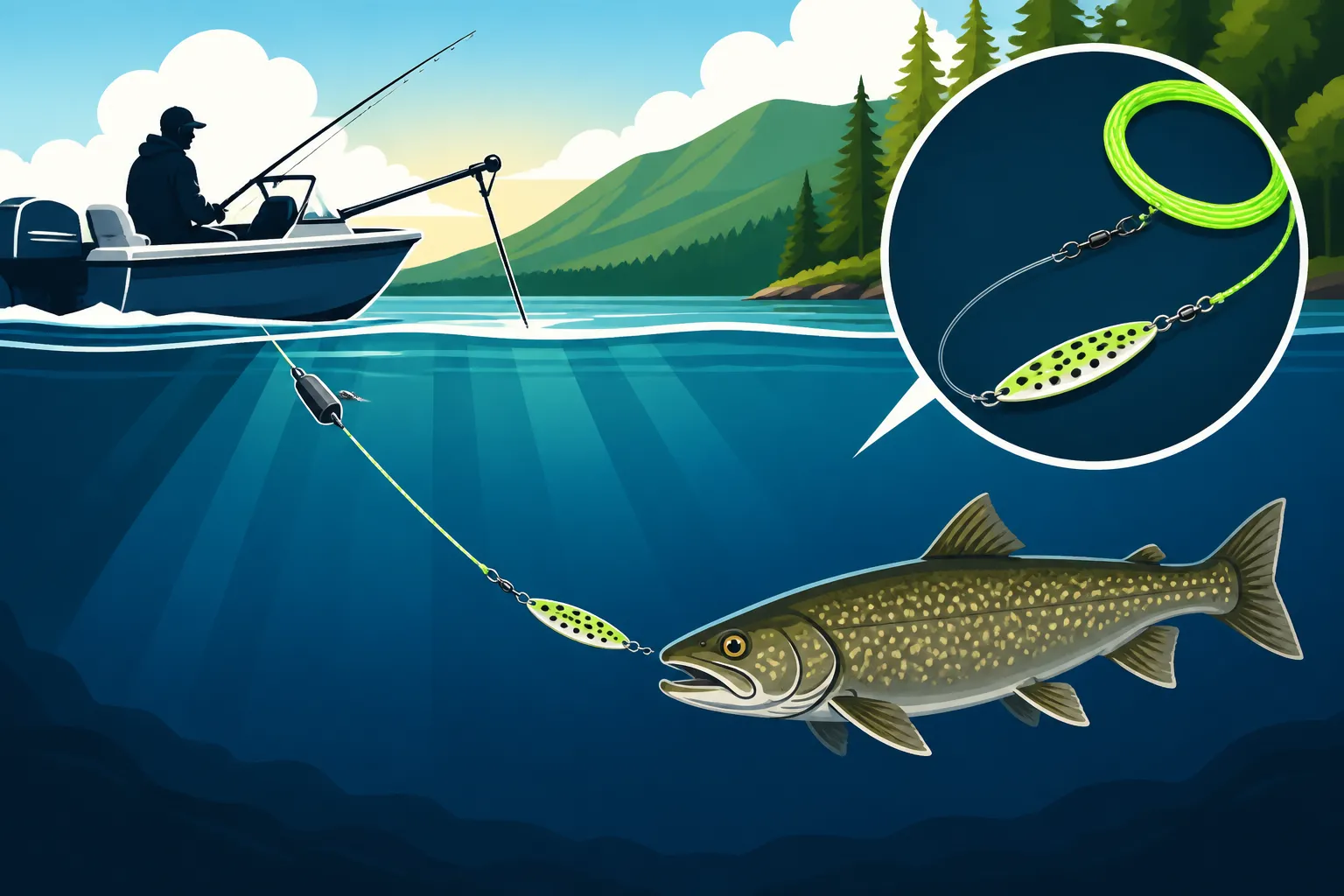
If you're serious about deep trolling for lake trout, especially in big water like Lake Champlain Fishing Guide, downriggers are often indispensable. These devices use a heavy cannonball weight to carry your fishing line (and attached lure) down to a precise, measured depth, then release it once a fish strikes.
For downrigger fishing, braided line is the overwhelming favorite. Its thin diameter means less blowback – the amount your line "bows" back in the water due to speed and current – allowing your cannonball to track almost directly below the boat. This translates to incredibly accurate depth control. You set your downrigger to 80 feet, and your lure is at 80 feet. The zero stretch of braid also ensures that when the line releases from the downrigger clip, you get a direct, immediate connection to the fish, transmitting every head shake and run directly to your rod. We've even discussed Best Downriggers for Walleye Trolling in the past, and many of those principles apply here.
Dipsy Divers and Planer Boards: Expanding Your Spread
Sometimes, lake trout aren't directly below the boat. They might be off to the sides, or you might want to present multiple lures at different depths and distances. This is where Dipsy Divers or diving planer boards come into play. These devices dive or pull your line out to the side when trolled, and often trip to release when a fish bites.
Again, braided line excels here. The minimal drag of braid allows these divers to reach their maximum potential depth and maintain a more consistent side-to-side track. With monofilament, the stretch and diameter can significantly reduce the effective depth these divers achieve and make them less responsive. The sensitivity of braid also helps you know if your diver has fouled, or if you're ticking bottom, allowing for quick adjustments.
Leaders and Connections: The Unsung Heroes
Even if you spool up with the most advanced braided line, you can't just tie your lure directly to it. Leaders are absolutely essential when deep trolling for lake trout.
Fluorocarbon Leaders: This is the most common and highly recommended leader material for lake trout. Fluorocarbon has several key advantages:
- Near Invisibility: It has a refractive index very similar to water, making it virtually invisible underwater. This is critical in clear lake trout waters, where fish can be line-shy.
- Abrasion Resistance: Fluorocarbon is generally much more abrasion-resistant than monofilament, which is important when fishing around rocky bottom or when a fish might thrash against structure.
- Low Stretch: While not zero stretch like braid, it has significantly less stretch than mono, aiding in sensitivity and solid hooksets.
Typically, you'll want to use a leader of 8 to 15 feet, sometimes longer depending on conditions, tied from your braided main line to your lure. The breaking strength of your leader will depend on the size of the fish you're targeting and the water clarity, but generally, 10-20 lb test fluorocarbon is a good starting point. You can find excellent fluorocarbon leader material on Amazon from brands like Seaguar or Berkley.
Knots for Connections:
Connecting your braided main line to your fluorocarbon leader is perhaps the most critical knot in your entire setup. Here are a couple of popular, strong options:
- FG Knot: This knot is incredibly strong, very slim, and passes through rod guides smoothly. It takes practice to tie correctly but is worth the effort for its reliability.
- Double Uni Knot: A more straightforward knot to tie than the FG, and still very strong. It's a bit bulkier, but highly effective.
Practicing these knots at home until you can tie them quickly and correctly will save you headaches (and potentially big fish) on the water.
Practical Tips for Maximizing Your Deep Trolling Success
Beyond the specific line types, there are several practical considerations that can greatly enhance your deep trolling for lake trout. It's all about attention to detail and consistent application.
Line Counter Reels: Your Depth-Finding Allies
Whether you're using leadcore, braid with divers, or even a weighted monofilament system, a good line counter reel is an absolute must. These reels have a built-in mechanism that tells you exactly how many feet (or yards) of line you have deployed.
Why they're essential:
- Repeatability: Once you find a depth where lake trout are hitting, a line counter allows you to precisely return your lure to that exact depth every single time. No more guessing.
- Pattern Recognition: It helps you identify patterns. Are they hitting at 65 feet, or 72? A line counter gives you the data you need to adjust and optimize.
- Managing Multiple Lines: When running a spread with several rods, knowing how much line is out on each helps prevent tangles and ensures your lures are at their intended depths.
- Learning Curve: For newer anglers, it removes a huge variable, making the learning process much smoother.
You can find a wide range of reliable line counter reels on Amazon from brands like Daiwa, Shimano, and Okuma. Invest in quality here; it will pay dividends.
Regular Line Inspection and Maintenance
Your fishing line is your direct connection to the fish, and it takes a beating, especially when deep trolling. Friction from rod guides, stress from fighting fish, nicks from underwater structure, and UV exposure all degrade your line over time.
What to look for:
- Fraying or Nicks: Carefully run your fingers along the last 10-20 feet of your main line and especially your leader. Any rough spots, nicks, or signs of fraying mean compromised strength.
- Discoloration: Braid can sometimes fade or show signs of wear through discoloration.
- Memory (Mono): Monofilament can develop "memory" (coiling) over time, especially if stored on a reel for long periods. This affects casting and presentation.
Maintenance tips:
- Retie Often: Especially your leader-to-lure knot. If you've been catching fish or fishing in rocky areas, don't hesitate to cut off a few feet and retie.
- Trim Damaged Sections: If you find a nick on your main line, it's always best to cut out the compromised section. Better to lose a little line than a big fish.
- Line Conditioner: For monofilament, a good line conditioner can reduce memory and prolong its life. Some anglers even use it on braid to make it slicker, available on Amazon.
- Replace Line Annually: Even if it looks okay, old line loses strength. Many serious anglers respool their reels with fresh line at least once a season, if not more frequently for high-use setups.
Experimentation and Local Knowledge
While this guide provides a solid foundation, remember that Vermont's lakes are diverse, and lake trout can be finicky. What works on Lake Willoughby Fishing Guide might be slightly different than on Lake Memphremagog Fishing Guide.
- Be Willing to Experiment: Don't be afraid to try different line types, leader lengths, or even leader materials (mono vs. fluoro) until you find what works best for a particular body of water or conditions.
- Talk to Local Experts: Your local bait and tackle shops are goldmines of information. The folks who run these shops and other local anglers fish these waters constantly and know the nuances. They can offer invaluable insights into what's currently working, what depths fish are holding, and what line setups are popular in that specific area.
- Observe and Adapt: Pay attention to what other successful anglers are doing, and don't be afraid to adapt your techniques based on the fish finder readings and bites (or lack thereof). This iterative process is what makes fishing so rewarding.
Finding the best line for lake trout deep trolling is a journey of learning and adaptation. By understanding the properties of each line type and pairing them with the right gear and techniques, you'll be well on your way to consistently connecting with those magnificent fish in Vermont's cold, clear depths.
Disclaimer
This article is for general informational purposes only and does not constitute professional advice. Laws, prices and regulations vary by location and change over time. Consult a qualified professional for guidance on your specific situation.