How to catch walleye at night on Lake Champlain
For many anglers, chasing walleye on Lake Champlain during the bright daylight hours can feel like a fool's errand. They’re notoriously shy and often retreat to deeper, cooler waters, leaving you scratching your head with an empty stringer. But here’s the secret: when the sun dips below the majestic Green Mountains, a whole new world of opportunity opens up. This guide is all about equipping you with the knowledge and tactics to successfully target and catch walleye at night on Lake Champlain, turning frustration into thrilling catches.
Why Night Fishing for Walleye on Lake Champlain is a Game Changer
Let's be honest, fishing all day under a blazing sun for a species that prefers low light can be disheartening. Walleye are nicknamed "marble eyes" for a reason – their eyes are specifically adapted for seeing in dim conditions, giving them a distinct advantage over their prey, and often, over us anglers, once the sun sets. This behavioral shift is precisely why night fishing is not just an alternative, but often the most effective way to target these delicious fish on a massive body of water like Lake Champlain.
Understanding Walleye Nocturnal Behavior
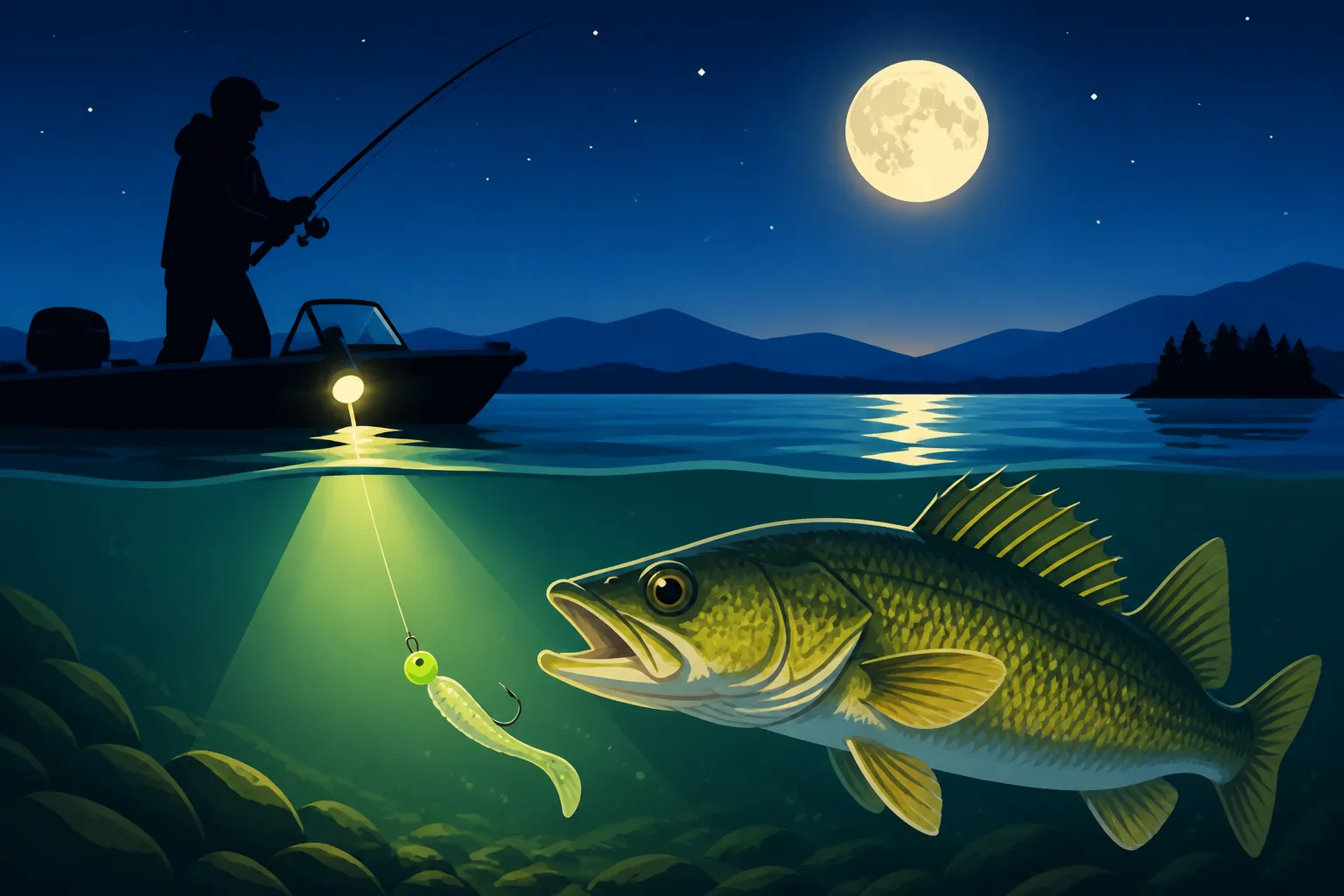
When twilight fades and the moon takes over, walleye undergo a significant behavioral transformation. During the day, they're often hunkered down in deeper, cooler pockets, or tight to structure, conserving energy and avoiding predators. But as darkness descends, they become much more active. They'll push up into shallower feeding flats, along weed lines, and onto rocky points, actively hunting baitfish that are also moving under the cover of darkness. This means you're no longer trying to coax a lethargic fish; you're intercepting an actively feeding predator. It's like flipping a switch – suddenly, the fish that were seemingly nonexistent are now on the prowl. This is a key insight when you're thinking about How to Catch Walleye on Lake Champlain.
One of the biggest advantages of their low-light vision is that walleye don't just see better, they also rely more heavily on their lateral line to detect vibrations. This means your lure selection and presentation can be geared towards creating subtle thumps and wobbles that mimic a struggling baitfish, even if the visual appeal is diminished in the dark. It’s a sensory game, and at night, walleye are playing it with all their strengths. Understanding this helps you predict where they might be feeding and what they might be receptive to.
Reduced Pressure and Increased Solitude
Another often-overlooked benefit of night fishing is the sheer tranquility and reduced competition. During the day, Lake Champlain can be a bustling place, especially in popular areas. There are pleasure boaters, other anglers, and general commotion that can spook wary fish or just make for a less peaceful experience. When night falls, however, most of that activity disappears.
You'll often find yourself with vast stretches of the lake almost entirely to yourself, particularly on weekdays. This solitude isn't just good for the soul; it's good for fishing. Fewer boats mean less sonar interference, less propeller wash, and generally calmer waters. The fish are less pressured, more willing to bite, and you can focus entirely on your presentation without worrying about other boats encroaching on your spot. It transforms the fishing experience from a competitive sport into a meditative pursuit, with the added bonus of often being more productive. This quiet atmosphere allows you to truly appreciate the unique beauty of Lake Champlain Walleye Fishing under the stars.
Essential Gear for Night Walleye Success
Night fishing isn't just daytime fishing after dark; it requires a bit of a gear adjustment to ensure both safety and success. You'll need reliable lighting, appropriate tackle for low-light conditions, and essential safety equipment that is often overlooked when the sun is high in the sky. Thinking ahead about your setup can make all the difference in a productive and enjoyable night on the water.
Lighting and Visibility Essentials
First and foremost, you need light, and plenty of it, but used strategically. A good quality headlamp is absolutely non-negotiable. Look for one with multiple settings, including a red light option. The red light is crucial because it preserves your night vision, allowing you to see without blinding yourself or your fishing buddies, and it spooks fish far less than a bright white light. You'll use the white light for tying knots or navigating the boat, but switch to red when you're actively fishing or just scanning the area. I've found some excellent multi-mode headlamps on Amazon that are specifically designed for anglers.
Beyond your personal headlamp, your boat's navigation lights are mandatory for safety and legal compliance. Make sure they are fully functional before you even think about leaving the dock. Additionally, a powerful spotlight can be invaluable for navigating treacherous areas, locating buoys, or signaling other boats in an emergency. However, use it sparingly; constantly shining a bright light into the water will absolutely shut down a walleye bite. Remember, the goal is to see without being seen, in a way. This is also covered in Best Boat Lights for Night Fishing.
Tackle and Boat Setup for Low Light
Your tackle choices for night fishing aren't drastically different from daytime, but presentation becomes even more critical. Lures with rattles, large profiles, or those that emit a distinct vibration are often more effective because walleye are relying on their lateral line. Darker colored lures, or even glow-in-the-dark options, can also be surprisingly effective as silhouettes against the moonlight or for a brief flash of glow. Soft plastic paddle tails rigged on jig heads, suspending jerkbaits, and deep-diving crankbaits are all excellent choices.
For your boat setup, organization is key. Trying to find a specific lure or tie a knot in the dark is frustrating. Have your primary tackle laid out, easily accessible, and consider tackle boxes with clear lids so you can see contents without fumbling. Your rod and reel setup should be robust enough for potential trophy walleye, but sensitive enough to detect subtle bites you might not see. Medium-heavy power spinning or baitcasting rods, paired with reels spooled with low-stretch line like braid or fluorocarbon, will give you the sensitivity and power you need. Don't forget a sturdy landing net with rubberized mesh, as walleye can be feisty at boat side, and rubber mesh protects their slime coat for healthier release. When looking for new gear, I often browse Amazon for reviews and comparative pricing on different brands.
Safety Considerations for Night Anglers
Safety simply cannot be overstated when you're on Lake Champlain after dark. The water is vast, and hazards that are easily spotted in daylight become invisible at night. Always, and I mean always, tell someone where you're going and when you expect to return. Wear your life jacket, even if you’re a strong swimmer. The unexpected can happen, and a life jacket is your best friend in cold, dark water.
Beyond personal floatation devices, ensure your boat has all required safety equipment: throwable cushions, a sound-producing device (horn or whistle), fire extinguisher, and a first-aid kit. A fully charged marine radio or cell phone (in a waterproof case) for emergencies is also crucial. Navigation can be tricky; rely on your GPS and your Best Fish Finders for Vermont Lakes with up-to-date charts, but always be aware of your surroundings and any known obstacles. Go slower than you would during the day, pay extra attention to buoy lights, and keep a watchful eye out for other boats, even though they may be few and far between. A cautious approach ensures a safe and enjoyable experience for everyone on board.
Top Techniques for Lake Champlain Night Walleye
Once you're properly geared up and safety is paramount, it's time to talk tactics. Night fishing for walleye isn't rocket science, but it does involve focusing on specific presentations that capitalize on their nocturnal feeding patterns. On Lake Champlain, you'll generally be choosing between covering water with trolling or targeting specific structure with casting and vertical jigging.
Trolling After Dark
Trolling is often the most effective method for covering large expanses of Lake Champlain at night and intercepting actively roaming walleye. The key here is presenting a lure that mimics a baitfish, like smelt or alewives, which walleye feed on. Deep-diving crankbaits are your bread and butter for this technique. Choose lures that run at the depth you're targeting, usually between 10-30 feet, depending on the specific structure and time of year. Longer trolling passes, often along contours, points, and sudden drop-offs, allow you to present your lure to more fish.
Speed is critical: generally, a slower troll, around 1.5 to 2.5 mph, is best after dark. This gives the walleye more time to react to the lure in low light. Pay close attention to your boat's speed and direction, using your GPS and fish finder to stay on course. Side-imaging or down-imaging sonar can be incredibly helpful for identifying submerged structure or baitfish schools even in the dark. Don't be afraid to experiment with different crankbait colors; sometimes a black or dark purple can silhouette better against the moonlight, while other nights, a lure with a subtle glow or UV finish can trigger a strike. For more specific lure advice, check out Best Lures for Walleye Trolling on Lake Champlain.
One common frustration is not knowing if your lure is running true in the dark. Consider using crankbaits that have a very distinct wobble, which you can often feel through the rod tip. Or, even better, rig a small, thin glow stick or a light-emitting diode (LED) indicator above your lure on your line or directly to the back of a planer board. This allows you to visually confirm your lure or board is still active and in position. Remember to check your lines frequently for weeds or debris, as these can quickly foul a lure and render it ineffective. This kind of systematic approach is key to effective Best Trolling Gear for Lake Champlain Walleye.
Casting and Vertical Jigging Structure
While trolling covers water, casting and vertical jigging allow you to surgically target specific structure where walleye are known to congregate. This is particularly effective around rocky points, submerged humps, weed line edges, or even bridge pilings. If your fish finder shows a distinct school of baitfish or marks of walleye holding tight to a particular spot, casting or vertical jigging can be devastatingly effective.
For casting, lipless crankbaits, swimbaits, or even a jig and soft plastic combo can work wonders. The key is to make accurate casts to the structure and work your lure slowly, allowing it to bump along the bottom or hover just above the cover. Use your headlamp's red light sparingly to check your line or bait, but otherwise, let your feel for the lure do the work. The "thump" of a jig hitting the bottom, or the subtle pull of a walleye inhaling your bait, will become familiar sensations.
Vertical jigging is ideal for those times when walleye are holding tight to a very specific piece of structure, or when you’ve marked them directly under the boat. Blade baits, jigging spoons, or a simple lead head jig tipped with a minnow or soft plastic are excellent choices. Position your boat directly over the structure using your electric trolling motor and anchor system. Drop your lure to the bottom, then lift and drop it with a cadence that mimics a struggling baitfish. The bites can often be very subtle, sometimes just a slight "mushy" feeling or a sudden weight when you lift. Having a sensitive rod, as discussed in Best rig for bottom fishing for walleye, is paramount here.
Using Slip Bobbers for Shallow Walleye
Don't overlook the power of slip bobbers when walleye push into shallower feeding areas at night. This technique is especially good over weed flats, along shorelines, or around rocky reefs where fish might be feeding in 5-15 feet of water. A slip bobber allows you to present live bait (like a shiner or nightcrawler) or even a small jig suspended at a precise depth, keeping it tantalizingly in the strike zone.
The setup is simple: thread your line through the slip bobber, then add a bobber stop to set your desired depth, followed by a small weight (split shot or a small egg sinker) to get your bait down, and finally, a hook. The beauty of the slip bobber is that you can cast it out easily, and the bait will sink to the predetermined depth, presenting naturally. Walleye often pick up baits gently at night, so a slip bobber will give you a clear visual of the bite as it dips or moves. You can even add a small glow stick to the top of the bobber for easy visibility.
This method is fantastic for anchoring up on a promising flat or point and fishing multiple lines. The slow, natural presentation of a live bait under a bobber is often irresistible to wary walleye, especially when they are focused on smaller forage. It takes advantage of their active feeding in shallow water without requiring constant movement, allowing you to relax and enjoy the night while the bobber does the work.
Finding the Right Spots After Dark
Lake Champlain is immense, and simply "going fishing" at night isn't enough. You need a strategy for locating productive water. Walleye, even at night, are creatures of habit and structure. Knowing what to look for on your charts and how to interpret your sonar can make all the difference between a long, fishless night and a successful outing.
Identifying Key Structure and Bottom Changes
Walleye are drawn to structure like magnets, day or night. This includes rocky points, reefs, humps, sharp drop-offs, and even subtle changes in bottom composition, like where soft mud meets hard rock. These areas provide ambush points and cover, especially when baitfish are moving through. At night, walleye will often move from deep water where they spend the day, up onto the tops and edges of these structures to feed. Your electronic charts and sonar are your best friends here. Spend some time studying contour lines on your map, identifying promising transitions and underwater topography.
When you're out on the water, use your fish finder to confirm what your maps are telling you. Look for hard bottom returns indicating rock or gravel, and note any sudden depth changes. Even subtle humps or depressions on a seemingly flat bottom can hold fish. Don't overlook weed lines, especially healthy green weeds in shallower water. Walleye will often cruise these edges, picking off smaller fish or invertebrates that live within the vegetation. It's all about understanding How to read structure for walleye on Lake Champlain.
Following Baitfish Movements
Walleye are predators, and like all predators, they follow their food source. On Lake Champlain, this means keeping an eye out for concentrations of baitfish, such as smelt and alewives. These smaller fish often move into shallower areas or suspend in schools at certain depths after dark, and the walleye won't be far behind. Your fish finder is crucial for detecting these schools. Look for dense clouds or arches on your screen, indicating baitfish. If you see baitfish, there's a good chance predatory fish like walleye are in the vicinity, or will be soon.
Sometimes, you can even spot baitfish jumping or shimmering on the surface in the moonlight, which is a sure sign of activity. Pay attention to birds like gulls or terns during twilight hours; if they're diving, it often indicates baitfish being pushed to the surface by predators below. You can also target areas known for high baitfish populations. For instance, knowing What walleye eat on Lake Champlain helps you choose lures that imitate these forage species. Remember that baitfish movements can be seasonal and influenced by water temperature, so adapting your strategy throughout the fishing season is important, especially when walleye might be following them to deeper water in summer as seen in How deep walleye go in summer on Lake Champlain.
Utilizing Current Breaks and River Mouths
While Lake Champlain is a large lake, it still has areas with significant current, particularly near river mouths or constrictions. These current breaks are prime feeding grounds for walleye. The current brings disoriented baitfish and other food items, and walleye will position themselves in calmer water just out of the main flow, waiting to ambush anything that drifts by. Look for eddies, seams, and slack water areas adjacent to faster current.
River mouths, in particular, are hotspots. Rivers bring nutrients and often cooler water into the lake, attracting baitfish and in turn, walleye. After dark, walleye will often stage near these river mouths, especially during certain times of the year. Trolling along the edges of the current where it meets the main lake, or casting into the slack water pockets, can be incredibly productive. Again, your sonar can help you identify these current breaks and the subtle depressions or structures that might be present. Learning to interpret these nuanced environmental cues is essential for finding the Best Walleye Spots on Lake Champlain.
Table: Night Walleye Fishing Checklist for Lake Champlain
| Category | Essential Items | Notes |
|---|---|---|
| Safety | Life jackets (worn!) | One for every person on board |
| Boat navigation lights (functional) | Check before every trip, carry spares | |
| Marine radio / Charged cell phone (waterproof) | For emergencies, keep accessible | |
| First-aid kit | Well-stocked for minor cuts, scrapes, etc. | |
| Throwable flotation device | Required by law, good for person overboard | |
| Fire extinguisher | Check expiration, easily accessible | |
| Lighting | Headlamp with red light option | Essential for knot tying, baiting, preserving night vision |
| Spotlight (handheld or mounted) | For navigation, emergency, used sparingly for fishing | |
| Boat interior/utility lights (dimmable) | For organization and setting up, avoid bright white near water | |
| Navigation | GPS with up-to-date charts | Crucial for navigating in the dark |
| Fish Finder (Sonar/Down/Side Imaging) | For locating structure, baitfish, and walleye | |
| Compass | Backup for electronics | |
| Tackle | Sensitive rods & reels | Medium-heavy power, spooled with braid or fluorocarbon |
| Variety of crankbaits (deep-diving, suspending) | Dark colors, rattles, UV/glow finishes often effective | |
| Jigs & soft plastics (paddle tails, grubs) | Various weights for different depths and presentations | |
| Live bait (minnows, nightcrawlers) | For slip bobber fishing, if preferred | |
| Slip bobbers, bobber stops, weights, hooks | For static presentations in shallow zones | |
| Sturdy landing net (rubberized mesh) | Essential for safe landing and handling | |
| Pliers/hook removers, line cutters | For unhooking fish, cutting line in low light | |
| Tackle organization (clear-lid boxes) | Keep tackle accessible and visible | |
| Comfort/Misc. | Warm clothing (layers) | Nights on Champlain can get chilly, even in summer |
| Waterproof outerwear | For dew, spray, or unexpected rain | |
| Cooler with food & drinks | Stay hydrated and fueled | |
| Bug spray | Especially important in stagnant air or near shore | |
| Charged spare batteries/power bank for electronics | Don't get caught with dead electronics |
Disclaimer
This article is for general informational purposes only and does not constitute professional advice. Laws, prices and regulations vary by location and change over time. Consult a qualified professional for guidance on your specific situation.