Largemouth Bass vs Smallmouth Bass Identification
For any angler venturing out onto Vermont's beautiful lakes and rivers, there's a common moment of hesitation when you've just landed a feisty bronze or green fish: "Is this a largemouth or a smallmouth?" The two species, while both offering incredible sport, have distinct characteristics that are crucial to recognize for everything from following regulations to tailoring your fishing approach. This guide will walk you through the precise differences so you can confidently identify your catch and become a more effective bass angler in the Green Mountain State.
The First Glance: Key Visual Cues for Identification
When you first pull a bass from the water, your eyes will naturally scan its overall appearance. While both are members of the black bass family, their body structure, mouth shape, and coloration offer immediate clues that, once you know what to look for, make telling them apart quite simple. It's not just about a vague "green" or "brown" hue; there are anatomical distinctions that are consistent and reliable.
The Mouth: A Dead Giveaway
Perhaps the most definitive way to distinguish between a largemouth and a smallmouth bass is by examining their mouths. This single feature often provides all the information you need, even for a quick identification on the water before release. It’s the first thing I look for when I’m out on Lake Champlain or a local pond.
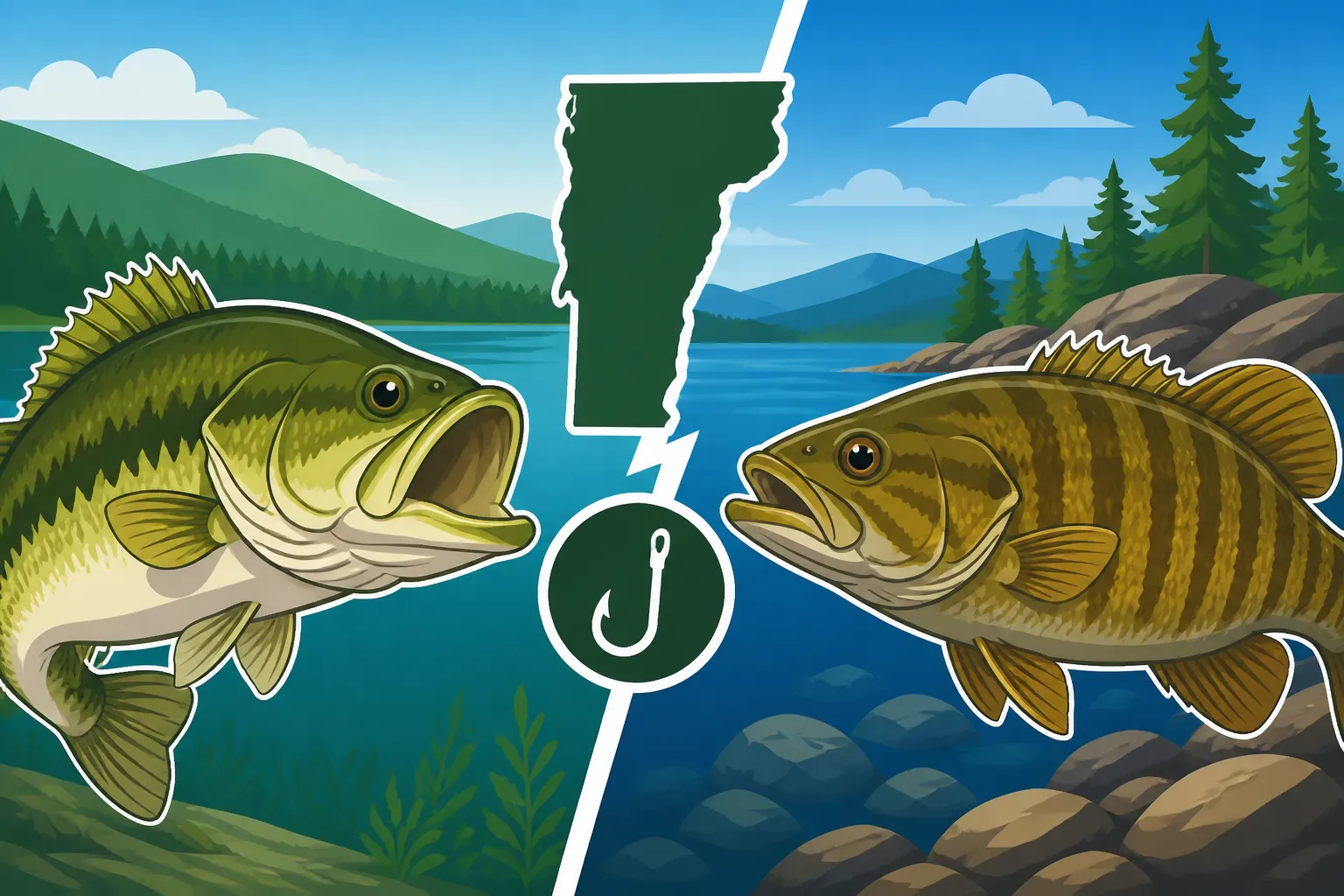
A largemouth bass, as its name cleverly suggests, has a significantly larger mouth. If you close the fish's mouth and look at the corner of its jaw (the maxillary), you'll notice that it extends beyond the rear edge of its eye. It's almost comically large, giving them a very distinctive "bass-mouth" look that's perfect for engulfing prey. Think of it like a big, greedy grin. This expansive oral cavity allows them to swallow surprisingly large meals, from frogs and mice to big shiners. Largemouth Bass Fishing in Vermont often involves capitalizing on this predatory nature with larger baits.
In stark contrast, the smallmouth bass has a much more modest mouth. When you close its mouth, the corner of the jaw will only extend to about the middle of the eye, or perhaps just slightly past the front edge of the eye, but never beyond the back of it. It's a more proportionate, less exaggerated mouth. This subtle difference is critical for identification. If you're struggling to compare, imagine drawing a vertical line down from the back of the eye; if the jaw joint goes past it, it’s a largemouth. If not, it's a smallmouth. This smaller mouth influences everything from the size of forage they target to the types of lures that are most effective, which we'll delve into later.
Dorsal Fin Divide and Body Shape
Beyond the mouth, the dorsal fin – the fin along the back – provides another excellent diagnostic tool. This feature, combined with their general body profile, gives them a very different silhouette in the water and in your hand.
The largemouth bass has a deep, almost complete division in its dorsal fin. You'll see two distinct sections: a spiny, rigid front portion and a softer, rayed rear portion. There's a noticeable, almost complete, dip or notch between these two sections. It looks like two separate fins that are barely connected. Their body tends to be more elongated and slightly compressed from side to side, giving them a somewhat "flatter" profile compared to a smallmouth, especially when they grow larger. This body shape is well-suited for darting through dense vegetation and ambushing prey from cover, a common tactic for Largemouth Bass Fishing in Vermont.
The smallmouth bass, on the other hand, possesses a dorsal fin that is only subtly notched, appearing almost continuous. While there is still a spiny front and a soft-rayed rear, the division between them is far less pronounced, making it look like a single, flowing fin. Their body shape is often described as more torpedo-shaped or football-like. They are typically more stout and robust for their length, giving them a powerful, compact appearance. This streamlined body is adapted for navigating currents and fighting hard in open water. Smallmouth Bass Fishing in Vermont often highlights their strong fighting capabilities.
Coloration and Markings: It's All in the Details
While color can vary dramatically based on water clarity, diet, and habitat, there are some general patterns and markings that tend to hold true for both species. Don't rely solely on color, but use it as a reinforcing characteristic.
Largemouth bass typically exhibit a dark, horizontal band or blotchy stripe running down their lateral line, from their gill plate to their tail. This stripe can be very prominent in some fish, almost like a black racing stripe, while in others it might be more broken or faded, appearing as a series of dark blotches. Their overall color usually ranges from a vibrant green to a darker olive green, often with a paler belly. The scales on their cheeks and gill covers are usually smooth. Sometimes, especially in clearer water, they can appear almost yellowish-green.
Smallmouth bass are often referred to as "bronzebacks" for a good reason. Their dominant coloration is typically a rich brown or bronze, sometimes with a yellowish tint, fading to a lighter belly. Instead of a horizontal stripe, they usually have distinct dark, vertical bars or tiger stripes along their sides. These bars can be very pronounced in some individuals, while in others they might be more mottled or faded. Their eyes are frequently reddish or orange, adding to their distinctive look. It's important to remember that a smallmouth pulled from dark, tannin-stained water might appear almost black, while one from clear, rocky lakebeds could be a light golden bronze. However, the vertical barring pattern is a strong indicator, as are the scales on their cheeks, which are noticeably smaller than those on the rest of their body and often give a rougher texture.
Understanding Their Homes: Habitat Differences in Vermont
Knowing where these fish prefer to live is not just interesting, it's incredibly practical for anglers. While there can be some overlap, largemouth and smallmouth bass generally seek out different environments within Vermont's diverse waterways. Understanding these preferences will significantly narrow down your search and help you choose the right fishing spots.
Largemouth: The Lover of Weeds and Stumps
Think of the largemouth bass as the ultimate ambush predator of the cover. They thrive in environments that offer plenty of places to hide, patiently waiting for an unsuspecting meal to swim by. This means you'll consistently find them in specific types of water and structure.
In Vermont, largemouth bass absolutely adore shallow, warm, and often murky waters. Their ideal habitat includes weed beds, lily pad fields, submerged timber, fallen trees, brush piles, boat docks, and cattail lines. They love to tuck themselves deep into this cover, especially if there's a good drop-off nearby or a current break. Ponds, slow-moving rivers, coves, and backwaters of larger lakes like Lake Champlain are prime largemouth territory. They are less tolerant of strong currents and prefer calm, protected areas where the water warms up quickly. The abundance of such habitats in Vermont means there are fantastic opportunities for Best Largemouth Bass Ponds in Vermont and quiet sections of larger bodies of water.
Their reliance on cover means they’re often found in relatively shallow water, perhaps only a few feet deep, even in the heat of summer. They use the overhead cover of vegetation or the shade of a dock to escape direct sunlight and launch surprise attacks. This preference for "junk" and structure is a key characteristic. If you're fishing a pond choked with weeds or a back bay filled with lily pads, you're almost certainly in largemouth country. They feel secure and can hunt effectively in these dense environments.
Smallmouth: The Rocky, Cooler Water Dweller
In contrast to their largemouth cousins, smallmouth bass are more nomadic and prefer environments with hard structure, cooler temperatures, and often some current. They are less about hiding and more about patrolling.
Smallmouth bass in Vermont are most at home in clear, cool waters with rocky bottoms, gravel shoals, ledges, and drop-offs. They love points, humps, and submerged islands in larger lakes, as well as the riffles, runs, and eddy lines of rivers. Lake Champlain, particularly its deeper, rockier sections, is famous for its Smallmouth Bass Habits on Lake Champlain. They are much more tolerant of current than largemouths and often use it to their advantage, positioning themselves behind structure to ambush prey swept downstream. You won't typically find them buried deep in dense weed beds, though they might patrol the edges of sparse vegetation if it’s near rocky structure.
They tend to frequent deeper water than largemouth, especially during the brighter parts of the day or in the heat of summer. While they will move shallow to spawn or feed, their comfort zone is often around rocky points, shelves, and breaks that lead to deeper water. Think classic "smallmouth structure": boulders, broken rock, gravel, and submerged ledges. If you're fishing a clear lake with a lot of exposed rock or a river with a good flow, you're almost certainly targeting smallmouth. These environments provide them with cover from predators, rich oxygen levels, and access to a diverse food source.
Overlap Zones: When They Share the Same Water
While their preferences are distinct, it's not uncommon to find both largemouth and smallmouth bass in the same body of water, and sometimes even in surprisingly close proximity. This is particularly true in larger, more diverse ecosystems like Lake Champlain or bigger river systems with varying habitats.
In these "overlap zones," you'll often find largemouth bass dominating the shallower, weedy, protected bays and backwaters, while smallmouth bass hold court on the adjacent rocky points, main lake humps, or river channels. For example, on Lake Champlain, a shallow, vegetation-rich bay might hold abundant largemouth, but just outside that bay, where the bottom transitions to rock and slopes into deeper water, you'll start encountering smallmouth. It's a testament to the adaptability of both species that they can coexist by carving out their specific niches.
Understanding these transitions is key to efficient fishing. If you're targeting smallmouth and find yourself casting into thick weeds, you're likely in the wrong spot. Conversely, if you're throwing a frog over lily pads and only hitting rocky points, you might want to move. Being able to identify the habitat quickly on the water helps you determine which bass species you're most likely to encounter and adjust your tactics accordingly. Many anglers, myself included, will often switch baits and techniques multiple times during a day on the water, depending on whether they're working a weed line for largemouth or a rocky shoal for smallmouth.
Behavior and Diet: Why Knowing Makes You a Better Angler
The distinct physical characteristics and habitat preferences of largemouth and smallmouth bass lead directly to differences in their behavior and diet. These behavioral patterns are what truly inform effective fishing strategies, from the lures you choose to the retrieve you employ. Knowing how they feed and move will dramatically increase your chances of success.
Largemouth Feeding Habits: Ambush Predators of the Shallows
The largemouth bass is the quintessential ambush predator. Their broad, flattened bodies and large mouths are perfectly designed for explosive, short-distance attacks. They often sit motionless, tucked deep into cover, waiting for an unsuspecting prey item to pass by.
When a potential meal approaches, they explode from their hiding spot, engulfing the prey with their massive mouth and retreating back into cover. Their diet reflects their opportunistic nature and their shallow, cover-laden habitat. They eat a wide variety of prey, including baitfish (like shiners and perch), crayfish, frogs, salamanders, aquatic insects, and even small rodents or birds that fall into the water. If it moves and fits in their mouth, a largemouth will likely try to eat it. This aggressive, visual hunting style means that noisy, attention-grabbing lures often work well. Best Bass Fishing Techniques for Lake Champlain for largemouth often involve targeting weed edges with topwater or weedless presentations.
You'll often find them striking aggressively at lures that mimic their prey, especially those fished around structure. Their willingness to attack means that a single piece of cover, like a submerged log or a dense lily pad patch, can hold multiple fish, each waiting for its turn to ambush. They're not generally chasing prey over long distances in open water; instead, they prefer to let the food come to them in their secure, concealed positions.
Smallmouth Feeding Habits: Roaming Hunters of the Depths
Smallmouth bass, with their streamlined bodies and smaller mouths, are more active, roaming hunters. They are often found in schools, especially in larger bodies of water, and will actively pursue their prey in open water or along rocky structures.
Their diet is heavily influenced by the forage available in their clear, rocky habitats. Crayfish are a paramount food source for smallmouth, often making up a significant portion of their diet. Beyond crayfish, they feed on various baitfish like smelt, shiners, and alewives, as well as aquatic insects. Unlike largemouth, they are less likely to target frogs or small mammals, as these aren't as prevalent in their preferred deep, rocky environments. Their predatory style involves more active searching and chasing. You'll often see them darting out from rocks or ledges to intercept baitfish or crawling along the bottom in search of crayfish. Best Baits for Smallmouth Bass on Lake Champlain frequently include lures that imitate these key forage items.
Smallmouth bass are known for their strong fighting abilities once hooked, often making powerful runs and acrobatic jumps. This reflects their active, open-water hunting style. While they might use a rock pile or ledge as a temporary ambush point, they are not typically "holed up" in thick cover like largemouth. Instead, they patrol their chosen structures, often in small groups, constantly searching for food. Understanding this means that covering water and presenting baits that move horizontally or mimic fleeing prey are often excellent strategies for smallmouth.
Seasonal Movements and Spawning Differences
Both species exhibit seasonal movements tied to water temperature, but their preferred conditions and spawning habits differ, influencing when and where you’ll find them.
Largemouth Bass typically spawn when water temperatures reach the mid-60s Fahrenheit. In Vermont, this generally occurs from late spring into early summer, depending on the specific water body and elevation. They build their nests in shallow, sheltered areas, often near emergent vegetation or woody cover, usually in just a few feet of water. During this pre-spawn and spawn period, they are highly aggressive and protective of their nests. After spawning, they will spend much of the summer in or near their preferred shallow, weedy, or woody cover. As fall approaches, they may move to deeper weed lines or brush piles before settling into deeper wintering holes with abundant structure. Largemouth bass spawning season in Vermont is a critical time for understanding their behavior.
Smallmouth Bass prefer slightly cooler water for spawning, usually beginning when temperatures reach the high 50s to low 60s Fahrenheit, often slightly earlier or concurrently with largemouth depending on the water. They construct their nests on hard bottoms like gravel, sand, or small rocks, typically in areas with some current or wave action, from a few feet deep to sometimes much deeper in clear lakes. They are highly protective of their nests, making them vulnerable to anglers. Throughout the summer, smallmouth often roam rocky points, ledges, and deeper offshore structures. In fall, they congregate on deeper main lake structures, often in large schools, before migrating to deep water for winter, often suspending over structure. Smallmouth bass spawning season in Vermont also influences where they're concentrated.
Tailoring Your Tackle: Fishing for Each Bass Species
Once you can accurately identify both largemouth and smallmouth bass, and understand their preferred habitats and behaviors, the next logical step is to adjust your fishing gear and techniques. Using the right tackle for the right bass species isn't just about efficiency; it's about maximizing your enjoyment and success on the water.
Largemouth Lures and Techniques: Punching Through the Cover
When you're targeting largemouth bass in Vermont, think "cover and commotion." Your tackle and lures should be designed to penetrate dense vegetation, avoid snagging, and provoke an aggressive strike from an ambushing predator.
Heavy cover calls for stout tackle. For jigs and Texas-rigged plastics, a medium-heavy to heavy power baitcasting rod, paired with a high-gear ratio reel and strong braided line (or heavy fluorocarbon), is essential. This setup allows you to get good hooksets through thick plastic and pull fish out of snags. Lures like weedless frogs, soft plastic worms, creature baits, jigs, and spinnerbaits are staples for largemouth. My tackle box for largemouth looks very different from my smallmouth box – it's packed with chunkier, weed-friendly options. If you're looking to stock up, check out the wide array of weedless soft plastics on Amazon, like those from popular brands designed specifically for punching through dense cover.
Techniques often involve pitching and flipping baits into tight pockets of cover, working them slowly, and waiting for that telltale "thump" or line jump. Topwater lures like frogs and buzzbaits are incredibly effective when fished over matted vegetation, triggering explosive surface strikes. Crankbaits are good for running along weed lines, while spinnerbaits can be retrieved through sparse cover. The key is to get your lure into the fish's hiding spot and then make it look like an easy meal. Remember, largemouth typically don't chase far, so presentations need to be in their strike zone and mimic something vulnerable.
Smallmouth Lures and Techniques: Finesse and Fast Retrieves
Fishing for smallmouth bass is often a game of finesse, speed, and covering water. Their preference for clear water, rocky structure, and active hunting means different lure types and presentation styles.
For smallmouth, I typically scale down my tackle slightly. A medium to medium-heavy power spinning rod is often preferred for lighter lures and more subtle presentations, though baitcasters are also used for heavier presentations. High-quality fluorocarbon or monofilament line, which has good abrasion resistance for fishing around rocks, is a common choice. Lures like tube jigs, drop shot rigs, Ned rigs, grubs, jerkbaits, and small crankbaits are highly effective. For those who prefer shopping online, you can find excellent smallmouth specific baits, including a variety of tube jigs and finesse worms, on Amazon. Best Crankbaits for Vermont Smallmouth Bass and Best Baits for Smallmouth Bass on Lake Champlain are often those that mimic crayfish or baitfish.
Techniques for smallmouth often involve casting and retrieving, covering a lot of water along rocky points, ledges, and humps. Vertical jigging is also very effective, especially when smallmouth are holding deep. Jerkbaits and crankbaits are excellent for evoking reaction strikes, while tube jigs and drop shot rigs are superb for targeting fish holding tight to rocky bottoms. Often, a faster, more erratic retrieve is better for smallmouth, as it mimics fleeing baitfish or scuttling crayfish. They are known for hitting moving baits hard and putting up a spectacular fight.
Rods, Reels, and Line: Matching Your Gear
Matching your rod, reel, and line to the species and conditions is paramount. You wouldn't use a fly rod to yank a largemouth out of a thick weed bed, just as you wouldn't use a heavy surf rod for delicate smallmouth presentations.
For largemouth, especially when fishing heavy cover, a powerful rod is essential. Think a 6'6" to 7'6" medium-heavy to heavy action baitcasting rod with a fast tip. This allows for accurate casting, powerful hooksets, and the strength to horse fish out of dense vegetation. Paired with a baitcasting reel with a good braking system and a fast retrieve ratio, you'll have the control and power needed. Line choices typically lean towards braided lines (30-65 lb test) for ultimate strength and sensitivity in cover, or heavy fluorocarbon (15-20 lb test) for abrasion resistance and invisibility.
For smallmouth, particularly when fishing lighter baits and clear water, sensitivity and versatility are key. A 6'6" to 7' medium-light to medium action spinning rod with a fast tip is a fantastic all-around choice. This allows for longer, more accurate casts with lighter lures and better feel for subtle bites. A spinning reel in the 2000-3000 series size, spooled with 8-12 lb fluorocarbon or monofilament, offers a good balance of strength and finesse. Some anglers prefer braided main line with a fluorocarbon leader for added sensitivity. For heavier applications, such as throwing larger jerkbaits or deep crankbaits, a medium-heavy baitcasting setup might be preferred, but generally, smallmouth fishing often calls for a more delicate touch.
| Feature | Largemouth Bass | Smallmouth Bass |
|---|---|---|
| Mouth | Corner of jaw extends past the eye | Corner of jaw extends to about the middle of the eye |
| Dorsal Fin | Deep, almost complete division between spiny/soft sections | Shallow, subtle notch; appears nearly continuous |
| Body Shape | More elongated, slightly compressed, "football-like" | More stout, torpedo-shaped, powerful |
| Coloration/Markings | Dark, horizontal band/blotches on sides, olive/dark green | Vertical bars/stripes on sides, bronze/brown hue |
| Preferred Habitat | Shallow, warm, weedy, woody cover, lily pads, docks | Clear, cool, rocky bottoms, gravel, ledges, current |
| Feeding Style | Ambush predator from cover, explosive strikes | Active, roaming hunter, chases prey in open water |
| Common Prey | Baitfish, frogs, crayfish, insects, mice | Crayfish, baitfish (smelt, shiners), insects |
| Typical Lures | Frogs, jigs, worms, spinnerbaits, crankbaits, buzzbaits | Tube jigs, drop shot, Ned rigs, jerkbaits, small crankbaits |
Why Accurate Identification Truly Matters
Beyond simply satisfying your curiosity, accurately identifying largemouth versus smallmouth bass has significant implications for responsible angling, conservation, and your overall success on the water. It's not just a trivial detail; it's a fundamental part of being an informed and ethical angler in Vermont.
Following Vermont's Regulations: Length and Bag Limits
This is perhaps the most immediate and critical reason to know your bass. The Vermont Fish & Wildlife Department sets specific regulations for different fish species, and these often include varying minimum length limits and daily bag limits for largemouth and smallmouth bass. Ignoring these distinctions can lead to unintentional violations and potential penalties.
For instance, the regulations might specify a certain minimum length for a largemouth bass to be kept, but a different, possibly larger, minimum length for a smallmouth bass. Similarly, the daily creel limit (how many you can keep) could differ between the two species. This is often done to manage the populations effectively, as each species might have different growth rates, reproductive success, or pressures within a specific water body. To stay on the right side of the law, you absolutely must know which bass you've caught before deciding whether to keep or release it. Always double-check the current Vermont Bass Minimum Length Limits and Vermont Bass Daily Bag Limit before heading out. Proper identification helps ensure the long-term health of our bass fisheries.
Conservation and Fishery Management
Beyond individual compliance, accurate identification plays a vital role in broader conservation efforts and fishery management. When anglers correctly identify and report their catches (or simply adhere to species-specific regulations), it provides invaluable data to wildlife biologists.
Fishery managers rely on data about catch rates, sizes, and species composition to assess the health of bass populations. If anglers are consistently misidentifying their catches, it can skew these data, making it harder for the state to make informed decisions about stocking programs, habitat improvements, or regulation changes. For example, if a particular lake is experiencing a decline in smallmouth numbers but anglers are reporting them as largemouth, the problem might go unaddressed. Being able to tell the difference is a small but meaningful contribution to the bigger picture of sustainable fishing in Vermont. Our Vermont Fishing License Guide for 2026 emphasizes responsible angling practices, and correct species identification is a cornerstone of that.
Personal Success and Learning Their Preferences
Finally, knowing the difference empowers you to become a much more successful and adaptable angler. As we've discussed, largemouth and smallmouth bass have distinct preferences for habitat, diet, and behavior. If you can correctly identify the species you're catching, or even the species you should be targeting in a particular area, you can make smarter decisions about your tackle, lures, and techniques.
Imagine you're fishing a new lake in Vermont. If you start catching bass with large mouths and dark horizontal stripes in a shallow, weedy cove, you immediately know you're in largemouth territory. You'll then reach for your weedless frogs, jigs, and heavy-action rod, confident that you're using the right tools for the job. Conversely, if you're pulling in bronze-backed fish with vertical bars and smaller mouths off a rocky point in deeper water, you know it's smallmouth time. You'll then switch to tube jigs, jerkbaits, and a more sensitive spinning setup. This adaptability is the mark of an experienced and effective angler. The more you learn about Smallmouth Bass Habits on Lake Champlain or how Largemouth Bass Fishing in Vermont differs, the more intuitive these choices become. It's all about understanding your target and respecting the unique qualities of each species.
Disclaimer
This article is for general informational purposes only and does not constitute professional advice. Laws, prices and regulations vary by location and change over time. Consult a qualified professional for guidance on your specific situation.