Best Crankbaits for Vermont Smallmouth Bass
Trying to dial in your smallmouth bass fishing in Vermont can feel like a constant puzzle, especially when it comes to choosing the right crankbait. The clear waters and varied structures of lakes like Champlain, Bomoseen, and Dunmore demand specific approaches, and throwing the wrong lure can lead to a frustratingly quiet day. This guide is all about demystifying the world of crankbaits, helping you understand which ones excel in Vermont's diverse smallmouth habitats and how to wield them for consistent success.
Understanding Vermont Smallmouth Bass Behavior and Forage
Before we even get to specific lures, it's absolutely crucial to understand what makes Vermont smallmouth tick. These aren't your sluggish pond bass; they're aggressive, structure-oriented predators that often feed on specific baitfish or crustaceans prevalent in our northern waters. Their behavior shifts dramatically with water temperature and light conditions, dictating where they'll be and what they're willing to strike. Knowing their typical diet and preferred hangouts will give you a massive advantage in selecting the right crankbait.
The crystal-clear nature of many Vermont lakes, especially in the deeper sections or at certain times of the year, also plays a significant role. Smallmouth bass rely heavily on sight, and an unnatural presentation or an out-of-place color can spook them in an instant. This means that matching the hatch, not just in terms of lure profile but also color and action, becomes paramount. We're not just throwing a plug; we're trying to mimic a meal.
Smallmouth Diet: Crayfish, Smelt, and Alewives
Vermont's smallmouth bass have a varied menu, but a few key forage species dominate their diet, and understanding these is key to selecting effective crankbaits. Crayfish are a universal favorite across many of our lakes and rivers. They hide in rocky crevices, under logs, and along ledges, providing a protein-packed meal. A crankbait that can mimic the erratic scuttling and fleeing behavior of a crayfish, particularly one with a dark, natural, or rusty color pattern, can be incredibly effective when dragged along rocky bottoms or bounced off structure.
Beyond crayfish, many of Vermont's larger smallmouth fisheries, like Lake Champlain, are home to abundant baitfish populations. Alewives and rainbow smelt are prime targets for opportunistic smallmouth. These schooling baitfish tend to be slender, silvery, and move quickly through the water column. When smallmouth are actively chasing schools of these baitfish, a crankbait with a more streamlined profile and a chrome or silver finish, designed to be retrieved at a higher speed, will often outperform other options. Understanding this subtle difference in forage can completely change your approach for a successful day.
Habitat Preferences Across Vermont Lakes
Vermont offers a diverse range of smallmouth habitats, from vast, deep lakes to shallower, rocky rivers, and each requires a slightly different crankbait strategy. In big, clear lakes like Champlain or Lake Willoughby, smallmouth often relate to deep points, rocky humps, offshore shoals, and transitions from hard bottom to weeds. They'll use these structures as ambush points for passing baitfish or as cover from predators. During the warmer months, you might find them in depths ranging from 10 to 30 feet, even deeper.
Conversely, in smaller lakes or sections of rivers, smallmouth might hold in shallower water around boulders, fallen trees, current seams, or gravel flats. They appreciate current, but not so strong that they have to fight it constantly. Understanding these preferences helps you pick a crankbait that can reach the fish's depth zone and move through their environment effectively without constantly snagging. A square bill might be perfect for bouncing off river rocks, while a deep diver is essential for probing those offshore humps on Lake Champlain. For more in-depth knowledge on specific areas, check out Lake Champlain Smallmouth Bass Fishing.
Decoding Crankbait Design for Vermont Waters
Crankbaits aren't just one-size-fits-all lures; they come in a dazzling array of shapes, sizes, and designs, each engineered for a specific purpose. Understanding the mechanics behind these designs is fundamental to choosing the right tool for the job when you're targeting Vermont smallmouth. A crankbait's effectiveness is largely determined by how its physical attributes allow it to perform in the water, from its diving capabilities to the vibrations it emits.
The subtle nuances of crankbait design can be the difference between a productive day and a frustrating one. The angle and size of the lip, the weight distribution, and even the internal components all contribute to how the bait moves, how deep it dives, and what kind of commotion it creates. Familiarizing yourself with these details means you're no longer just guessing; you're making informed decisions that put you closer to those aggressive smallmouth.
Lip Design and Dive Depth Explained
The most obvious distinguishing feature of a crankbait is its lip, or bill. This piece of plastic or occasionally metal dictates everything from how quickly the bait dives to how deep it ultimately reaches. A short, wide, and more vertical lip, often found on square bill crankbaits, will create a shallower dive, usually staying in the top few feet of the water column. These are fantastic for deflecting off cover in shallow, rocky areas without snagging.
In contrast, a longer, narrower, and more horizontal lip is characteristic of medium and deep diving crankbaits. The increased surface area and angle of the lip push the lure down rapidly as you retrieve it. The longer and more parallel to the bait's body the lip is, generally the deeper the crankbait will dive. For probing those deep points and humps on Lake Champlain or other large lakes, a deep diver with a precisely engineered lip is indispensable for getting down to where the big smallmouth are holding.
Buoyancy, Rattles, and Action
Beyond the lip, a crankbait's buoyancy, internal rattles, and overall action contribute significantly to its appeal for Vermont smallmouth. Most crankbaits are either floating, suspending, or sinking. Floating crankbaits are great for shallow water, allowing you to stop your retrieve and let them float up over snags before continuing. Suspending crankbaits, a favorite for many anglers, will hover at a specific depth when paused, imitating a wary or injured baitfish – a highly effective tactic, especially in cooler water or during a cold front. Sinking crankbaits, like lipless varieties, can be fished at various depths by controlling the retrieve speed and allowing them to fall.
Rattles, or the lack thereof, are another critical factor. Many crankbaits contain internal BBs or beads that create noise and vibration as they move through the water. This can be a huge attractor in stained water or during low light conditions, helping smallmouth locate the lure. However, in extremely clear water or highly pressured environments, a "silent" crankbait can sometimes be more effective, offering a more natural, subtle presentation. The action refers to the wobble or shimmy of the bait. Some crankbaits have a tight, subtle wiggle, while others have a wide, aggressive thumping action. Experimenting with these variables based on the water clarity and the mood of the fish is key.
Essential Crankbait Styles for Vermont Anglers
Now that we understand the underlying mechanics, let's talk about the specific types of crankbaits that earn their keep in a Vermont smallmouth angler's tackle box. Each style has its unique strengths, designed to excel in different depths, cover types, and smallmouth moods. Having a selection of these key styles on hand will ensure you're prepared for whatever Vermont's waters throw at you.
It's tempting to try and make one lure do everything, but the truth is, a diverse arsenal allows for a more adaptive and ultimately more successful approach. Think of each crankbait style as a specialized tool; you wouldn't use a hammer to drive a screw. Similarly, using a shallow-running crankbait in 30 feet of water is just as ineffective as trying to probe deep structure with a lipless bait. The right tool for the right job is paramount in the diverse fishing environments of Vermont.
Shallow and Square Bill Crankbaits
When smallmouth are holding tight to shallow cover, whether it's rocky shorelines, submerged timber, or weed edges in places like Lake Bomoseen or shallower sections of Lake Champlain, shallow and square bill crankbaits are your best friends. These lures typically dive only a few feet deep, making them ideal for navigating skinny water without constantly snagging the bottom. The square bill, in particular, has a unique ability to deflect off obstacles, often triggering an aggressive reaction strike from nearby bass.
These baits excel in situations where you want to "crash" into cover. Their robust lip design allows them to bounce off rocks and wood without getting hung up, creating a sudden, erratic movement that mimics a panicked baitfish or crayfish. This sudden change in direction is often what provokes an otherwise hesitant smallmouth to strike. Consider natural crawfish patterns or baitfish patterns like perch or shiner when working these baits, as they're often retrieved in areas where those forage species reside. Many anglers find excellent square bills at places like Bass Pro Shops, which often stock a wide range of regional patterns.
Medium and Deep Diving Crankbaits
For targeting those deeper smallmouth haunts, such as the offshore humps and ledges of Lake Champlain or the steep drop-offs of Seymour Lake, medium and deep diving crankbaits are indispensable. Medium divers typically reach depths of 6 to 15 feet, while deep divers can plunge 15 to 25 feet, sometimes even more depending on line size and retrieve speed. These baits are designed to get down to the fish quickly and stay in the strike zone for as long as possible.
When using these, pay close attention to the dive curve of your chosen crankbait. You want it to be hitting the bottom or deflecting off structure just enough to create commotion without constantly burying itself. A long cast is key to allowing these baits to reach their maximum depth. Experiment with retrieve speeds; sometimes a faster retrieve is needed to get them down, while a slower, more deliberate crank with pauses can entice a strike. For deep-water techniques, especially on larger bodies of water, you might want to explore articles like Best Trolling Gear for Lake Champlain Walleye as some of the principles of getting lures deep can apply to smallmouth, even if walleye are the target.
Lipless Crankbaits: Versatility in Action
Lipless crankbaits, often referred to simply as "rattletraps" regardless of brand, are incredibly versatile tools for Vermont smallmouth. Unlike their lipped cousins, these baits lack a protruding bill and feature a flattened nose. They sink quickly, allowing you to fish them at virtually any depth by simply controlling the countdown and retrieve. What they lack in a diving lip, they make up for in sound and vibration. Most lipless crankbaits have loud internal rattles that produce a distinct "thump" as they vibrate rapidly during the retrieve.
This high-frequency vibration and loud rattle make them excellent search baits, especially in wind-blown areas or stained water where smallmouth rely more on their lateral line to detect prey. They can be burned quickly over submerged grass, ripped off the bottom in rocky areas, or vertically jigged through schools of suspended baitfish. Their compact profile and ability to be cast long distances also make them effective for covering a lot of water quickly. On Amazon, you can often find multi-packs of lipless crankbaits in various colors, which is a great way to build your collection.
Here's a quick comparison of popular crankbait types:
| Crankbait Type | Typical Dive Depth (feet) | Ideal Conditions | Key Features | Best Retrieve Style |
|---|---|---|---|---|
| Square Bill | 1-5 | Shallow cover, rocks, wood, docks, weeds | Short, wide, square lip; deflects off obstacles | Erratic, stop-and-go, bump-and-go |
| Medium Diver | 6-15 | Mid-depth flats, points, humps, weed lines | Medium length, rounded lip; moderate dive angle | Steady, varying speed, occasional pauses |
| Deep Diver | 15-25+ | Deep humps, ledges, channels, main lake points | Long, narrow lip; steep dive angle | Long casts, steady retrieve to reach depth |
| Lipless Crankbait | All Depths (sinking) | Shallow to deep, sparse weeds, open water | No lip; internal rattles; high vibration | Fast retrieve, rip-and-fall, vertical jigging |
Matching Crankbaits to Vermont's Seasons
Vermont's fishing seasons bring dramatic shifts in water temperature, which profoundly impacts smallmouth bass behavior. What works brilliantly in the warm days of summer might be totally ineffective during the chilly waters of spring or fall. Adapting your crankbait selection and presentation to these seasonal changes is a hallmark of a consistently successful angler. You're not just fishing for smallmouth; you're fishing for seasonal smallmouth.
Understanding these seasonal patterns will also help you predict where the fish are likely to be staging, feeding, or recuperating. For instance, smallmouth will stage differently in pre-spawn than they will in mid-summer. Knowing these tendencies allows you to choose a crankbait that not only looks appealing but also gets to the fish in their preferred depth range and behavioral pattern for that time of year.
Spring Tactics: Pre-Spawn and Early Season
Spring in Vermont, particularly during the pre-spawn period, sees smallmouth bass moving shallower as water temperatures begin to rise, typically into the high 40s and 50s. They're looking for warmer water and staging areas near future spawning grounds. During this time, the fish are often aggressive but can also be finicky due to fluctuating weather. Medium-diving crankbaits are excellent choices here, as they can effectively cover those intermediate depths where smallmouth are staging.
Slow-rolling a silent or subtle-rattle crankbait along rocky points and transitions can be highly effective. The key is to match the retrieve to the water temperature; cooler water usually means a slower retrieve. Once the water gets into the low 50s, square bills can become deadly in shallower zones as smallmouth start to nose around for crayfish and any early baitfish. Remember, cold water means fish metabolisms are slower, so pauses in your retrieve, especially with a suspending crankbait, can be crucial. For more insights on the season, check out Vermont Bass Season Opening Date for 2026 (while specific dates vary, the general season pattern is consistent).
Summer Strategies: Thermoclines and Deep Water
As Vermont heats up, smallmouth bass in many of our larger, deeper lakes will move offshore to find cooler, more oxygenated water, often congregating around the thermocline. This is when deep diving crankbaits truly shine. Targeting main lake points, offshore humps, rock piles, and submerged islands in 15-30 feet of water becomes the game plan. The smallmouth will be feeding heavily on baitfish like smelt and alewives, which also inhabit these deeper, cooler zones.
Color choices during summer in clear water often lean towards natural baitfish patterns like chrome and blue, or silver and black. A steady, consistent retrieve that keeps the crankbait in the strike zone is often best. However, don't be afraid to experiment with faster retrieves to trigger reaction bites, especially around schooling bait. In shallower, warmer waters or rivers, topwater fishing for smallmouth can be phenomenal in early mornings and late evenings, but during the bright midday sun, they'll often retreat to deeper, cooler current breaks or structure where a medium diver or even a lipless crankbait ripped off the bottom might get a bite.
Fall Feast: Cold Water Crankbaiting
Fall is a fantastic time for trophy smallmouth in Vermont, as these fish go on a feeding frenzy to pack on weight for the winter. As water temperatures drop from the 60s into the 40s, smallmouth will often move shallower initially, following baitfish that are also pushing into bays and coves. Lipless crankbaits, burned over dying weed beds or ripped off hard bottom, can be incredibly effective during this period. The loud rattle and vibration can call fish in from a distance.
As the water gets colder, and approaches the upper 40s and low 50s, smallmouth will start to school up tightly and move to deeper main lake structures, similar to their summer haunts but often even deeper and tighter to cover. This is when deep-diving crankbaits are essential, fished slowly and deliberately. Consider dark, subtle colors like browns or subtle perch patterns, mimicking dying baitfish or crayfish. The fish might be less aggressive but still willing to strike a slow-moving, natural-looking bait. When targeting these big autumn smallmouth, knowing Best Techniques for Fall Walleye can even offer some cross-over insights for deep water crankbaiting tactics.
Colors, Patterns, and Presentation
Once you've selected the right crankbait style and have a seasonal strategy in mind, the final pieces of the puzzle are color, pattern, and the way you present the lure. Vermont's waters are generally quite clear, which means smallmouth bass can be particular about what they see. The subtle details can make all the difference, transforming a slow day into a productive one.
It's not enough to just throw a crankbait; you need to make it dance. The retrieve speed, pauses, and how you interact with structure all contribute to creating an irresistible meal for a hungry smallmouth. Mastering these elements will elevate your crankbait game and lead to more consistent hook-ups.
Natural vs. Attractor Colors for Clear Water
In the predominantly clear waters of Vermont, natural color patterns are often your best bet for crankbaits. Think about the primary forage:
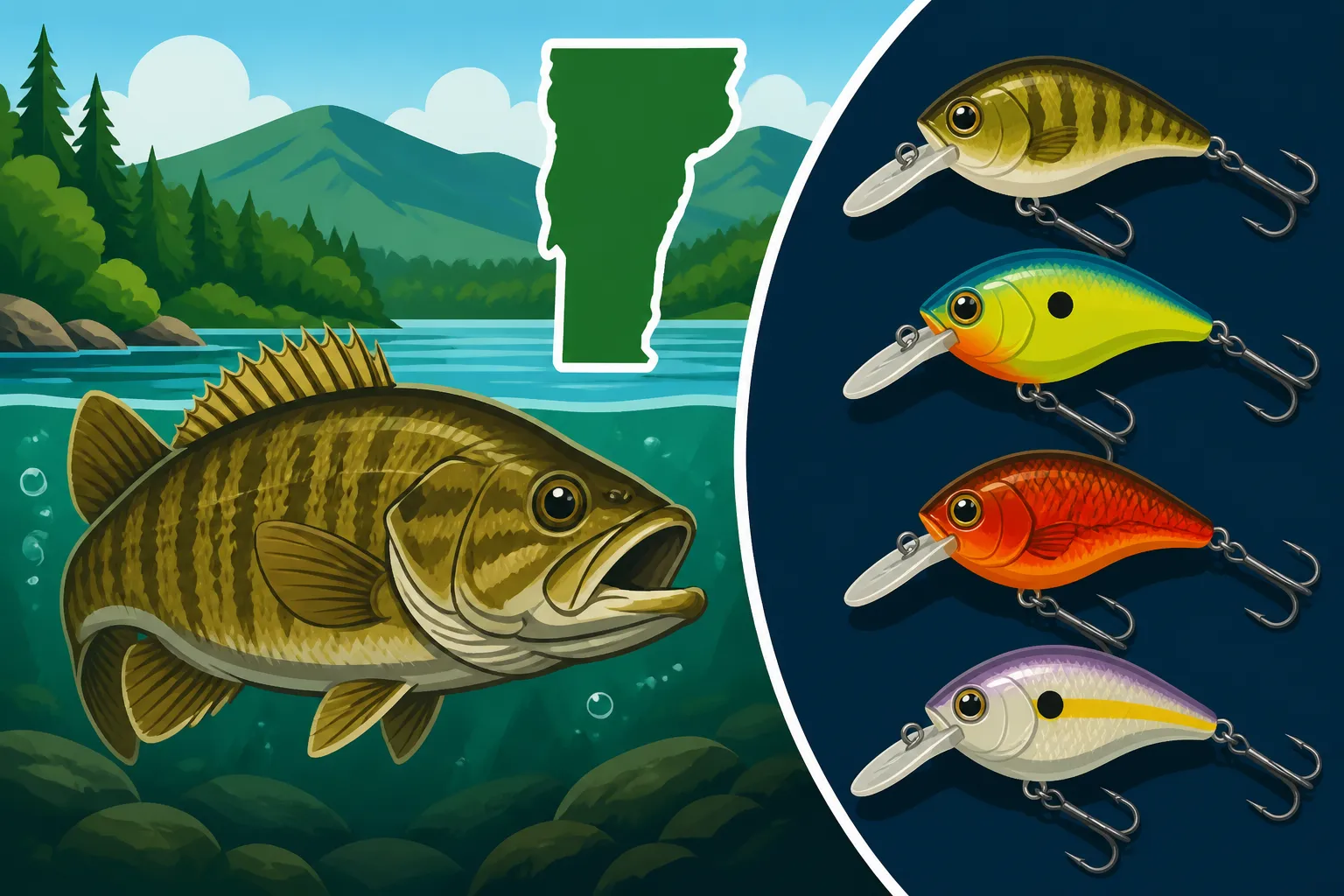
- Crayfish patterns: Browns, oranges, reds, and greens, often with mottled or spotted finishes. These are fantastic for square bills and medium divers being retrieved along rocky bottoms.
- Baitfish patterns: Silver, chrome, white, blue, black, and sometimes yellow/chartreuse when mimicking perch or sunfish. These are great for lipless crankbaits and deep divers, especially when smallmouth are chasing open-water baitfish schools.
However, there's always a place for attractor colors, especially in specific conditions. Chartreuse, bright orange, or firetiger patterns can be excellent in stained or muddy water, on overcast days, or when trying to elicit a reaction strike from aggressive fish. Sometimes, a bright flash can trigger a curious smallmouth even if it doesn't perfectly mimic a natural food source. The general rule of thumb: start natural, and if fish aren't biting, try an attractor color. For more on what these fish like to eat, consider What smallmouth bass eat on Lake Champlain.
Mastering the Retrieve: Speed, Pauses, and Deflections
The way you retrieve your crankbait is just as important as the bait itself. It's about bringing the lure to life and mimicking prey.
- Steady Retrieve: A simple, constant reeling motion is often a great starting point, especially with deep divers. It keeps the bait tracking true and allows it to reach its maximum depth. Varying your speed slightly can sometimes trigger a chase.
- Stop-and-Go: This is deadly with suspending crankbaits. Reel, pause, reel, pause. The pause allows the bait to hang motionless, often imitating an injured or disoriented baitfish, which can be irresistible to a following smallmouth.
- Burn-and-Kill: A very aggressive retrieve where you reel quickly, then suddenly stop, allowing the bait to rise (if floating) or hover (if suspending) before ripping it forward again. This can provoke powerful reaction strikes from highly active fish.
- Deflections: This is arguably one of the most effective techniques with square bills and medium divers. Actively try to make your crankbait hit cover – rocks, logs, stumps, weed edges. When the bait deflects off an object, it creates an erratic, fleeing motion that often triggers an immediate strike from an ambushing smallmouth. The key is to use a rod with enough backbone to feel the contact and prevent snagging, but sensitive enough to detect the subtle tick of a bite.
Final Thoughts on Cranking for Vermont Smallmouth
Crankbaits are undeniably one of the most effective and exciting ways to target smallmouth bass in Vermont. From the shallow, rocky rivers to the vast, deep expanses of Lake Champlain, there's a crankbait designed for nearly every scenario you'll encounter. The real secret to success lies not in having every single crankbait ever made, but in understanding the core principles behind their design and how to apply them to the unique behaviors and habitats of Vermont's smallmouth bass.
Remember to pay attention to the details: the water temperature, clarity, available forage, and the type of structure you're fishing. Experiment with different retrieve speeds, colors, and sizes. Don't be afraid to try something a little different if the fish aren't biting; often, a subtle change can unlock a pattern. With a thoughtful approach and a selection of these versatile lures, you'll be well on your way to experiencing the thrill of those hard-fighting Vermont smallmouth. Keep practicing, keep learning, and most importantly, keep enjoying the beautiful waters of Vermont!
Disclaimer
This article is for general informational purposes only and does not constitute professional advice. Laws, prices and regulations vary by location and change over time. Consult a qualified professional for guidance on your specific situation.