Best hook size for stocked trout bait fishing
You've just arrived at a freshly stocked pond or stream in Vermont, bait in hand, full of excitement. But then you find yourself staring at your tackle box, a bewildering array of hooks staring back at you. Which one do you choose? It's a common dilemma for anglers, and picking the right hook size for stocked trout bait fishing is absolutely critical not just for getting bites, but for successfully landing those fish. This guide is here to unravel that mystery, ensuring your next Vermont trout adventure is both productive and enjoyable, helping you select the perfect hook every time.
Understanding Stocked Trout and Their Eating Habits
When we talk about stocked trout in Vermont, we're often talking about fish that have spent a good portion of their lives in hatcheries. This upbringing profoundly influences how they behave once they're released into our beautiful lakes and rivers. Unlike their wild counterparts, who are constantly hunting for natural forage and are incredibly wary, stocked trout can sometimes be a bit… naive. They're used to regular feeding times and processed pellets, which means their initial instinct in a new environment might not be to immediately attack a perfectly presented dry fly or chase a spinner. Instead, they often gravitate towards easy meals, and that's where bait fishing really shines.
These fish are essentially learning to be wild again, often under significant fishing pressure. Their initial hunger, combined with a lack of natural predatory instincts, makes them quite susceptible to baits that are familiar in taste or easily digestible. They might be less selective about what they eat in the first few days or weeks post-stocking, but they can still be incredibly wary of anything that looks or feels unnatural. This is where your choice of hook size and presentation becomes paramount. You want something small enough to be easily ingested, yet strong enough to hold a feisty trout.
Think about it from the trout's perspective: they're in a new world, a bit stressed, and looking for calories. A big, clunky hook can be a major turn-off, especially if they've been pricked before. Small details matter, and a subtle approach often yields the best results. The goal is to make your bait look as appealing and harmless as possible, encouraging a confident bite rather than a tentative nibble. This understanding is the foundation for selecting the right hook size.
Why Stocked Trout Behave Differently
Hatchery life is comfortable, but it doesn't prepare a trout for the challenges of a natural ecosystem. In a hatchery, food appears reliably, often in pellet form, and there are no natural predators lurking. When these trout are released into a Vermont pond or stream, they experience a sudden shift. They are exposed to new water temperatures, currents, and an entirely different food source. This stress, combined with the presence of other anglers, can make them quite skittish. However, their conditioned response to readily available food often outweighs their initial wariness, making them prime targets for bait. You can learn more about their habits in How to Catch Trout Right After Stocking in Vermont.
Their feeding behavior is a blend of curiosity and survival. They're often in groups, exploring their new surroundings, and if one trout takes a bite, others might follow. This herd mentality can work in your favor, but it also means that if your bait looks suspicious, it might deter the whole school. They haven't developed the same level of discernment as truly wild fish, which have generations of survival instincts ingrained. This is why a small, well-hidden hook with an enticing bait can be so effective; it exploits their hunger without alarming their still-developing natural caution.
The key takeaway here is that while they might be eager, they're not dumb. They're just learning. You still need to present your bait in a way that minimizes suspicion. A hook that's too large can disrupt the natural movement of your bait or simply be too visible, causing the trout to shy away. We're aiming for that perfect balance: a hook that disappears into the bait, allowing the trout to focus solely on the meal you're offering.
The Importance of Natural Presentation
No matter how hungry a stocked trout is, a natural presentation will always increase your chances of a bite. This isn't just about how your bait looks; it's also about how it moves, smells, and feels. A big, heavy hook can completely ruin the natural drift of a worm or the subtle buoyancy of PowerBait. The goal is to make your offering seem like a part of the natural environment, not something tethered to a piece of metal. This is especially true in clearer Vermont waters, where fish have a better chance of spotting anomalies.
Consider the buoyancy of your bait. Many popular trout baits, like PowerBait or marshmallow, are designed to float off the bottom, presenting themselves above weeds or debris. If your hook is too heavy or too large, it can drag the bait down, defeating its purpose. Conversely, if you're fishing with a natural worm, a hook that's too large can make the worm look unnatural and less appealing as it drifts through the current. The hook should complement the bait, not overpower it.
A natural presentation also extends to your line and leader. Using a light leader, often fluorocarbon, can make a huge difference in fooling these sometimes-finicky fish. When combined with a small, inconspicuous hook, it creates an almost invisible connection to your bait, making it irresistible. Remember, trout have excellent eyesight, and anything that stands out as artificial can send them darting away. The more seamlessly your hook integrates with your bait, the better your chances of success.
The Hook Size Sweet Spot: Numbers and Nuances
Alright, let's get down to the brass tacks: hook sizes. This is where a lot of anglers get confused, because the numbering system for hooks seems backwards compared to what we might expect. With fishing hooks, generally, the smaller the number, the larger the hook. So, a size 2 hook is much larger than a size 10 hook. This can be a bit counter-intuitive, but once you get the hang of it, it makes sense. For stocked trout bait fishing, we're almost always looking at the smaller end of the spectrum.
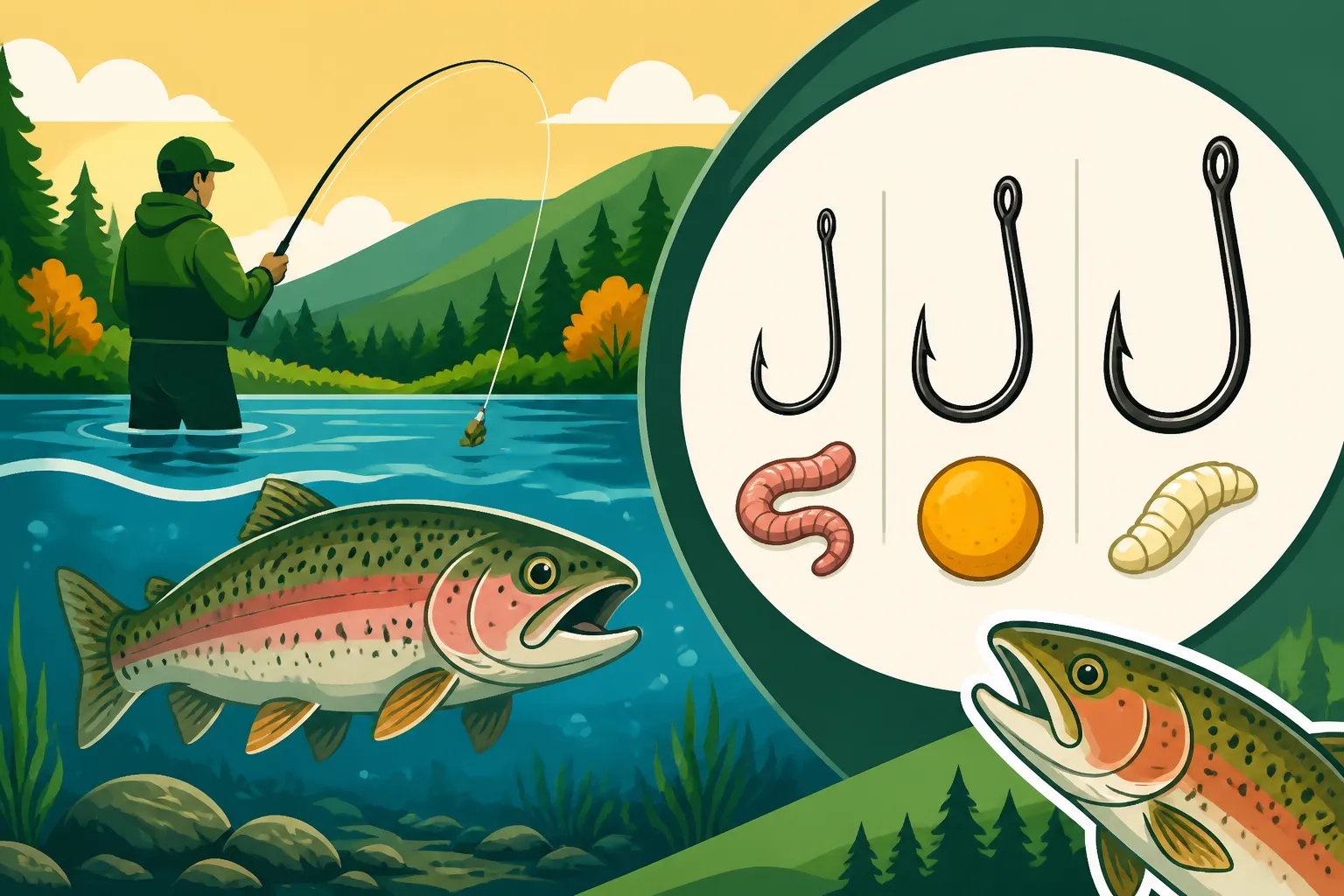
The "sweet spot" for stocked trout often lies in hooks ranging from size 8 down to size 14. Sometimes even smaller, a size 16, can be effective if you're using tiny baits or dealing with particularly wary fish in ultra-clear water. Going much larger than a size 8 often results in fewer bites, as the hook becomes too obvious or too difficult for the trout to ingest. It's all about matching the hook's physical presence to the size and type of bait you're offering, and ensuring it can be easily taken into a trout's mouth.
Think of it like this: a trout has a relatively small mouth compared to a bass or a pike. It needs to be able to comfortably take the entire bait-and-hook package into its mouth for a solid hookset. If the hook is too large, the trout might just nibble at the bait, or even spit it out before you can react, leaving you with a frustrating lack of hook-ups. So, precision here is key to turning those tentative taps into solid strikes.
Common Hook Sizes for Stocked Trout
For stocked trout, especially when using common baits, a few hook sizes tend to rise to the top as angler favorites.
- Size 10 and 12: These are arguably the most versatile sizes. They work wonderfully with many common baits like PowerBait dough, small pieces of worm, corn, or even a single salmon egg. They are small enough to be discreet, yet large enough to hold onto a feisty trout. If you're buying a new pack of hooks and aren't sure where to start, a pack of size 10 or 12 single baitholder hooks from a trusted brand you might find at Bass Pro Shops or on Amazon is a fantastic general-purpose choice.
- Size 8: A bit larger, size 8 hooks are good for chunkier baits, like a larger ball of PowerBait, a bigger nightcrawler section, or even a small marshmallow. They offer a bit more strength and gap for bigger presentations, but you'll want to ensure your bait completely covers the hook to maintain that natural look.
- Size 14 and 16: These smaller hooks are perfect for tiny baits, like a single kernel of corn, a small plastic trout worm, or when fish are being particularly finicky and only nibbling. The smaller wire of these hooks is incredibly subtle, ideal for clear water conditions or when targeting smaller stockers. However, they can bend out on larger, stronger fish if you're not careful with your drag.
Here's a quick reference table for common hook sizes and bait pairings:
| Hook Size | Common Baits | Primary Use Case | Key Consideration |
|---|---|---|---|
| Size 8 | Larger PowerBait balls, full nightcrawler sections, marshmallows | Larger presentations, slightly bigger stockers | Ensure bait fully covers hook; can be more visible. |
| Size 10 | Standard PowerBait balls, ½ nightcrawler, salmon eggs, corn | All-around versatile, good balance of strength/stealth | Excellent starting point for most situations. |
| Size 12 | Smaller PowerBait, ¼ nightcrawler, salmon eggs, small plastics | Finer presentation, slightly wary fish, smaller baits | Discreet, good for clear water. |
| Size 14 | Single corn kernel, tiny plastic baits, very small worm bits | Ultra-finesse, very clear water, picky eaters | Can bend on larger fish; requires gentle handling. |
Matching Hook Size to Your Bait Choice
This is perhaps the most crucial aspect of selecting the right hook. The hook needs to be proportionate to your bait. You want the bait to envelop the hook as much as possible, leaving only the sharp point and barb exposed, or sometimes even completely hidden, for a natural presentation.
If you're using PowerBait or other moldable dough baits, you want a hook that allows you to form a ball around it. For a standard dime-sized ball, a size 10 or 12 hook works perfectly, allowing the bait to float naturally. If you go too small, the bait might be too large for the hook to penetrate properly, leading to missed strikes. Too large, and the hook's bulk will either sink your buoyant bait or be too visible. Best Bait for Opening Day Trout in Vermont also dives into this.
For live worms, like nightcrawlers or garden worms, the hook size depends on whether you're using a whole worm or a piece. For a whole, smaller worm or a section of a nightcrawler, a size 8 or 10 baitholder hook is ideal. The little barbs on the shank help keep the worm from sliding off. If you're just using a tiny piece of a worm for finesse fishing, a size 12 or 14 might be better. The goal is for the worm to move naturally, wiggling enticingly, not to be weighed down or stiffened by an oversized hook.
Corn, salmon eggs, or small plastic baits demand even smaller hooks, often a size 12 or 14. These baits are naturally small, and an oversized hook would be immediately apparent to a trout. The trick is to just barely hook these tiny offerings, ensuring the point is exposed for a solid hookset without compromising the bait's appeal. Remember, a trout's mouth is smaller than you might think, so a compact presentation is always an advantage.
Factors Beyond Just the Number
While the hook size number is a huge indicator, there are other characteristics that play a significant role in your hook choice for stocked trout bait fishing. These include the wire gauge, the gap, and the shank length.
The wire gauge refers to the thickness of the metal used to make the hook. Lighter wire hooks (often found in smaller sizes like 12-16) are more discreet and penetrate easily, which is great for finicky trout. However, they can bend out on larger, stronger fish or if you set the hook too aggressively. Heavier wire hooks (like those often found in size 8-10 in some brands) are stronger but can be more visible and harder to hide in bait. Most trout hooks are made with a fine or medium wire to prioritize stealth and easy penetration.
The gap is the distance between the hook point and the shank. A wider gap generally means better hook-up potential, as there's more space for the hook to grab hold in the fish's mouth. However, too wide a gap on a small hook can make it harder to conceal within compact baits. You want a hook with enough gap to penetrate the trout's jaw, but not so much that it's poking out conspicuously from your bait.
Finally, the shank length (the straight part of the hook) influences how easy it is to embed the hook in certain baits. A short-shank hook is often preferred for moldable baits like PowerBait, as it creates a compact package. Longer shank hooks, like those on some worm hooks, are better for threading on live worms, allowing the worm to lie straighter and more naturally. Each of these elements works in concert with the hook's numbered size to create the optimal presentation and hooking potential.
Picking the Right Hook Style for Bait Fishing
Beyond just the size, the style of hook you choose can significantly impact your success when bait fishing for stocked trout in Vermont. There are several popular styles, each with its own advantages, depending on your bait, fishing technique, and whether you plan to keep your catch or release it. Understanding these differences will empower you to make more informed choices at your local tackle shop or when browsing online at places like Bass Pro Shops or Amazon.
The right hook style can make the difference between a solid hookset deep in the trout's mouth and a frustrating missed strike. It can also influence the health of the fish if you're practicing catch-and-release, which is increasingly popular for wilder trout or special regulation waters in Vermont. Being thoughtful about your hook style shows respect for the fish and the fishery, contributing to a better experience for everyone.
It's not just about what catches the fish, but how it catches them. A poorly chosen hook can lead to gut-hooking, which is detrimental to released fish. Therefore, considering the style based on ethical angling practices is as important as its effectiveness in getting a bite.
Treble Hooks vs. Single Hooks
This is one of the most common debates when it comes to trout fishing with bait, especially for PowerBait.
-
Treble Hooks: These hooks have three points radiating from a single shank. They are designed to increase your chances of hooking a fish, as they offer multiple points of contact. Many anglers swear by small treble hooks (often sizes 10 or 12) for PowerBait, believing they lead to more hook-ups because of the increased surface area for the fish to grab. However, treble hooks come with significant downsides. They are much more likely to deeply gut-hook a fish, making catch-and-release almost impossible without severe harm. They can also be a pain to unhook, both from the fish and from your net or clothing. For these reasons, many experienced anglers and conservationists discourage their use, especially in areas where catch-and-release is common or even mandated. You can find information about specific regulations in Vermont Fishing Regulations Explained.
-
Single Hooks: Single hooks, with their lone point, are generally considered a more ethical and often just as effective choice for bait fishing. They are much less likely to gut-hook a fish, making release easier and safer for the trout. A size 8, 10, or 12 single baitholder or octopus hook is an excellent choice for most bait presentations. With a proper hookset and the right size, single hooks offer plenty of holding power. They're also easier to manage when unhooking the fish, reducing handling time and stress on the trout. For general stocked trout fishing in Vermont, I almost always recommend sticking with single hooks. They simplify the process and are better for the fish, aligning with modern conservation efforts.
Baitholder and Worm Hooks
These are variations of single hooks specifically designed for bait.
-
Baitholder Hooks: These are classic single hooks that often have one or two small, sharp barbs along the shank. These barbs are invaluable for keeping your bait, especially worms or moldable dough baits, from sliding down the hook or off entirely when casting or retrieving. A size 10 or 12 baitholder hook is a fantastic all-purpose choice for stocked trout bait fishing. The barbs provide that extra bit of security, ensuring your bait stays exactly where you want it for a perfect presentation. They're strong enough for most stockers and generally very effective.
-
Worm Hooks (Aberdeen or Octopus Style): While "worm hook" can be a general term, styles like Aberdeen or octopus hooks are particularly good. Aberdeen hooks are typically thin-wired with a round bend, making them ideal for delicate worms or when you want maximum stealth. Octopus hooks, characterized by their short shank and wide gap, are fantastic for live baits because their shape allows the bait to move more freely and naturally. The wide gap also ensures a good hookset even when the bait is chunky. For smaller worms or power bait, a size 10 or 12 octopus hook is often preferred by many anglers because of its effective hooking angle and ability to hold a variety of baits securely. Look for these styles when you're stocking up on terminal tackle.
Circle Hooks for Catch and Release
If you are serious about catch-and-release fishing, especially for species you might inadvertently catch or on specific waters in Vermont that encourage or require it, then circle hooks are your best friend. A circle hook has a point that turns inward towards the shank, forming a distinct circular shape.
The magic of a circle hook is that it's designed to hook the fish in the corner of its mouth, almost always avoiding the gullet or stomach. You don't set the hook aggressively with a circle hook; instead, you let the fish take the bait and then slowly reel in, allowing the hook to slide into position and catch in the jaw as the line tightens. This self-setting nature greatly reduces deep hooking, drastically improving the survival rate of released fish. While they might take a little getting used to for anglers accustomed to traditional hook-setting, the benefits for fish health are undeniable. They are a responsible choice, particularly when fishing the Vermont Catch and Release Fly Fishing Only Waters or other designated catch and release areas. For stocked trout, a size 10 or 12 circle hook can be very effective, especially with natural baits like worms. It’s a great way to ensure that any fish you return to the water swims away healthy.
Rigging Your Bait for Success in Vermont Waters
Choosing the right hook is just one piece of the puzzle; how you actually rig your bait with that hook is equally important. A perfectly selected hook won't do you much good if your bait is presented awkwardly or unnaturally. The goal is always to maximize appeal and minimize suspicion, tempting those recently stocked Vermont trout into a confident bite. This involves understanding how different baits behave in the water and rigging them to their best advantage.
Think about the dynamics of the water itself – whether you're fishing a still pond or a gently flowing stream. Your rigging should complement these conditions, allowing your bait to present itself as a natural, easy meal. This isn't just about getting bites; it's about getting quality bites that lead to solid hooksets and successfully landed fish. There are subtle tricks for each bait type that can significantly boost your success rate.
Many anglers overlook the finesse involved in bait rigging, often assuming that just getting the bait on the hook is enough. But the seasoned pros know that the devil is in the details. A little attention to how your bait is threaded, weighted, and presented can transform a slow day into a memorable one on the water.
Presenting PowerBait and Dough Baits
PowerBait and other moldable dough baits are staples for stocked trout anglers, primarily because they are designed to float, lifting your bait off the bottom and above any weeds or debris.
- The Ball Method: For PowerBait, the most common method is to form a small, compact ball around a single hook (typically size 10 or 12). The key is to completely cover the hook, including the shank and eye, so only your line is visible. This creates a buoyant, irresistible sphere. Pinch off a piece of PowerBait, press your hook into it, and then roll it between your palms until it forms a perfectly round ball. The rounder and smoother the ball, the more naturally it will float and the less suspicious it will appear.
- Small, Compact, and Buoyant: Remember, less is often more with PowerBait. A small, dime-sized ball is usually sufficient. A larger ball might not float as well, or it might be too much for a smaller trout to take into its mouth. The buoyancy is crucial; ensure your PowerBait ball, with the hook inside, floats readily. If it sinks, you might have used too much bait or too heavy a hook. Often, I'll test it in a bucket of water before heading out. This ensures it's doing its job, which is to stay visible and enticing in the trout's strike zone.
Attaching Live Worms and Minnows
Live baits, like worms and minnows, offer natural scent and movement that can be incredibly effective, especially for trout that have been in the water for a little while and are adapting to natural food sources.
- Worms (Nightcrawlers, Garden Worms): For nightcrawlers, you can use a whole worm or a section. If using a whole nightcrawler, thread it onto a size 8 or 10 baitholder hook, leaving a good portion of the worm free to wiggle enticingly. Don't crowd the hook. For smaller garden worms or worm sections, simply pass the size 10 or 12 hook through the worm a couple of times, making sure it's securely attached but still able to move. The goal is to maximize the natural movement and scent of the worm without letting it fall off the hook. A lively, wiggling worm is far more attractive than a stiff, dead one.
- Minnows (Where Legal): If you're using small live minnows (always check Vermont Fishing Regulations Explained, as live minnow use can be restricted in certain waters), use a small, light-wire hook like a size 8 or 10, typically an octopus or Kahle style. You can hook the minnow lightly through the lips (best for keeping it lively and natural) or just below the dorsal fin. This allows the minnow to swim naturally, mimicking an injured baitfish – an easy meal for a hungry trout. The lighter the hook, the more freely the minnow can swim, making it irresistible. Keep your minnows fresh and lively for the best results.
Terminal Tackle Considerations
Your hook isn't isolated; it's part of a larger rigging system. The other components of your terminal tackle—like weights, swivels, and leaders—all work together to present your bait effectively.
- Weights: For bait fishing with PowerBait, many anglers use a small split shot or an egg sinker above a swivel, with a 12-24 inch leader of light fluorocarbon (4-6 lb test) leading to the hook. This keeps your buoyant PowerBait floating just off the bottom while anchoring your line. For worms or minnows, you might use slightly heavier weights, depending on current and depth. The key is to use the minimum amount of weight necessary to get your bait to the desired depth and hold it in place. Too much weight will make your presentation clunky and unnatural.
- Leaders and Swivels: A good quality, clear fluorocarbon leader is almost essential. Fluorocarbon is nearly invisible underwater and is more abrasion-resistant. Connect your main line to your leader with a small barrel swivel. The swivel helps prevent line twist, especially important when using rotating baits or in current. Again, choose the smallest swivel that's strong enough for the job to maintain stealth.
- Overall Balance: The entire setup should be balanced. Your rod, reel, line, and terminal tackle should all work harmoniously to allow for smooth casting, natural bait presentation, and effective hooksets. For general stocked trout fishing, a light-action spinning rod with 4-6 lb monofilament or fluorocarbon line, coupled with your chosen small hook and minimal weight, will give you the sensitivity and finesse needed to feel those subtle trout bites. Consulting resources like Best Tackle for Vermont Trout Fishing can give you an idea of balancing your gear. Similarly, checking Best Tackle Box Setup for Vermont Anglers can help you organize all these essential components. You might also want to explore Best Beginner Fishing Spots in Vermont for easy access.
Remember, the goal is always to make your bait look as natural and appealing as possible to those hungry, but often wary, stocked trout in Vermont's beautiful waters. By choosing the right hook size and style and rigging your bait effectively, you'll greatly increase your chances of a successful and enjoyable fishing trip. And don't forget to check Vermont Trout Season and Stocking Rules and the Vermont Fish Stocking Search Tool, Explained to know where and when to find these eager fish!
Disclaimer
This article is for general informational purposes only and does not constitute professional advice. Laws, prices and regulations vary by location and change over time. Consult a qualified professional for guidance on your specific situation.