Best Techniques for Deep Water Summer Lake Trout
Summer in Vermont is absolutely gorgeous, but it can also be incredibly frustrating for anglers trying to find those elusive lake trout. One day they're biting shallow, the next they've vanished into the depths, leaving you scratching your head and wondering if you'll ever connect with one of these magnificent fish. This guide is all about cutting through that confusion, diving deep into the tactics, gear, and knowledge you'll need to consistently find and catch lake trout when they retreat to the cooler, darker reaches of Vermont's stunning lakes during the warmer months.
Understanding Summer Lake Trout Behavior
When the surface waters of our beautiful Vermont lakes start to warm up, often hitting uncomfortable temperatures for cold-water species like lake trout, these fish don't just disappear. Instead, they make a strategic move to deeper, more thermally stable environments. Understanding why they do this and where they go is the first critical step to putting more fish in your boat.
The Thermocline and Lake Trout Habitat
The concept of the thermocline is absolutely vital for summer lake trout fishing. Imagine our lakes as having distinct layers of water. During summer, the sun heats the top layer, creating what's called the "epilimnion"—warm, oxygen-rich water. Below this, there's a transitional zone where the temperature drops rapidly; this is the thermocline. Underneath the thermocline lies the "hypolimnion," which is much colder and generally stable in temperature, but can sometimes become oxygen-depleted in very deep, stagnant areas.
Lake trout are cold-blooded creatures and thrive in water temperatures typically ranging from the low to mid-50s Fahrenheit (around 10-14°C). When the surface warms, they'll seek out the optimal combination of cold water and sufficient oxygen, which usually means they'll be found precisely within or just below the thermocline. This can vary by lake, but often means depths from 30 to 80 feet, sometimes even deeper on immense bodies of water like Lake Champlain or Lake Willoughby. Knowing how to identify the thermocline with your fish finder is like having a secret map to where the fish are holding.
Forage Fish and Their Influence
Lake trout are apex predators in their ecosystems, and their movements are heavily dictated by the presence and movements of their prey. In many Vermont lakes, a primary forage fish for lake trout is the rainbow smelt. Smelt are also cold-water species, and as the lake warms, they too will descend to the cooler depths. Where the smelt go, the lake trout will follow.
Therefore, when you're scanning your electronics for signs of life, don't just look for big fish arches. Pay close attention to any "clouds" or dense schools of baitfish. These are often smelt, and if you find a concentration of smelt holding at a certain depth, you can bet that the lake trout won't be far behind. Sometimes the trout will be actively pushing through these bait balls, but other times they'll simply be lurking on the edges, waiting for an easy meal. Understanding the life cycle and preferred habitats of these forage species, particularly rainbow smelt, is key to consistent success.
Seasonal Movements and Depths
While lake trout are generally deep in summer, their exact depth can fluctuate throughout the season and even day-to-day. Early summer might see them a bit shallower, say in the 30-50 foot range, as the lake is still stratifying. By mid-summer, when surface temperatures are at their peak, they could be holding consistently at 60-100 feet. Factors like light penetration also play a role; on bright, sunny days, they might go a bit deeper to escape the intense overhead sun, even if the water temperature is ideal slightly shallower.
Conversely, on overcast days or during periods of low light like dawn and dusk, they might temporarily move shallower to feed. Strong winds can also mix the water column to some extent, sometimes pushing baitfish and trout slightly shallower or deeper depending on the currents created. It's a dynamic environment, which means you need to be constantly checking your electronics and adjusting your presentation to match their current depth preference. This dynamic movement is one of the reasons why understanding How Deep Lake Trout Go in Summer is so crucial for anglers.
Essential Gear for Deep Water Lake Trout
Going after deep-water lake trout isn't like casting for bass in a shallow pond. You need specialized gear to present your lures effectively at significant depths and to battle powerful fish from those same depths. Investing in the right tools will not only increase your chances of success but also make the entire experience more enjoyable.
Rods, Reels, and Line Selection
For deep water lake trout, you're looking for stout, durable tackle. A medium-heavy to heavy action trolling rod, typically 7 to 9 feet in length, is ideal. These rods have a strong backbone to handle the pull of a downrigger ball or a Dipsy Diver, but also a forgiving tip to absorb the shock of a strike and keep the fish pinned. Brands like Ugly Stik or St. Croix offer great options that are durable and sensitive enough. For reels, a high-capacity baitcasting reel is almost a necessity. You need to hold a lot of line, often several hundred yards, and have a smooth, powerful drag system. A reel with a line counter is a game-changer, allowing you to precisely monitor how much line you have out and replicate successful presentations.
When it comes to line, many anglers opt for a main line of braided superline, ranging from 30 to 50 lb test. Braid has virtually no stretch, which provides excellent sensitivity for detecting subtle bites at depth and direct power for setting the hook. However, you'll almost always want to tie on a fluorocarbon leader, typically 10 to 20 lb test, for a few reasons. Fluorocarbon is nearly invisible underwater, which is crucial for wary lake trout, and it has some stretch, which can act as a shock absorber during violent head shakes. The length of your leader can vary, but generally, 10 to 20 feet is a good starting point. This setup ensures you have the strength to fight the fish and the stealth to entice it.
Downriggers and Dipsy Divers Explained
These are your primary tools for getting lures down to where the lake trout live.
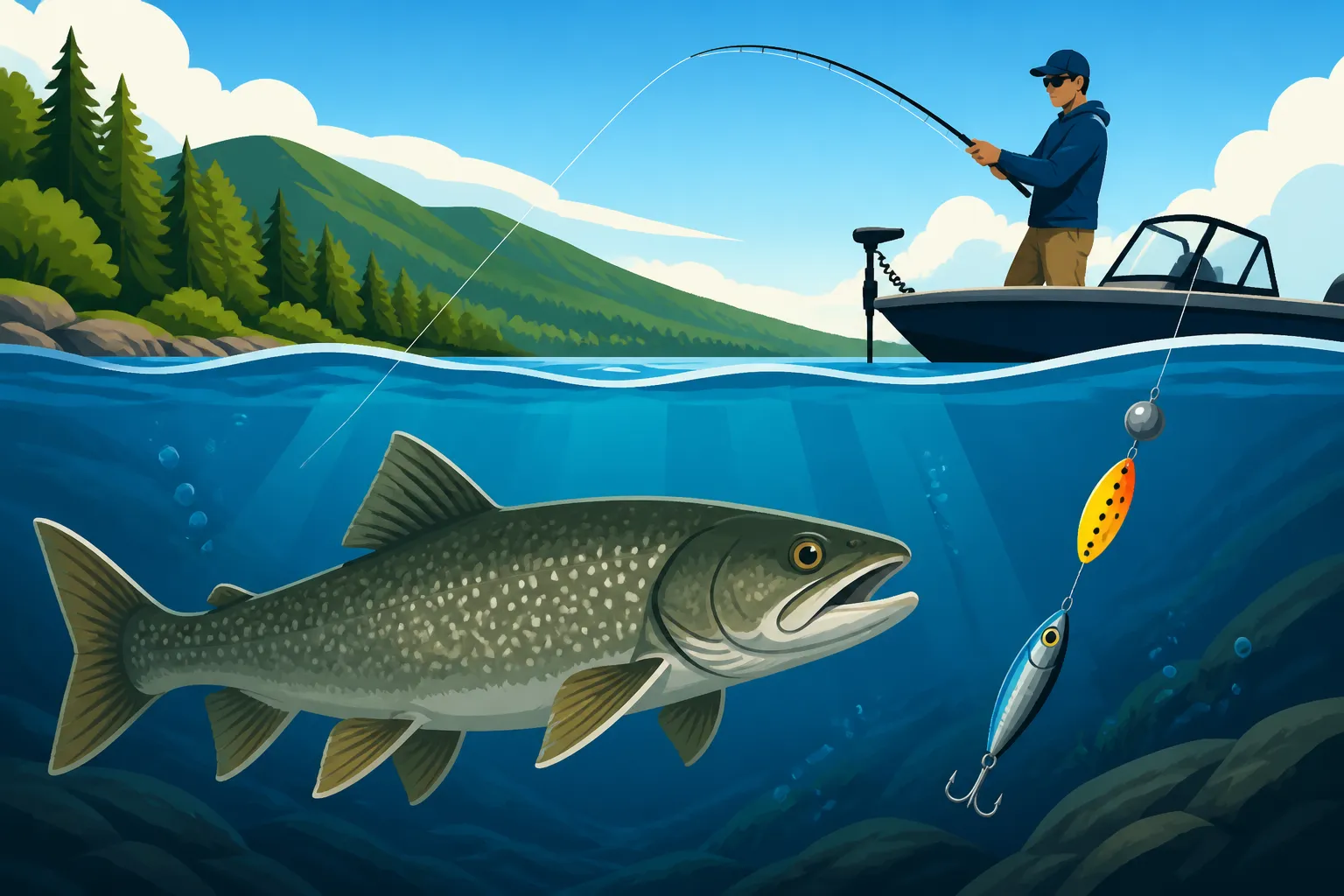
Downriggers: A downrigger is essentially a small winch that allows you to attach a heavy lead ball (typically 8-15 lbs) to a cable, which you then lower to your desired depth. Your fishing line is clipped into a release mechanism on the downrigger cable. When a fish strikes your lure, the line pops free from the clip, and you fight the fish directly on your rod and reel. The beauty of downriggers is their precision; you can set your lure exactly at the depth you're marking fish or bait. Quality downriggers from brands like Cannon or Scotty are a serious investment but are indispensable for serious deep-water trolling.
Dipsy Divers (or similar diving planers): These are disc-shaped devices that attach directly to your main fishing line. When deployed, they "dive" down and away from the boat, reaching significant depths without the need for additional weight. The depth they achieve depends on their size, the amount of line you let out, and your boat speed. They also have an adjustable trip mechanism, so when a fish bites, the Dipsy flips over, reducing its diving resistance and allowing you to fight the fish more easily. Dipsy Divers are more portable and less expensive than downriggers, making them a great option for boats without fixed downrigger mounts or for anglers looking for a more mobile setup. You can find a wide array of these and other diving planers on Amazon, often with various sizes and color options to experiment with different depths and presentations.
Sonar and GPS for Precision Fishing
Modern marine electronics are absolutely non-negotiable for deep-water lake trout fishing. A high-quality fish finder (sonar unit) with a good transducer is your eyes below the surface. You'll want a unit capable of displaying clear images of the bottom contour, individual fish arches, and most importantly, the thermocline and baitfish schools. Look for units with CHIRP sonar, which provides superior target separation and clarity at depth. A large, clear screen makes a huge difference when you're trying to interpret subtle signals.
Integrated GPS capabilities are equally important. Once you find a productive area—a distinct drop-off, a submerged hump, or a concentration of bait—you can mark a waypoint on your GPS. This allows you to precisely return to that spot, or to set up a trolling pass that follows the contour or structure where the fish are holding. Many modern units combine these features into powerful chartplotter-fishfinder combos. Brands like Humminbird, Lowrance, and Garmin are industry leaders, offering units with features like side imaging and down imaging that can reveal even more about the underwater world. These advanced tools help immensely in How to Fish Deep Structure for Summer Lake Trout and overall success.
Top Techniques for Deep Water Success
Once you have your gear sorted, it's time to put it to work. Deep water lake trout fishing primarily revolves around presenting lures at the correct depth and speed. While there are several methods, controlled depth trolling and vertical jigging are arguably the most effective during the summer months.
Controlled Depth Trolling
This is the bread and butter of deep-water lake trout fishing. Controlled depth trolling involves using downriggers, Dipsy Divers, or lead core line to present your lures precisely at the depth where fish are holding, then slowly pulling them through that strike zone. The key is control – maintaining your lure at the exact depth and speed that entices a bite.
Typically, you'll start by using your sonar to locate the thermocline, baitfish, and any suspended lake trout. Once you have a target depth, you'll deploy your downrigger balls or Dipsy Divers to that depth. Varying your boat speed, usually between 1.8 to 3.0 mph, can trigger strikes. Pay close attention to your rod tip action; a lively tip indicates your lure is working correctly, while a dead tip might mean you've picked up weeds or your lure isn't running true. Experiment with different lead lengths (the distance between your lure and the downrigger clip or Dipsy Diver) – sometimes a longer lead is more natural, other times a shorter one for a more aggressive presentation. The goal is to cover water effectively at the fish's preferred depth, making your lure appear as a tempting, easy meal. This technique is extensively covered in many resources on Trolling Techniques for Vermont Lake Trout.
Vertical Jigging and Drop Shotting
While trolling covers broad areas, vertical jigging and drop shotting are excellent for targeting specific marks or concentrations of fish you've found on your fish finder. Imagine you're idling over a distinct hump or a tight school of bait with lake trout lurking below – that's when these techniques shine.
Vertical Jigging: This involves dropping heavy jigs or spoons directly down to the fish's depth. Once at depth, you use a series of sharp upward snaps and pauses to impart an erratic, wounded baitfish action to your lure. The strike often comes on the fall. Lures like heavy tube jigs, flutter spoons, or specialized jigging spoons are very effective. The key is to keep a tight line and be ready for a strike, which can sometimes be a subtle "thump" at extreme depths. This is often done when the fish are concentrated or when they're less willing to chase a trolled lure.
Drop Shotting: This finesse technique is less common for deep-water lake trout but can be deadly when the fish are finicky. A drop shot rig involves tying a hook directly to your main line, and then a weight is tied to the very end of the line, usually 12-18 inches below the hook. This setup allows your bait (often a soft plastic minnow or worm imitation) to suspend horizontally at a specific depth, just above the weight. You can keep the bait in the strike zone with minimal movement, often just twitching your rod tip. This presentation is incredibly natural and can be irresistible to inactive lake trout. Both these methods require a sensitive rod to detect subtle bites from the depths.
Still Fishing with Live Bait
While less dynamic, still fishing with live bait can be incredibly effective, especially when lake trout are concentrated in a small area or are less aggressive. This is a more patient approach, but it often yields larger, more wary fish. The most common live bait for lake trout is large shiners or smelt, though in some areas, suckers or ciscoes might also be used.
The challenge is getting the bait down to the correct depth and keeping it alive and active. Using heavy pyramid or bell sinkers (often 1-3 ounces or more, depending on depth and current) is essential. You can rig your live bait on a large single hook or a treble hook, ensuring it swims naturally. Some anglers use a "balloon rig" where a balloon keeps the bait suspended at a set depth, or simply drop their lines straight down with enough weight to keep the bait in the strike zone. If you're fishing multiple lines, stagger your depths to cover more of the water column. Be sure to use strong leader material, as lake trout have sharp teeth and powerful jaws. This method works well when you've pinpointed a specific piece of structure or a small school of fish on your sonar and want to present a stationary, irresistible meal.
Reading the Water and Locating Fish
You can have the best gear in the world, but if you're not putting your lures where the fish are, you're just dragging metal through water. Learning to interpret your electronics and understand underwater topography is paramount for summer lake trout success in Vermont's diverse lakes.
Interpreting Your Fish Finder
Your fish finder is your window into the underwater world. Learning to interpret its readings effectively is one of the most valuable skills you can develop. First, learn to identify the thermocline, which usually appears as a distinct, often fuzzy, horizontal line across the screen where the temperature changes rapidly. This is your primary target zone.
Next, look for baitfish. These often show up as "clouds" or dense schools of small marks. If you see baitfish near the thermocline, you're likely in a productive area. Finally, look for the lake trout themselves. They will typically appear as strong, distinct arches, often larger than baitfish marks, either suspended within or just below the bait, or hovering near structure. Don't just focus on the largest marks; sometimes smaller arches indicate actively feeding fish. Keep an eye on the depth readouts and adjust your downriggers or jigs accordingly. A good sonar unit, especially one with high-definition side imaging from brands like Humminbird, can help you scan wider areas and pinpoint structure that you might otherwise miss.
Targeting Structure and Drop-offs
Lake trout, like many predatory fish, are often associated with underwater structure. During summer, this structure acts as ambush points, current breaks, or areas where baitfish congregate. Look for submerged humps, points that extend far out into the lake, underwater islands, rock piles, and dramatic depth changes (drop-offs).
On large lakes like Lake Champlain, identifying these subtle underwater features requires careful study of detailed lake maps (often pre-loaded on your GPS unit) and vigilant scanning with your fish finder. If you find a rocky point that drops from 40 feet down to 80 feet, that's a prime location for lake trout to ambush passing smelt. Troll parallel to these contours, or make repeated passes over a specific hump. Remember, lake trout don't just hang out in the middle of nowhere; they use the available structure to their advantage, both for feeding and for security. You'll find many of the best spots by studying maps for potential deep water structure, especially around areas mentioned in our Lake Champlain Fishing Guide or Lake Willoughby Fishing Guide.
Identifying Bait Balls and Active Feeding Zones
As mentioned earlier, forage fish are critical to locating lake trout. Actively feeding lake trout will often push baitfish into tight "bait balls" or scatter them as they make their predatory passes. When you see dense concentrations of baitfish on your screen, especially if they are getting harassed or broken up by larger marks, you've found an active feeding zone.
These zones are not always stationary; baitfish can move, and consequently, the lake trout will move with them. Pay attention to how the bait is oriented – if it's tight to the bottom, the trout might be there too. If it's suspended, then fish your lures accordingly. Sometimes, you might even see birds diving on the surface, which can indicate baitfish being pushed to the surface by predators below. While not common for deep lake trout, it's a general indicator of bait activity. Continuously scanning for these bait balls and adjusting your approach is crucial. When you hit a school of actively feeding fish, that's when you can experience some incredible action!
Tackle and Lure Selection for Summer
When you're fishing deep for lake trout, lure selection is critical not only for attracting fish but also for ensuring your presentation performs correctly at depth. It's a balance of profile, action, and visibility.
Spoons, Plugs, and Stickbaits
These are the workhorses of deep-water lake trout trolling.
Spoons: Metal trolling spoons are incredibly versatile and effective. Their wobbling, fluttering action perfectly mimics a wounded baitfish, like a smelt. Spoons come in various sizes, from 3 to 6 inches, and a plethora of colors. Popular choices include silver, gold, blue/silver, green/silver, and watermelon patterns. The action of a spoon can be tuned by its size and shape; wider spoons have a broader wobble, while narrower spoons have a tighter, faster wiggle. Many successful patterns are available on Amazon, making it easy to experiment.
Plugs and Stickbaits: These include lipped diving lures that swim with a darting or wobbling action. They often provide a more aggressive profile and can be very effective, particularly if the lake trout are feeding on larger forage. Rapala Deep Tail Dancers, Storm ThunderSticks, or similar minnow imitations are excellent choices. Again, size and color matter, but action is paramount. These lures often work well when fish are slightly more active or when you want to target different depth ranges by varying your lead length and lure's inherent diving capability. Knowing the optimal lure selection for walleye on Lake Champlain often translates well to lake trout, given similar forage and depths.
Soft Plastics and Jigging Lures
When you're vertical jigging or drop shotting, soft plastics and specialized jigging lures are your best bet.
Soft Plastics: Large tube jigs (3-5 inches), swimbait-style plastics, or large grub tails rigged on heavy lead heads (often 1/2 oz to 1.5 oz, or even heavier) can be deadly. These mimic baitfish and offer a more subtle, lifelike action, especially on the fall. White, pearl, smoke, and natural baitfish colors are usually good starting points. The soft, undulating action of a plastic tail can be irresistible to a lake trout that might be inspecting a lure closely.
Jigging Lures: Heavy metal jigging spoons (like Swedish Pimples, Crippled Herring, or Kastmasters) are designed to flash and flutter as they fall, mimicking a dying baitfish. Their weight allows them to get to depth quickly. Vertical jigs with a more darting action, like the Berkley Gulp! Jigging Grub, can also be very effective. The key with these is to work them with an aggressive lift-and-drop retrieve, allowing them to flutter and enticing a reaction strike. The "thump" of a lake trout hitting a jig can be quite exhilarating from deep water!
Choosing the Right Colors and Sizes
This is where the art of fishing comes in. There's no single "best" color or size for lake trout, as it can change daily or even hourly depending on light conditions, water clarity, and the fish's mood. However, there are some general guidelines.
Colors:
- Bright, sunny days/clear water: Natural baitfish patterns (silver, blue, green), white, pearl, and holographic finishes are often effective. Lake trout have excellent eyesight, and natural patterns blend in.
- Overcast days/stained water: Brighter, more contrasting colors like chartreuse, orange, firetiger, or even glow-in-the-dark lures can be more visible at depth where light penetration is limited.
- Darkness/Deepest depths: Anything with a glow feature or strong contrast can be key.
Sizes:
- Match the hatch: Try to use lures that are similar in size to the primary forage in the lake (e.g., smelt in Vermont lakes are typically 3-6 inches).
- Aggressive fish: Larger lures can sometimes draw more attention and trigger bigger strikes from active fish.
- Finicky fish: Downsizing your lure can often elicit bites from less aggressive or pressured fish.
It's always a good idea to have a selection of different colors and sizes on hand and to be willing to experiment until you find what the fish are keying in on. Pay attention to what's working for other anglers if you see them catching fish, and don't be afraid to try something completely different if the bite is slow.
Safety and Conservation Practices
Deep water fishing, especially on large, open lakes, comes with its own set of safety considerations. Furthermore, as responsible anglers, we have a duty to protect the fishery for future generations.
Safe Boating and Weather Awareness
Vermont's lakes, particularly Lake Champlain, can get rough quickly. Summer thunderstorms can roll in with little warning, and even a stiff breeze can kick up significant waves on a large body of water. Always check the marine forecast before heading out, and be prepared to cut your trip short if conditions deteriorate.
Ensure your boat is in good working order, with all required safety equipment on board, including plenty of life jackets (and make sure everyone is wearing them, especially children – remember the Life Jacket Requirements for Vermont Boaters), a first-aid kit, flares or other signaling devices, and a fully charged cell phone or marine radio. When trolling, be mindful of other boats and always follow navigation rules. It's easy to get focused on your rods and electronics, but situational awareness on the water is paramount. If you're on a smaller lake, don't underestimate its ability to get choppy either; always err on the side of caution.
Catch and Release Best Practices
Lake trout are a slow-growing species, and responsible catch and release practices are essential for maintaining healthy populations. If you plan to release a fish, handle it minimally and gently.
- Minimize Fight Time: Use appropriate tackle to bring the fish in relatively quickly, reducing exhaustion.
- Keep it Wet: Try to unhook the fish while it's still in the water, or if you must bring it aboard, use a large, knotless rubber net to minimize scale and slime removal. Avoid placing the fish on hot surfaces.
- Gentle Handling: Support the fish horizontally, especially if it's a large one, to avoid damaging its internal organs or spine. Avoid squeezing it.
- Quick Release: Remove the hook quickly using pliers or a dehooking tool. If the fish is deeply hooked, cut the line as close to the hook as possible.
- Revival: If the fish seems stressed or lethargic, hold it upright in the water by the tail and gently move it back and forth to force water over its gills until it swims away strongly.
Understanding proper handling contributes significantly to the survival of released fish and ensures Vermont's future fishing opportunities. Many of the Vermont Fishing Regulations Explained also touch on specific species limits and handling, so always review those before hitting the water.
Respecting Vermont's Regulations
Vermont has specific fishing regulations designed to manage its fisheries sustainably. These include season dates, length limits, and daily creel (bag) limits for various species, including lake trout. These regulations can change, so always consult the most current Vermont Fish & Wildlife Department fishing guide before you go.
For example, on some lakes, there might be special regulations on the number or size of lake trout you can keep. Ignoring these rules can lead to hefty fines and loss of fishing privileges. Know your limits, respect the law, and practice ethical angling. It’s also wise to be aware of Vermont Boating Laws for Anglers to ensure your entire trip is compliant and safe. A little homework before you leave the dock can save you a lot of headaches later and ensure you're contributing to the health of Vermont's incredible lake trout populations.
| Technique | Primary Gear | Ideal Depth Range (Summer) | Best Conditions | Pros | Cons |
|---|---|---|---|---|---|
| Controlled Trolling | Downriggers, Dipsy Divers, Lead Core, Trolling Rods | 30-100+ feet | Covering large areas, Active fish | Precise depth control, Covers lots of water | Requires specialized gear, Can be slower |
| Vertical Jigging | Heavy Jigs/Spoons, Sensitive Rod | 30-120+ feet | Marked fish, Structure fishing | Direct contact, Exciting strikes, Targets specific fish | Less water covered, Can be fatiguing |
| Still Fishing w/ Bait | Heavy Sinkers, Live Bait (shiners/smelt), Stout Rod | 30-100+ feet | Finicky fish, Stationary schools | Highly effective for wary fish, Can yield larger fish | Requires patience, Less active method |
Disclaimer
Please remember that fishing conditions, regulations, and fish behavior can change. Always consult the latest Vermont Fish & Wildlife Department regulations before heading out. This guide is for informational purposes only and does not constitute official legal advice. Enjoy your time on Vermont's beautiful waters, and fish responsibly!