Best landing net size for trout
One of the most common frustrations for any trout angler is finally hooking into that beautiful, hard-fighting fish, only for it to slip out of your hands or, worse, thrash itself free just as you're trying to land it. Often, the culprit isn't your angling skill, but simply having the wrong landing net for the job. This guide is here to walk you through the often-overlooked details of choosing the best landing net size for trout fishing in Vermont, ensuring you can land your catch safely, respectfully, and efficiently every single time.
Why Your Landing Net Size Matters More Than You Think for Trout
It's easy to dismiss a landing net as just another piece of gear, something you grab off the rack without much thought. But for trout anglers, especially those who practice catch-and-release, the size and design of your net can make a monumental difference. It’s not just about getting the fish in hand; it’s about protecting the fish, making the whole process smoother, and frankly, making your fishing experience more enjoyable and less stressful.
The Impact of Net Size on Fish Health and Release
When you're reeling in a feisty trout, its energy levels are already taxed. The last thing you want is to prolong that struggle at the bank or boat. A net that's too small forces you to try and cram the fish in, often resulting in it flopping out, getting caught in shallow water, or banging against rocks. This prolonged handling and stress can severely impact the fish's chances of survival after release. Think about it: a small net means more fumbling, more time out of the water, and more opportunities for the fish to injure itself.
Moreover, the delicate slime coat that protects trout from disease and parasites can be easily rubbed off by rough handling or abrasive net materials. If a fish is thrashing against a small, stiff net, or worse, flopping on the bank because the net wasn't deep enough to secure it, that protective layer is compromised. A properly sized net allows for a quick, clean scoop, minimizing contact with hands (unless necessary for hook removal) and keeping the fish submerged or at least wet, reducing stress and injury. We all want to see those beautiful Vermont trout swim away strong, ready to be caught another day, and your net choice plays a huge role in that.
Practical Considerations: Maneuverability and Storage
Beyond fish welfare, the practical aspects of net size are a big deal for us anglers. Imagine bushwhacking through dense riverside brush in Vermont's remote areas, trying to keep a massive, unwieldy net from snagging on every branch. Or picture yourself in a small fishing kayak on one of Vermont's stunning lakes, with a net so long it constantly gets in the way of your paddle or casts. A net that's too large can be a cumbersome liability, turning a peaceful fishing trip into a constant battle with your gear.
Conversely, a net that's too small might be easy to carry, but it becomes a frustration the moment you hook a decent-sized fish. It's about finding that sweet spot where the net is large enough to be effective but compact enough not to be a nuisance. Consider how you fish: are you wading small brooks, navigating a kayak on Lake Champlain, or fishing from a boat on Lake Willoughby? Each scenario demands a different balance of net size, handle length, and portability. The best net is one that feels like an extension of yourself, there when you need it, and out of the way when you don't.
Decoding Landing Net Dimensions for Vermont Trout
When you're staring at a wall of nets at a place like Bass Pro Shops or browsing options online on Amazon, the numbers and terms can be a bit overwhelming. "Hoop size," "handle length," "net depth"—what does it all mean for catching a plump Vermont rainbow trout or a wild brook trout? Let's break down these crucial dimensions so you can make an informed choice that truly fits your fishing style and the fish you're targeting.
The "Hoop Size" and Trout Length
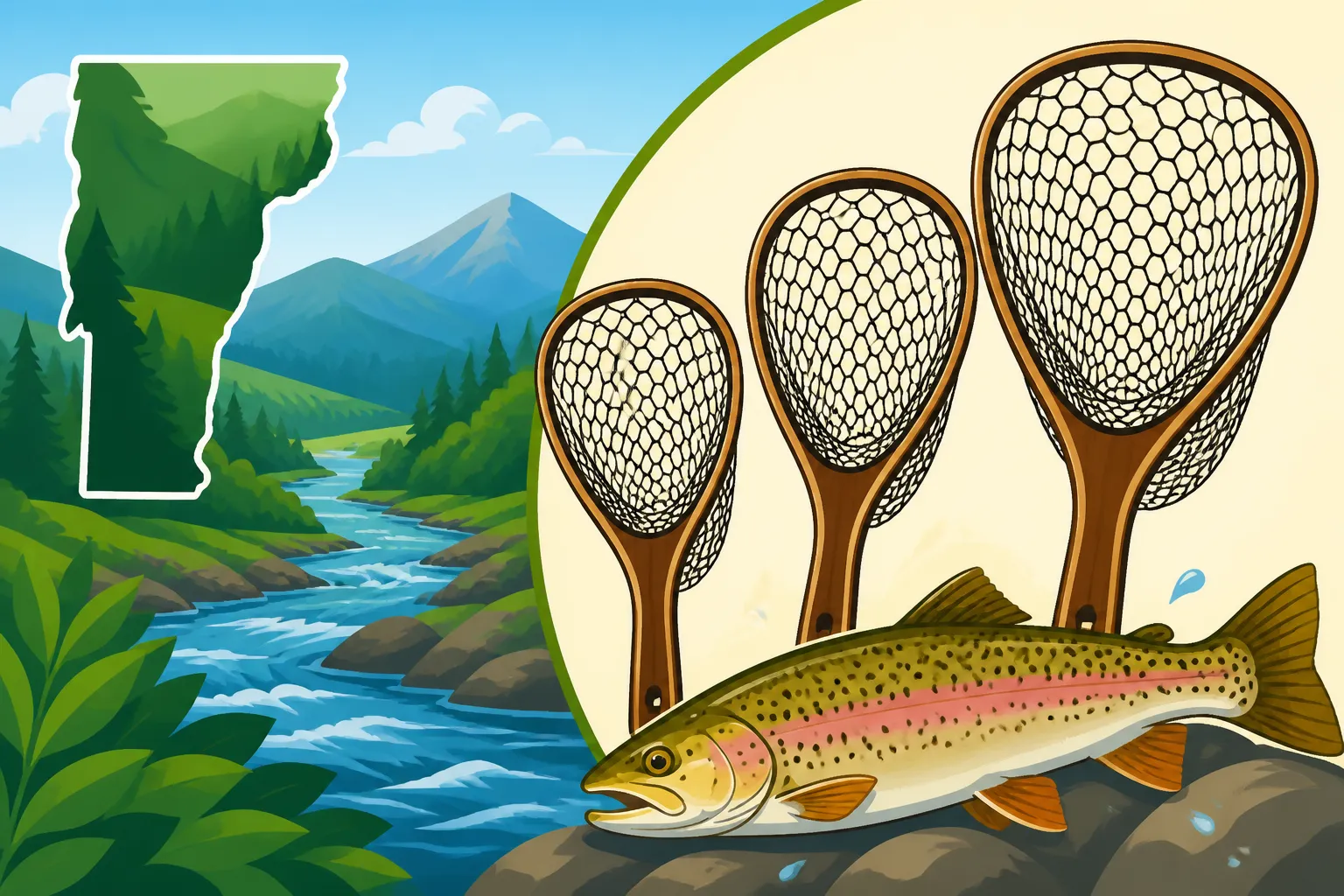
The hoop size, often referred to as the basket size or opening, is perhaps the most critical dimension. This is the actual opening through which you'll scoop your fish. For Vermont trout, which can range from small, feisty 8-inch brookies in mountain streams to substantial 20-inch-plus browns in larger rivers or lakes, your hoop size needs to be appropriate.
- Small Trout (6-12 inches): For the average stream-dwelling brook trout or smaller stocked rainbows, a hoop size of around 10-12 inches wide and 14-18 inches long is usually sufficient. This allows for a quick scoop without excessive fumbling, keeping the net light and maneuverable in tight quarters. Many anglers fishing smaller streams prefer a compact net for portability, and this size fits the bill perfectly for those picturesque native brook trout.
- Medium Trout (12-18 inches): If you're targeting the more common size of rainbow and brown trout found in Vermont's medium-sized rivers like the Winooski or Lamoille, or larger stocked ponds, you'll want a hoop size in the 12-15 inch wide by 18-22 inch long range. This gives you enough room to net a healthy fish quickly and efficiently, reducing the risk of it flopping out. These are often the workhorse nets for many dedicated trout anglers.
- Large Trout (18+ inches) & Salmon: When you're dreaming of a trophy brown from the Battenkill River or a landlocked salmon from Lake Willoughby, or perhaps a substantial lake trout, you absolutely need a bigger net. Look for hoop sizes upwards of 16-20 inches wide and 24-30 inches long, or even larger. These larger hoops provide the necessary space to land a powerful, long fish without damaging fins or scales. You'll thank yourself for having this extra real estate when that magnum trout comes to the surface. For deep-bodied fish like some lake trout, the depth of the net also becomes increasingly important, which we'll cover next.
Handle Length: Stream vs. Boat vs. Bank
The handle length of your landing net dramatically impacts its usability in different fishing environments. A short handle is great for wading, but useless from a high bank. A long handle is perfect for boats, but a tripping hazard in a small stream.
- Short Handles (6-12 inches): These are the classic "wading nets" or "backpack nets." They're designed for ultimate portability and minimal interference while you're actively casting and moving in a stream. The short handle keeps the net close to your body, often clipped to a vest or pack, allowing for a quick, one-handed scoop once the fish is subdued and close. These are ideal for anglers who spend their days exploring Best Trout Streams in Vermont or Best Fly Fishing Rivers in Vermont. The idea is that you'll have the fish right at your feet or within arm's reach when it's time to net.
- Medium Handles (18-36 inches): This handle length offers a good balance for a variety of scenarios. It's long enough to provide extra reach from a drift boat, a kayak, or when fishing from a slightly elevated bank or dock. Many all-around nets fall into this category, offering versatility for anglers who fish a mix of waters. Some medium-handled nets are even collapsible or telescoping, offering the best of both worlds – compact for transport but extendable for reach.
- Long Handles (36+ inches): When you're fishing from a larger boat, a high bank, or a pier, a long-handled net is indispensable. These often feature an extendable shaft, allowing you to reach far out from the boat's edge or down a steep bank to net a fish. For anglers targeting big fish from a distance, or those fishing from canoes or larger fishing vessels on lakes like Lake Champlain, a long, sturdy handle ensures you can safely net your catch without leaning precariously over the water. For example, if you're out chasing Walleye Fishing on Lake Champlain or Lake Trout Fishing in Vermont from a powerboat, you'll appreciate the reach of a long-handled net.
| Net Feature | Small Stream Trout (6-12") | Medium River Trout (12-18") | Large Lake Trout/Salmon (18"+) |
|---|---|---|---|
| Hoop Size | 10-12" W x 14-18" L | 12-15" W x 18-22" L | 16-20"+ W x 24-30"+ L |
| Handle Length | 6-12" (Wading/Backpack) | 18-36" (General Purpose/Kayak) | 36"+ (Boat/Bank, often extendable) |
| Mesh Material | Rubberized, Knotless | Rubberized, Knotless | Rubberized, Knotless |
| Net Depth | Shallow to Medium | Medium to Deep | Deep |
| Portability | Excellent (Light, Compact) | Good (Some models collapsible) | Fair (Often bulky, heavy) |
| Best Use Case | Small streams, tight cover | Rivers, mid-sized lakes, kayaks | Large lakes, big boats, high banks |
Mesh Material and Design: Beyond Just Size
While the overall dimensions of your net are paramount, don't overlook the crucial details of the mesh material and the net's depth. These elements might seem minor, but they significantly impact both the fish's well-being and your ease of use. A perfectly sized net with the wrong mesh can still be detrimental to a trout, and a net that's not deep enough can lead to heartbreak.
Rubber vs. Nylon: Protecting the Trout's Slime Coat
This is a non-negotiable for serious trout anglers, especially those who practice catch-and-release. The material of your net's mesh directly interacts with the fish, and not all materials are created equal when it comes to fish health.
- Rubberized, Knotless Mesh (The Gold Standard): If you care about the fish (and you should!), a rubberized, knotless mesh net is the only way to go. These nets are incredibly gentle on a trout's delicate slime coat, which is its first line of defense against infection and disease. Unlike traditional knotted nylon, rubberized mesh is smooth and non-abrasive, drastically reducing the removal of this vital protective layer. Another massive benefit is that hooks rarely get tangled in rubber mesh. Imagine trying to untangle a treble hook from a wriggling trout in a knotted nylon net – it's a nightmare for both you and the fish, prolonging the fight and increasing stress. With rubber, a quick shake usually frees the hook, allowing for a swift release. Many top brands offer these, and you can easily find excellent options for sale on Amazon or at your local Bass Pro Shops.
- Nylon Mesh (The Old School, Less Ideal Option): Traditional nylon nets, especially those with knots, are a budget-friendly option, but they come with significant drawbacks for trout fishing. The rough, abrasive texture of nylon can strip away a fish's slime coat, leaving it vulnerable. The knots can also cause fin damage and, as mentioned, are notorious for tangling hooks, turning a quick release into a frustrating and potentially harmful ordeal. While they might be fine for some hardier species you intend to keep, for trout, especially those destined to swim another day, steer clear of plain knotted nylon if possible.
Net Depth: Ensuring a Secure Hold
The depth of your net basket is another critical, yet often overlooked, feature. A net that's too shallow, even if the hoop size is adequate, risks having a lively fish flop right out before you can secure it.
- Shallow Nets (6-8 inches deep): These might be okay for very small, docile trout or panfish, but for any decent-sized trout, they're generally insufficient. A fish that's still full of fight can easily flip itself out of a shallow net, especially if you're trying to net it in moving water or from a boat that's rocking.
- Medium to Deep Nets (10-16+ inches deep): This is the sweet spot for most trout fishing. A net with good depth allows the fish to be fully submerged or securely contained once scooped. This minimizes thrashing, protects the fish, and gives you time to remove the hook cleanly before release. For longer fish like larger browns or landlocked salmon, ample depth prevents their tails from hanging out and potentially causing injury or allowing them to leverage themselves out of the net. A deeper net also means you can keep the fish in the water while you work, further reducing stress.
Remember, a good net doesn't just catch the fish; it protects it. Prioritizing rubberized, knotless mesh and sufficient depth goes a long way in being a responsible angler in Vermont's beautiful waters.
Matching Your Net to Vermont's Diverse Trout Waters and Species
Vermont is a trout angler's paradise, offering everything from tiny, wild brook trout streams nestled in the Green Mountains to vast, deep lakes holding trophy lake trout and landlocked salmon. The beauty of this diversity also means that a "one-size-fits-all" net approach simply won't cut it. To truly maximize your success and ensure the welfare of the fish, you need to consider the specific waters and species you'll be pursuing.
Small Stream Brook Trout: Keeping it Compact
If your idea of trout fishing involves hiking into a remote corner of Vermont, sneaking up on crystal-clear, bubbling brooks, and targeting native Brook Trout: Vermont's Native Trout, then a compact, lightweight net is your best friend. These streams often have dense overhead cover, tight casting lanes, and require a lot of walking and wading. A bulky net will constantly snag on branches, bushes, and your waders, turning an enjoyable trek into a frustrating slog.
For these situations, look for nets with a smaller hoop (around 10-12 inches wide by 14-18 inches long) and a short handle (6-12 inches). Many come with an elastic lanyard or magnetic release system, allowing you to clip them to your vest or backpack, keeping them out of the way until needed. When you hook into a small, jewel-toned brook trout, you want to be able to reach for your net quickly and scoop it in one swift motion. Portability is key here, often more so than sheer netting power, as the fish are typically smaller. These nets pair perfectly with lighter fly rods suitable for smaller waters, often featured in guides like Best Fly Rods for Vermont Trout Streams.
River Browns and Rainbows: A Bit More Reach and Scoop
Moving up in size to Vermont's medium to large rivers like the Otter Creek, White River, or the famed Battenkill, you'll encounter larger brown and rainbow trout that demand a more substantial net. These rivers often offer wider stretches, deeper runs, and more powerful currents, meaning you'll need a net with more reach and a bigger hoop to handle actively fighting fish.
For river fishing, a net with a hoop size of 12-15 inches wide by 18-22 inches long and a medium handle (18-36 inches) is often ideal. This handle length gives you the extra reach needed to net fish from a slightly elevated bank or when wading in deeper water. It also provides a better leverage point against the current. If you're drifting a boat down a river, this size is also quite manageable. Remember that these fish, especially strong brown trout, can put up quite a fight, so a deeper net will help contain them securely. When you're Wading Techniques for Vermont Trout Streams in a larger river, having that extra length on your net can make all the difference when a strong fish decides to run downstream.
Lake Trout and Landlocked Salmon: Go Big or Go Home
When you're out on the vast, deep waters of Lake Champlain, Lake Willoughby, or other large Vermont lakes targeting powerful species like Lake Trout Fishing in Vermont or Landlocked Salmon Fishing in Vermont, you absolutely cannot skimp on net size. These fish are often significantly larger, heavier, and more powerful than their stream-dwelling cousins. Trying to net a 25-inch landlocked salmon with a small wading net is not only futile but dangerous for both you and the fish.
For these big lake fish, you'll need a large, sturdy net with a hoop size of at least 16-20 inches wide and 24-30 inches long, or even larger. The net depth should be substantial, often 16 inches or more, to fully encompass a long, heavy fish. The handle should be long, ideally extendable (36+ inches), to reach over the side of a boat or kayak. Many boat anglers opt for heavy-duty aluminum or composite nets that can withstand the weight and power of these species. These nets are designed for maximum scoop capacity and strength, ensuring that when you finally bring that trophy fish alongside the boat, you can land it quickly and safely, minimizing the stress and handling time. It’s an investment, but one that pays off handsomely when you're looking at a true Vermont giant.
Practical Tips for Choosing and Using Your Trout Net
Finding the perfect landing net for your Vermont trout adventures isn't just about reading specs; it's about hands-on experience and ongoing care. A well-chosen net can last for years and contribute significantly to your enjoyment and the health of the fish. Let's talk about how to make that choice and keep your net in prime condition.
Hands-On Selection: What to Look For in the Store
While online shopping on platforms like Amazon offers convenience and a vast selection, there’s immense value in handling a net in person before you buy, especially for such a crucial piece of gear. When you visit a specialty fishing shop, like your local Bass Pro Shops, take your time to really get a feel for the nets.
First, consider the balance and weight. Pick up the net and mimic a netting motion. Does it feel unwieldy or awkwardly heavy? Will you be able to wield it quickly and efficiently with one hand if necessary? For a wading net, lightness and ease of carry are paramount. For a boat net, while still needing to be manageable, robustness might take precedence.
Next, examine the construction. Check the frame for rigidity and durability. Is it made of sturdy aluminum, wood, or a composite material? Are the joints strong? A flimsy net will let you down when you need it most. For nets with extendable handles, test the locking mechanism. Does it extend and retract smoothly, and does it lock securely without wobble? You don't want the handle collapsing mid-net.
Finally, inspect the mesh. Confirm that it's truly rubberized and knotless if that's what you're after. Feel the texture. Is it soft and smooth? Imagine a trout sliding into it. Are the openings large enough to allow water to flow through easily (reducing drag when scooping) but small enough to prevent fins from getting caught? Don't be shy; this is your gear, and you need to be confident in its performance before you take it out on a beautiful Vermont river.
Maintenance and Care for Longevity and Fish Health
A landing net is constantly exposed to water, mud, fish slime, and sometimes even hooks and lures. Proper maintenance isn't just about making your net last longer; it's also about preventing the spread of aquatic invasive species and keeping it hygienic for the next fish you land.
After every fishing trip, especially if you've landed fish, give your net a good rinse with fresh water. This washes away any fish slime, dirt, or debris. If you've been fishing in different bodies of water, a more thorough cleaning with a mild soap solution can help prevent the transfer of any unwanted organisms. Pay particular attention to the mesh, as it's the part that directly touches the fish.
Always allow your net to air dry completely before storing it. Hanging it up in a well-ventilated area is ideal. Storing a damp net can lead to mildew, unpleasant odors, and can weaken materials over time. Regularly inspect the mesh for any tears or snags, and check the frame for bends or cracks. Minor tears in rubberized mesh can sometimes be repaired with specialized adhesives, but significant damage might warrant a replacement. For wooden nets, a periodic light oiling can help preserve the wood.
By taking these simple steps, your landing net will remain a reliable tool for many seasons of Vermont trout fishing, ensuring healthy releases and fewer frustrating moments on the water.
Disclaimer
This article is for general informational purposes only and does not constitute professional advice. Laws, prices and regulations vary by location and change over time. Consult a qualified professional for guidance on your specific situation.