Best Ice Auger for Vermont Lakes
There’s nothing quite like the crisp air and quiet solitude of a Vermont ice fishing day, but that peace can quickly turn into frustration if you’re struggling to cut through thick, stubborn ice with the wrong equipment. Many anglers find themselves exhausted by slow hand augers or annoyed by the noise and fumes of gas-powered models, while others worry about battery life in the frigid cold. This comprehensive guide is designed to cut through the confusion and help you select the absolute best ice auger to conquer Vermont’s diverse frozen waters, ensuring your time on the ice is spent fishing, not drilling.
Understanding Vermont's Ice Fishing Landscape and Your Auger Needs
Ice fishing in Vermont is a unique experience, offering everything from quaint, shallow ponds tucked away in the Green Mountains to the expansive, often challenging waters of Lake Champlain. What works perfectly on a small, stocked trout pond might leave you high and dry (or rather, low and hole-less) on a massive, windswept lake. That’s why understanding the specific conditions you’ll encounter, and how they impact your auger choice, is absolutely critical before you make a purchase.
The Diverse Ice of Vermont Lakes
Vermont's winter landscape presents a variety of ice conditions that demand different auger capabilities. Smaller, shallower ponds and lakes, especially those in more sheltered valleys, tend to freeze earlier and more consistently. The ice might not get incredibly thick, and it’s often relatively uniform, making it easier to drill through. Think about the conditions you might find on places like Lake Dunmore or even some of the smaller coves on Lake Bomoseen.
However, once you venture onto larger bodies of water like Lake Champlain or Lake Memphremagog, the game changes entirely. Here, the ice can vary dramatically in thickness, often reaching well over a foot or two as the season progresses. You’ll frequently encounter multiple layers of ice, sometimes with slush and refrozen water sandwiched in between, or even a layer of snow that has frozen solid on top. These variable, often "dirty" ice conditions can quickly bog down an underpowered auger or dull a delicate blade. It's not uncommon to hit a patch of hard, refrozen slush that feels like concrete, making a powerful and efficient auger an absolute necessity. Remember, knowing How thick ice needs to be for Vermont anglers to walk on it is crucial, but equally important is being prepared for the type of ice you'll be drilling.
Ultimately, choosing an auger isn't just about how many inches of ice you expect, but the quality and consistency of that ice. If you plan to fish a wide range of Vermont's Best Ice Fishing Lakes in Vermont, you'll likely need an auger that can handle more than just pristine, clear ice.
Matching Auger Size to Target Species and Hole Needs
The diameter of the hole you plan to drill is a fundamental consideration that directly impacts your auger choice. This isn't just about the biggest fish you might catch; it's about the practicalities of fishing for your target species.
For instance, if your primary goal is to jig for panfish like yellow perch or black crappie, or even smaller brook trout in stocked ponds, a 6-inch diameter hole is often more than sufficient. These smaller holes are incredibly easy to cut, require less effort, and allow you to drill many holes quickly, which is key for finding active schools of panfish. A narrower hole also means less ice to clear and less heat loss, making for a slightly warmer experience on bitter cold days. For species like perch, even a small 4-inch hole can work, minimizing effort significantly. Learning techniques like Jigging for Perch Through the Ice often involves drilling numerous exploratory holes.
However, if you're targeting larger game fish, you'll need to step up your hole size. An 8-inch auger is a great all-around choice for many Vermont anglers. It’s wide enough to comfortably land most average-sized northern pike, walleye, and lake trout, while still being manageable to drill. You might even consider an 8-inch auger if you're after substantial smallmouth bass on Lake Champlain, where they can grow quite large. When considering rules for certain species, keep in mind things like Vermont Walleye Limit on Lake Champlain can sometimes dictate how big of a fish you might encounter.
For the true trophy hunter, especially those chasing monster lake trout, big northern pike, or the elusive muskellunge on Lake Memphremagog, a 10-inch auger becomes almost essential. While drilling a 10-inch hole takes significantly more effort and power, it provides the necessary room to maneuver a large fish, preventing it from getting stuck or breaking your line against the ice edge. Trying to pull a 30-inch walleye through an 8-inch hole can be a heart-stopping, sometimes heartbreaking, challenge. Weighing your target species against the physical exertion required for larger holes is a balance every Vermont ice angler must consider.
Portability and Power: The Vermont Ice Angler's Dilemma
One of the biggest internal debates for any ice fisherman in Vermont is the eternal trade-off between an auger's portability and its raw power. Your fishing style and preferred access methods will heavily dictate which side of this fence you land on.
Are you the type of angler who enjoys a long walk across a frozen lake, perhaps towing a sled loaded with minimal gear to find those remote honey holes? If so, every pound of equipment matters. A heavy gas auger, while powerful, can quickly become a lead weight on a long trek, turning a leisurely stroll into an arduous workout. For these mobile anglers, a lightweight, easy-to-carry option is paramount, even if it means slightly less cutting power. You want to save your energy for the fight with the fish, not the walk to the spot.
Conversely, if you primarily access your fishing spots via snowmobile, ATV, or even by vehicle in the designated ice fishing villages on large lakes, then weight becomes less of a concern. In these scenarios, the ability to rapidly cut many holes, or to power through exceptionally thick or challenging ice, often takes precedence. Speed and brute force become your friends, allowing you to quickly set up tip-ups or explore multiple depths in search of active fish. You won't mind the extra heft of a powerful auger if it's riding on a machine.
Another consideration is how many holes you typically drill. If you're someone who likes to drill a single hole and set up for the day, almost any auger will do the job. But if you're constantly exploring, punching dozens of holes in a session, or participating in tournaments where efficiency is key, a powerful and fast auger can make all the difference. Vermont's winters can be brutally cold, and the less time you spend drilling, the more time you can spend fishing – and staying warm!
Finally, consider the reliable starting of your auger in sub-zero Vermont temperatures. Gas augers can be notoriously finicky in the cold, requiring choke adjustments and multiple pulls. Electric augers offer instant starts but their battery performance degrades in extreme cold. The choice here reflects not just power, but also convenience and peace of mind when you're bundled up on a frozen lake.
Types of Ice Augers: Pros and Cons for Vermont Conditions
The world of ice augers has expanded dramatically over the years, moving beyond just the classic hand-crank models. Today, anglers have a fantastic array of options, each with its own set of advantages and disadvantages tailored to different fishing styles and conditions. Let's break down the main types you'll encounter and how they stack up for Vermont's unique ice fishing scene.
Hand Augers: The Classic, Lightweight Choice
Ah, the trusty hand auger! For many of us, this was our introduction to ice fishing. It's a simple, manual tool that relies entirely on your own strength and a bit of technique to cut through the ice. Consisting of a handle, a shaft, and a set of sharp blades, it's the epitome of "less is more" in the ice fishing world. These augers are often seen on smaller, more secluded ponds or during the early and late parts of the ice season when ice thickness is still moderate. They're a fantastic choice for a casual outing, perhaps introducing someone to the sport under Vermont youth fishing license rules by age, where the focus is more on the experience than on punching dozens of holes.
The pros of a hand auger are numerous, especially for certain Vermont angling scenarios. They are incredibly lightweight, making them perfect for those long walks across a lake or when you need to be highly mobile, frequently relocating to find fish. There's no fuel to worry about, no batteries to charge, and absolutely no noise or fumes, which is a huge plus if you value peace and quiet or are fishing in areas sensitive to disturbance. They are also, by far, the most budget-friendly option upfront and require minimal maintenance – just keep those blades sharp and rust-free! For a quick trip to a local stocked pond for trout or panfish, a hand auger is tough to beat for sheer simplicity and portability.
However, hand augers do have their significant limitations, especially when faced with the realities of a full Vermont winter. Trying to crank through 12, 18, or even 24 inches of ice, especially the multi-layered, refrozen stuff, can be an utterly exhausting experience. Your arms and back will feel it after just a few holes, and if you plan on drilling many holes, forget about it. They are also considerably slower than powered augers, and you're typically limited to smaller hole sizes, usually 6 or 8 inches, to keep the effort manageable. For serious ice anglers who hit the ice frequently or target larger species on big lakes, a hand auger is generally relegated to backup duty or specific, light-duty situations.
Propane and Gas Augers: Raw Power for Thick Ice
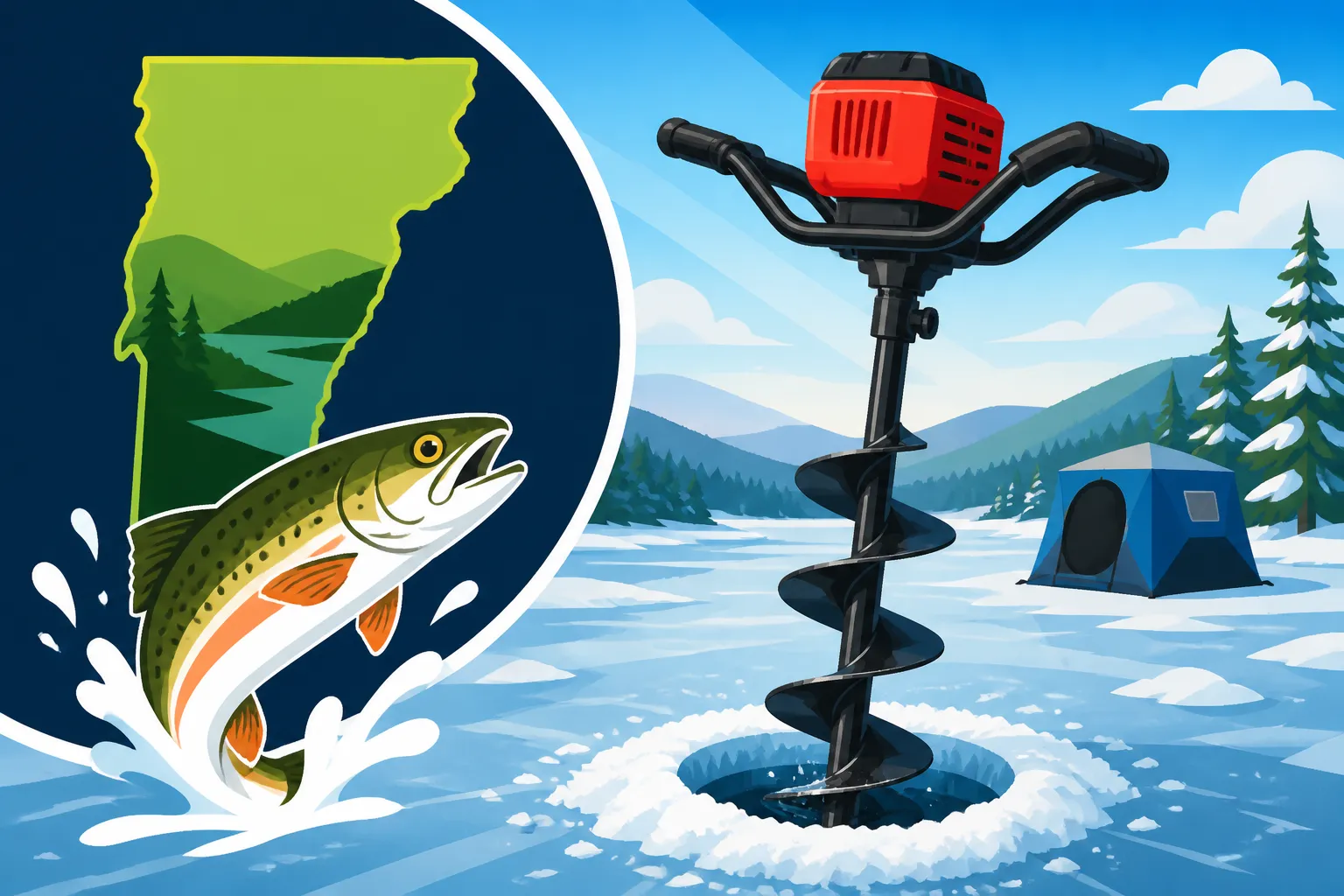
When you need to punch through serious ice with authority, the traditional gas-powered auger (or its cleaner cousin, the propane auger) has long been the go-to choice. These robust machines feature a small internal combustion engine that spins the auger bit, making quick work of even the thickest ice. They are the workhorses of the ice fishing world, designed for serious anglers who need to drill many holes, quickly, regardless of ice conditions. If you're gearing up for the heart of Vermont ice fishing season dates when ice can be at its maximum thickness, a powered auger will be your best friend. Brands like Eskimo and Jiffy have built their reputations on these powerful units.
The primary advantage of these augers is their raw power and speed. They can cut through feet of ice in seconds, allowing you to efficiently set up a spread of tip-ups or quickly move from spot to spot in search of active fish. They handle dirty ice, refrozen slush, and extreme thickness without breaking a sweat, making them indispensable for tackling the expansive waters of Lake Champlain or other large Vermont lakes where ice can be unpredictable. For guiding services or large groups, the sheer efficiency of a gas or propane auger is often unmatched.
However, this power comes with a trade-off. Gas and propane augers are significantly heavier than hand or electric models, making them cumbersome to carry, especially if you're walking any considerable distance. Gas models require a fuel mix, which can be messy to handle, emit strong fumes, and are notoriously loud, disrupting the peaceful winter ambiance. Both types can also be finicky to start in extreme cold, sometimes requiring multiple pulls and adjustments, which is frustrating with numb fingers. Propane augers offer a cleaner burn and easier starting, but propane tanks can be bulky and are not always as readily available as gasoline. Additionally, maintenance on these engines is more involved than with manual or electric options, and the initial cost is generally higher than a hand auger.
Electric (Battery-Powered) Augers: The Modern Angler's Friend
The rise of powerful lithium-ion battery technology has revolutionized the ice fishing world, bringing us the electric auger. These units feature a dedicated electric motor powered by a rechargeable battery, offering a compelling blend of power, convenience, and environmental friendliness. Electric augers have rapidly gained popularity among Vermont anglers looking for a quieter, cleaner alternative to gas models, especially those who frequently fish Best Ice Fishing Lakes in Vermont and appreciate being able to move around stealthily. Brands like Ion and StrikeMaster are leading the charge in this segment.
The benefits of electric augers are quite appealing. They are incredibly quiet, allowing for stealthy approaches to fishing spots and enabling you to hear bites or communicate with fishing buddies without shouting over an engine. There are no fumes, no messy fuel to mix, and they start instantly with the push of a button, even in bitter cold. They are also generally lighter than gas augers, making them easier to transport, though still heavier than most hand augers. They offer ample power to cut through significant ice thickness, often handling 18-24 inches of solid ice with ease, and are perfectly capable of drilling dozens of holes on a single charge. Many anglers find the experience of using an electric auger far more pleasant than a noisy, smelly gas unit.
However, electric augers do come with their own set of considerations. The most common concern is battery life, especially in extreme cold, which can significantly reduce runtime. While modern batteries are robust, carrying a spare battery (which adds to the cost and weight) is often a wise move for a full day of fishing or when planning to drill many holes. The initial investment for a high-quality electric auger can also be substantial, often comparable to or even exceeding the cost of a gas auger. While they are powerful, some truly extreme ice conditions or the need to drill hundreds of holes might still push them to their limits, where a gas auger might offer a slight edge in sustained brute force. You also need access to power to recharge your batteries, which requires some planning.
Drill Attachment Augers: Combining Power and Versatility
A more recent innovation that has taken the ice fishing world by storm is the drill attachment auger. This clever setup ditches the dedicated motor in favor of using a powerful, heavy-duty cordless electric drill as the power source. You simply attach a specially designed auger bit directly to the chuck of your drill, transforming your everyday power tool into an ice-cutting machine. This option has become a favorite for its incredible portability and versatility, often seen on the backs of anglers walking onto the ice or tucked into sleds for quick deployment.
The pros of drill attachment augers are significant. First and foremost, they are incredibly lightweight and compact, as you’re only carrying the auger bit itself, plus your drill. This makes them ideal for highly mobile anglers who cover a lot of ground. If you already own a powerful cordless drill (we’re talking 18V or higher, with plenty of torque), the cost of entry is often lower than a dedicated electric auger, as you’re just buying the attachment. They are also very quiet, similar to electric augers, and offer instant, fume-free starting. Many anglers find them perfect for quick scouting missions or when fishing with just a few holes. Brands like Eskimo with their Pistol Bit or the various options from Ion (like the G2 or R1 with an adapter) have made this style of auger incredibly popular.
However, there are important caveats to consider. The performance of a drill attachment auger is entirely dependent on the quality and power of your cordless drill. A weaker drill will struggle, overheat, or simply fail to cut through thicker ice. You'll need a robust drill with a high Amp-hour (Ah) battery and, ideally, a brushless motor for optimal performance and battery life. Battery life is directly tied to your drill's battery, so having multiple high-capacity batteries is crucial for a full day of fishing. There’s also the risk of damaging your drill if it's not designed for the sustained torque demands of ice drilling, potentially voiding its warranty. While excellent for moderate ice and casual use, they might not be the best choice for consistently tackling very thick ice (over 2 feet) or drilling a huge number of holes in a single session, as your drill might overheat or drain batteries too quickly.
Key Features to Consider When Buying an Ice Auger for Vermont
Choosing the right ice auger isn't just about picking a type; it's about delving into the specific features that will make your time on Vermont's frozen lakes more enjoyable and productive. From the cut of the blade to the battery life in sub-zero temperatures, every detail matters. Ignoring these features can lead to buyer's remorse and a frustrating day on the ice.
Auger Bit Diameter and Blade Type
We’ve touched on this before, but the auger bit's diameter is foundational. For panfish and trout in smaller ponds, a 6-inch diameter is speedy and efficient. Move up to an 8-inch for a fantastic all-around option that handles most species from walleye to average pike and even sizable lake trout, providing a good balance between ease of drilling and hole size. For true trophy hunters on big waters like Lake Champlain or Lake Memphremagog, where landing a large northern pike or lake trout is the goal, a 10-inch auger provides the necessary clearance. Remember, increasing diameter dramatically increases the amount of ice you need to cut, meaning more power and effort are required.
Beyond diameter, the type of blade system is critical for cutting efficiency. There are generally two main styles: chipper blades and shaving blades. Chipper blades, often found on older gas augers, are designed to chip away at the ice. They tend to be very robust and excel at cutting through "dirty" or refrozen ice that might contain gravel or debris. They can be a bit slower but are incredibly durable. Shaving blades, often found on hand augers and most electric augers, are designed to slice or shave through the ice, creating a very clean, fast cut. These are generally much more efficient on clean, solid ice but can be more susceptible to damage if they hit rocks or hard debris.
No matter the type, blade sharpness is paramount. A dull auger is effectively useless. Look for models with easily replaceable blades, or blades that can be sharpened. Some anglers keep spare blades on hand, especially if they fish frequently or in areas where striking underwater objects is a possibility. The convenience of quickly swapping out a dull set of blades for razor-sharp ones can save your fishing day.
Weight, Portability, and Ease of Transport
When you're bundling up for a day of ice fishing in Vermont, every piece of gear contributes to your total load. Your auger's weight and how easy it is to transport should be a major consideration, especially if you plan to move around a lot or access remote spots.
Think about your usual mode of travel on the ice. Are you hiking a mile or two across a frozen lake, pulling a sled behind you? In this scenario, a lightweight hand auger or a drill attachment auger can be a godsend. These can often be carried with minimal effort, allowing you to cover more ground and conserve energy for actually fishing. If you're comparing larger powered augers, even a few pounds difference can feel substantial after a long walk. Check out options available at a local Bass Pro Shops, or consider browsing online at Amazon for lighter models.
If you typically use a snowmobile or ATV, or have vehicle access to your fishing grounds (like many have on the larger bays of Lake Champlain during peak season), then the weight of the auger becomes less of an issue. Here, you might prioritize power and speed over ultra-light portability.
Also, consider the physical dimensions and ease of breakdown. Some augers have collapsible shafts or two-piece designs that make them more compact for transport in a car trunk or on a snowmobile. Carrying cases or covers can also protect your auger (and your vehicle) during transport. If you plan to carry your auger on your back for an extended period, looking into lightweight options and potentially a dedicated carrying harness or backpack might be beneficial. This aspect of the auger often ties into other essential equipment, like what's discussed in Best Ice Fishing Gear for Vermont.
Power Source and Fuel/Battery Management
The heart of any powered auger is its power source, and understanding the nuances of gas, propane, electric, and drill attachments is key to making an informed decision for Vermont's varying conditions.
For traditional gas augers, the power is undeniable, but so is the need for careful fuel management. You'll need to carry a mixed gasoline and oil fuel blend, which can be messy and requires specific storage. Cold starts can be a challenge, sometimes requiring multiple pulls and priming, which can be frustrating with cold hands. Proper maintenance, like spark plug checks and fuel filter replacements, is also essential for reliable operation.
Propane augers offer a cleaner alternative to gas. They typically start more easily in the cold and produce no fumes, making them more pleasant to use in a shanty or tent. The downside is carrying propane tanks, which can be bulky, and ensuring you have enough spare tanks for extended trips. While propane is generally readily available, it’s worth noting that it’s not as ubiquitous as gasoline.
Electric augers are the epitome of convenience with their instant, push-button start and silent operation. However, battery management is paramount. Consider the Amp-hour (Ah) rating of the battery – higher Ah means longer run time. Cold weather significantly impacts battery performance, reducing its effective capacity, so many anglers carry a spare battery, especially for full days or multi-day trips. Look for augers with robust, cold-weather-rated batteries. Charging solutions are also important; some batteries charge faster than others, and having a car charger can be a huge convenience. The type of motor (brushed vs. brushless) also affects efficiency and battery life, with brushless motors generally being more efficient and durable.
For drill attachment augers, the power source is your cordless drill's battery. This means you need high-capacity (e.g., 6 Ah or more) 18V or 20V lithium-ion batteries. Consider a brushless drill for maximum torque and efficiency. Many anglers carry two or more fully charged batteries to ensure they don't run out of juice mid-day, especially when drilling 8-inch or larger holes in thick ice.
Top Recommendations for Different Vermont Angler Profiles
There’s no single “best” ice auger for everyone in Vermont, because every angler has a different style, different goals, and different preferences for comfort and convenience on the ice. What's perfect for a weekend warrior chasing panfish might be completely inadequate for a serious trophy hunter. Let's explore some top recommendations tailored to various types of Vermont ice fishing enthusiasts.
For the Lightweight, Mobile Angler
If your idea of a perfect ice fishing day involves covering a lot of ground, poking numerous holes to locate active fish, or accessing remote spots that require a good hike, then weight and ease of transport are your absolute top priorities. You want something that won't wear you out before you even wet a line.
A classic hand auger, such as a StrikeMaster Mora or an Eskimo Hand Auger, is an excellent choice here. These are incredibly lightweight, often weighing under 10 pounds, and require no fuel or batteries. They’re perfect for punching 6-inch or 8-inch holes in moderate ice, especially during early or late season. If you're heading to a high-elevation pond for brook trout, or a small, stocked lake under Vermont Trout Season and Stocking Rules, a hand auger allows you to move stealthily and quickly without disturbing the quiet of the wilderness. They are also incredibly reliable and require minimal maintenance, making them a worry-free option for those who prioritize simplicity.
Another increasingly popular and highly effective option for the mobile angler is a drill attachment auger. Combining a quality, high-torque cordless drill with a specialized auger bit, like the Eskimo Pistol Bit or an Ion G2/R1 with a conversion kit, creates a surprisingly powerful and incredibly lightweight setup. The auger bit itself is often just a few pounds, and your drill typically weighs less than 5 pounds. This means you can easily carry the entire system in a backpack, quickly drill holes, and then move on. It’s quiet, clean, and extremely efficient for drilling numerous holes up to 8 inches in diameter through most Vermont ice conditions. Just remember to pack extra high-capacity batteries for your drill, especially on colder days.
These lightweight options allow you to embrace the joy of covering ground, exploring new spots, and responding quickly to changing fish patterns without being bogged down by heavy, cumbersome gear.
For the All-Around Vermont Ice Fisherman
Many Vermont ice anglers fall into this category: they fish regularly, pursue a variety of species, and want a balance of power, convenience, and manageable weight. They might hit a small pond one weekend and a larger lake the next, and they need an auger that can handle most situations without being overkill or underpowered.
For this versatile angler, a quality electric (battery-powered) auger is often the sweet spot. Models like the Ion G2 or a StrikeMaster Lithium 40v offer excellent power, easily cutting through a foot or two of ice with 8-inch or 10-inch bits. They are dramatically quieter and cleaner than gas augers, providing instant starts and no fumes, which is a huge benefit if you spend time in an ice shanty. While heavier than hand augers or drill attachments, they are generally lighter and less cumbersome than full-sized gas units, making them more manageable for moderate walks or transport via sled or snowmobile. They strike an ideal balance, providing plenty of juice for multiple holes throughout the day on most of Vermont's varied waters.
If the thought of battery anxiety still gives you pause, or if you prefer the sheer reliability of a fuel-powered engine without the mess of mixed gas, a propane auger could be a fantastic alternative. Units such as the Jiffy Pro4 or an Eskimo Propane Auger provide robust cutting power, rivaling that of gas augers, but with the added benefits of easier starting in the cold and a cleaner, fume-free burn. They are a bit heavier than electric augers but still a viable option for those who want consistent power for 8-inch or 10-inch holes and don't mind carrying a propane tank. They offer a great middle ground for anglers who want more grunt than an electric but desire a cleaner experience than traditional gas.
These all-around options are incredibly popular because they address the needs of a broad spectrum of ice anglers, making them reliable companions for exploring Vermont's diverse frozen fisheries.
For the Serious Angler Chasing Big Fish or Many Holes
Then there are the dedicated, hardcore ice anglers in Vermont. These are the folks who are out every chance they get, often in the coldest weather, chasing trophy species, participating in tournaments, or guiding others. They might be drilling dozens, even hundreds, of holes in a single day, or punching massive 10-inch holes through feet of ice to pull up giant lake trout, northern pike, or muskellunge. For them, raw power, speed, and unwavering reliability are paramount, and they're willing to accept the trade-offs of weight and noise.
For this angler, a heavy-duty gas auger is often still the king. Models like the Jiffy Legend or an Eskimo Mako/Barracuda are built for extreme conditions. They deliver unmatched torque and cutting speed, easily chewing through 10-inch holes in even the deepest, dirtiest ice Vermont can throw at them. When you’re fishing an expansive area like Lake Champlain, where you might be moving a lot of tip-ups around, or if you’re fishing for big game like those found in the Lake Champlain Ice Fishing Village Guide, the sheer cutting capacity of a gas auger is often a necessity. These augers are also favored by professional guides who need their equipment to perform flawlessly, day after day, under demanding conditions.
While these augers are undoubtedly the heaviest, noisiest, and most maintenance-intensive option, their ability to consistently and quickly cut through any ice situation makes them indispensable for specific, high-demand scenarios. The fumes, the weight, and the loud roar become acceptable sacrifices for the assurance of being able to drill any hole, anywhere, anytime. For the angler whose season depends on brute-force efficiency, a robust gas auger often remains the top choice, ensuring they can tackle the biggest fish and the toughest ice without hesitation.
Here's a quick comparison of the auger types to help you visualize the trade-offs:
| Auger Type | Power Source | Pros | Cons | Ideal for Vermont Angler |
|---|---|---|---|---|
| Hand Auger | Manual | Lightweight, quiet, affordable, simple, no fuel/batteries | Fatiguing on thick ice, slow, small holes only | Early/late ice, panfish, short trips, tight budget, quiet spots |
| Drill Attachment | Cordless Drill | Very portable, uses existing gear, quiet, compact | Requires powerful drill, drill battery limits, can overheat drill | Mobile anglers, moderate ice, 6-8 inch holes, quick scouting |
| Electric (Battery) | Battery | Quiet, clean, instant start, decent power, no fumes | Battery life anxiety, higher initial cost, cold affects battery performance | All-around use, good for 8-10 inch holes, most lakes, regular use |
| Propane | Propane | Powerful, cleaner than gas, reliable start, less fumes | Heavier, noisy, fuel costs, propane tanks bulky | Regular use, thick ice, 8-10 inch holes, desire for cleaner fuel |
| Gas | Gasoline | Max power, fastest, cuts any ice, ultimate reliability | Heavy, noisy, smelly, fuel mix, cold starts, more maintenance | Heavy duty, big fish, many holes, extreme conditions, guides |
In conclusion, selecting the best ice auger for your Vermont adventures truly boils down to an honest assessment of your personal fishing style, the specific waters you frequent, and your budget. There isn't a single "perfect" auger for everyone, but by considering the factors of ice conditions, target species, portability needs, and power source, you can confidently choose the right tool for your next outing. Whether you prefer the quiet solitude of a hand auger on a small pond or the roaring power of a gas auger on Lake Champlain, having the right equipment ensures that your focus remains on the fish, and not on the struggle to get your line in the water. Remember to check out local sporting goods stores like Bass Pro Shops or browse online retailers like Amazon to compare features and find the best fit for your needs.
Disclaimer
This article is for general informational purposes only and does not constitute professional advice. Laws, prices and regulations vary by location and change over time. Consult a qualified professional for guidance on your specific situation.