Best kayak cart for portaging between ponds
There’s nothing quite like the feeling of discovering a secluded pond in Vermont, one that maybe isn't accessible by car, but the sheer thought of lugging your kayak across varied terrain can be enough to make you stick to the easier-to-reach spots. This often means missing out on incredible fishing opportunities. This guide is all about changing that, showing you how a good kayak cart can unlock a whole new world of serene, unpressured waters in the Green Mountain State.
Why a Kayak Cart is a Game-Changer for Vermont Anglers
Let's be honest, kayaking is fantastic, but the "getting to the water" part can be a real workout, especially when you're trying to reach those hidden gems that aren't right next to a paved parking lot. In Vermont, with our mix of rugged mountains, rolling hills, and countless ponds nestled away, a kayak cart isn't just a convenience; it's often a necessity for true exploration. It transforms what could be a back-breaking chore into an enjoyable part of your fishing adventure, letting you access spots you once only dreamed of.
The Reality of Multi-Pond Adventures in Vermont
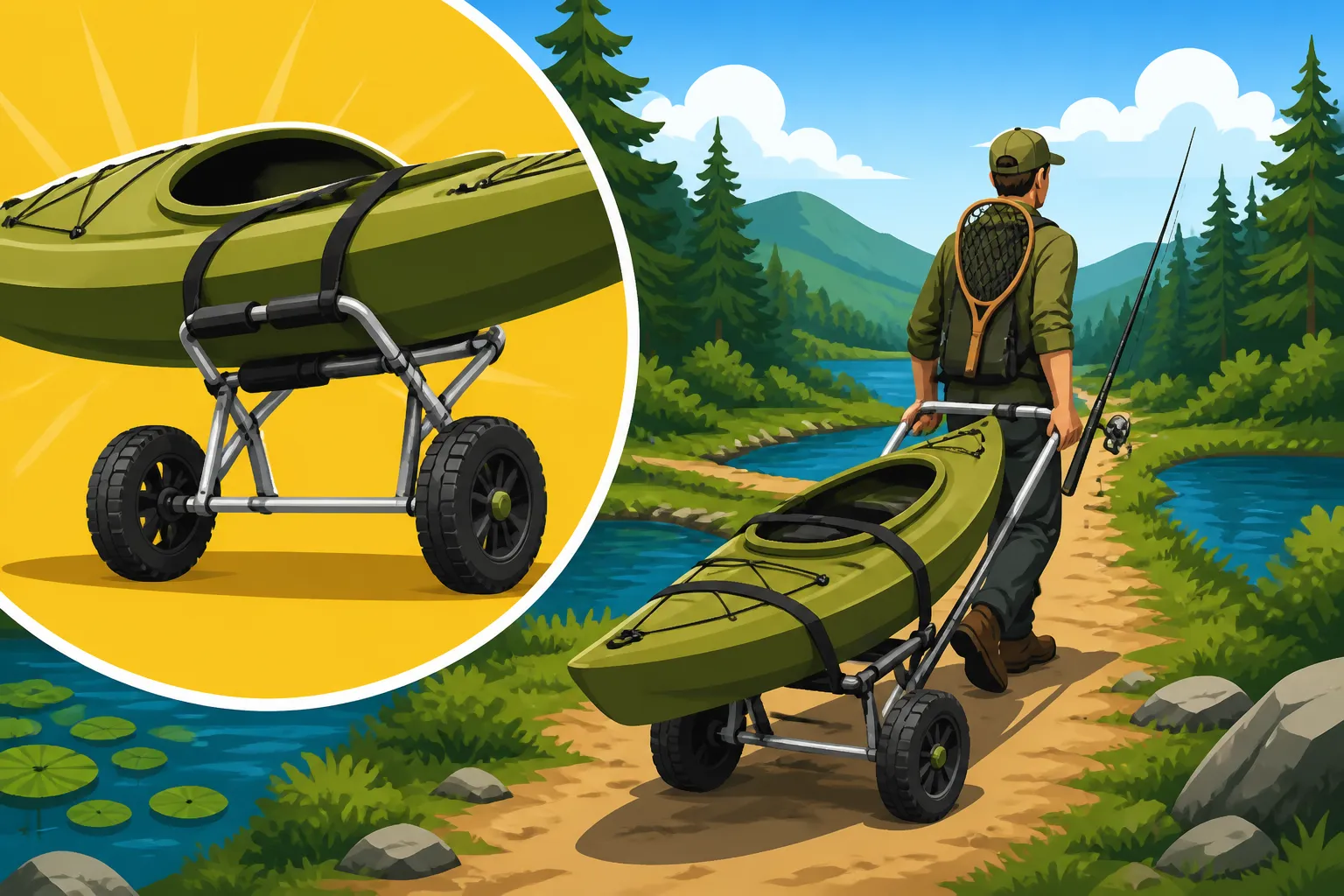
Picture this: you've fished your favorite local lake dozens of times, but there's a smaller, pristine pond just over a rise, connected by a faint deer trail, promising untouched waters. Without a kayak cart, that pond remains a distant fantasy, too far and too difficult to carry your boat. Vermont's landscape is dotted with these kinds of opportunities – small, isolated bodies of water that hold healthy fish populations simply because they're harder to reach. A sturdy cart lets you pack up your gear, load your kayak, and trek that quarter-mile or even a mile through varied terrain, from grassy fields to rocky paths, making those multi-pond adventures a real possibility.
These aren't just hypothetical scenarios; I've personally seen anglers bypass incredible fishing because the portage was too intimidating. From a small forest pond in the Northeast Kingdom to a mountain lake in the Green Mountains, the best spots often require a bit of effort to reach. A well-chosen kayak cart minimizes that physical barrier, opening up vast tracts of public land and wild waters. It allows you to focus on the fishing, not on the arduous journey to get there.
Protecting Your Back and Your Boat
Kayaks, even the lighter recreational models, can be surprisingly heavy and awkward to carry, especially solo. Trying to shoulder a 60-pound fishing kayak, along with your tackle box, rods, and cooler, for any significant distance is a recipe for a sore back, strained muscles, and potentially dropping or damaging your precious boat. A kayak cart takes the vast majority of that weight off your body, distributing it evenly and allowing you to simply pull your vessel like a wagon. This significantly reduces the risk of injury, letting you save your strength for paddling and fighting fish.
Beyond protecting your own well-being, a cart also protects your investment. Dragging a kayak across gravel, dirt, or asphalt can cause abrasive damage to the hull, leading to scratches, gouges, and premature wear. Over time, this kind of damage can compromise the integrity of your kayak. A cart lifts the hull off the ground, safeguarding it from abrasive surfaces and sharp objects, ensuring your kayak stays in prime condition for many seasons of use. Think of it as a small insurance policy for your most important piece of fishing gear.
Expanding Your Fishing Horizons Beyond Launch Sites
Many of the most popular fishing spots in Vermont have designated boat launches, but these often concentrate anglers in certain areas, leading to more pressured fish. The true magic happens when you can access waters beyond these conventional entry points. A kayak cart gives you the freedom to explore miles of shoreline, launch from less-traveled access points, or even move between interconnected waterways that might have small land barriers. This means reaching coves, backwaters, and smaller ponds that larger boats can't, or simply won't, bother with.
Consider a scenario where you're fishing a large lake, and the bite slows down. Instead of calling it a day, a kayak cart allows you to easily pull your boat out, walk it a short distance to an adjacent, smaller pond, and continue your adventure. This flexibility can make the difference between an average day and an unforgettable one. It's about breaking free from the limitations of traditional access and truly embracing the wild fishing opportunities Vermont has to offer. You might discover some incredible Best remote backcountry trout ponds in Vermont or Best trout ponds accessible by short hike that few others bother with.
Key Features to Look for in a Kayak Cart for Portaging
Choosing the right kayak cart isn't a "one size fits all" situation. The best cart for you will depend heavily on the type of kayak you own, the terrain you typically navigate, and how far you plan to portage. There are several crucial features to consider to ensure you get a cart that truly serves your needs, rather than becoming another piece of forgotten gear in your garage. Let's break down what really matters.
Wheel Type and Terrain Suitability
The wheels are arguably the most critical component of any kayak cart, as they dictate where and how easily you can transport your boat. Different wheel types excel on different surfaces:
- Pneumatic (Air-Filled) Wheels: These are like small bicycle tires. They offer excellent shock absorption, making them ideal for rough, rocky, or uneven trails. They also perform well on soft sand and gravel by deflating slightly to create a wider footprint, which prevents sinking. The downside is they can go flat, so carrying a small pump or patch kit isn't a bad idea. For many of Vermont's varied trails, from the dirt paths around Lake Willoughby to the stony tracks leading to a remote pond, pneumatic wheels are often the best choice.
- Solid Rubber (Puncture-Proof) Wheels: These wheels are generally narrower and harder. They excel on paved surfaces, hard-packed dirt, and grassy areas. They are completely maintenance-free and you'll never have to worry about a flat. However, their rigidity means they offer less shock absorption on rough ground and can struggle on very soft surfaces, potentially sinking into sand or mud. If your portages are mostly short and on well-maintained paths, these are a solid, no-fuss option.
- Balloon/Beach Wheels: These are oversized, low-pressure pneumatic wheels designed specifically for soft sand. Their massive footprint makes them incredibly effective on beaches where other wheels would simply sink. While not as common for typical "portaging between ponds" in Vermont, if your fishing takes you to extensive sandy shores on a larger body of water like Lake Champlain, these are invaluable. They can be a bit cumbersome on narrower trails, though.
When considering the terrain, think about the most challenging conditions you expect to encounter. If you're hoping to reach those pristine Green Mountain ponds, a cart with robust pneumatic wheels will serve you far better than one designed for a smooth beach walk.
| Wheel Type | Best Terrain | Pros | Cons |
|---|---|---|---|
| Pneumatic (Air-Filled) | Rough, rocky, uneven, gravel, soft sand | Excellent shock absorption, handles varied terrain, less sinking on soft ground | Can go flat, requires maintenance |
| Solid Rubber | Paved, hard-packed dirt, grass | Puncture-proof, maintenance-free, durable | Poor shock absorption, struggles on soft/rough terrain |
| Balloon/Beach | Very soft sand, wide-open beaches | Exceptional floatation on sand | Bulky, less ideal for narrow/rough trails |
Frame Construction and Durability
The frame of your kayak cart needs to be sturdy enough to handle the weight of your kayak and gear, endure the bumps and scrapes of the trail, and resist the corrosive effects of water exposure. Most quality kayak carts are made from marine-grade aluminum or reinforced plastic (polypropylene).
- Aluminum Frames: These are generally lighter and very strong. Marine-grade aluminum is highly resistant to corrosion, making it perfect for use around freshwater or even brackish waters if you ever venture outside Vermont. Look for carts with welded joints rather than bolted ones for superior strength, though good bolted designs can also be very robust. An aluminum frame cart like some found on Bass Pro Shops or Amazon can offer a great balance of weight and durability.
- Reinforced Plastic Frames: These are often more affordable and also highly resistant to corrosion. Modern plastics can be surprisingly strong and durable, especially when reinforced at stress points. They tend to be a bit bulkier than aluminum frames but can be a good option for those on a tighter budget or for kayaks that aren't excessively heavy.
Beyond the material, consider the load capacity. Check the manufacturer's specifications to ensure the cart can comfortably handle the weight of your fully loaded kayak. Remember to factor in your cooler, tackle box, and other essentials. Also, look at the overall design—a wider stance generally offers more stability, which is important when navigating uneven ground or side slopes.
Securing Your Kayak: Straps and Supports
Once you've got the right frame and wheels, the next challenge is making sure your kayak stays put on the cart, especially over bumpy terrain. A cart with a good cradle system and robust securing straps is crucial.
- Cradle Design: Many carts feature V-shaped cradles or adjustable bunks that conform to the hull of your kayak, providing stable support. Some have rubber padding to protect the hull from scratches. Self-centering designs can make loading much easier, especially when you're by yourself. For fishing kayaks, which often have unique hull shapes or scupper holes, look for carts that are specifically designed to accommodate these features. Scupper carts, for instance, insert posts directly into the scupper holes, offering a very secure and stable carry, but they only work for kayaks with suitable scupper hole placement and size.
- Securing Straps: Cam buckle straps are common and effective. Look for straps that are long enough to wrap securely around your kayak and the cart frame, even if your kayak is wider or taller than average. Quick-release buckles are a nice touch for ease of use. Bungee cords are generally not recommended as the primary securing method for portaging, as they can stretch and allow the kayak to shift, leading to instability or even the boat falling off. For serious portaging, you want a tight, non-stretching hold.
I've had my kayak slip off a poorly secured cart more times than I care to admit, usually at the most inconvenient moment. It's frustrating and can damage your gear. So, take the time to ensure the securing mechanism is robust and user-friendly.
Portability and Storage When Not in Use
After you've successfully portaged your kayak to the water, you don't want a bulky cart getting in the way or taking up valuable space in your kayak. This is where portability and storage become key features.
- Folding Design: Most good kayak carts for portaging are designed to fold down. Look for quick-release pins or hinges that allow the wheels and frame to collapse into a compact package. This makes it easy to stow the cart inside the hull of a larger fishing kayak, strap it to the deck, or even fit it into a backpack if you have a smaller, more minimalist cart.
- Weight: A lightweight cart is easier to carry when it's not under the kayak. While durability is paramount, a cart that's unnecessarily heavy will negate some of the back-saving benefits. Aluminum frames generally win here, offering a good strength-to-weight ratio.
- Assembly/Disassembly: How easy is it to put together and take apart? If you're constantly on the go, a cart that can be deployed or packed up in under a minute is a huge time-saver. Some carts feature tool-free assembly, which is incredibly convenient when you're out in the field.
Think about how you'll manage the cart once you're on the water. Will it fit in your kayak? Can you attach it securely to the outside without interfering with your paddling or fishing? Many anglers carry a dry bag specifically for gear like this, which can also hold a Best dry box for phone and keys on the water. A truly portable cart seamlessly integrates into your fishing routine, rather than becoming an additional hassle.
Choosing the Right Kayak Cart for Different Vermont Scenarios
Vermont's fishing opportunities are incredibly diverse, from the expansive waters of Lake Champlain to countless small, secluded ponds and winding rivers. The "best" kayak cart isn't just about features; it's about matching the cart to the specific demands of your angling adventures. What works perfectly for a quick dash across a paved path will fall short on a rugged, root-filled forest trail.
For Short, Smooth Trails and Paved Paths
If your portages are typically short, on relatively smooth surfaces like paved roads, groomed park paths, or hard-packed dirt trails, you have a lot of flexibility in your cart choice. These scenarios don't demand extreme durability or specialized wheels, making them the most forgiving.
For these situations, a basic, lighter-weight cart with solid rubber wheels is often sufficient and highly convenient. These carts are usually very easy to set up and break down, and their puncture-proof wheels mean you never have to worry about flats. They're excellent for moving your kayak from a parking area to a nearby boat launch or crossing a small section of land between adjacent, easily accessible ponds. You might be launching your Best kayak for Lake Champlain at a busy public access point and need to get it from your car to the water, where a simple cart can make that short but potentially crowded journey much smoother. Many popular models available on platforms like Amazon will fit this bill, offering a good balance of cost and utility. The key here is simplicity and ease of use, as the terrain itself isn't presenting major obstacles.
For Rugged Backcountry and Forest Trails
Now, if your ambition is to explore those truly wild, off-the-beaten-path ponds and streams in the heart of Vermont's wilderness, where trails are unmaintained, rocky, muddy, or crisscrossed with roots, you'll need a much more robust and specialized kayak cart. This is where a budget cart will quickly fail you, leading to frustration and potential damage to your gear.
For rugged backcountry and forest trails, a cart with large, heavy-duty pneumatic (air-filled) wheels is essential. These wheels absorb shocks, roll over obstacles more easily, and can be slightly deflated to gain better traction and floatation on soft ground. Look for a cart with a sturdy, possibly wider, aluminum frame for stability and corrosion resistance. Designs that offer a lower center of gravity or a "kickstand" feature can be helpful for stability when loading your kayak on uneven ground. Consider carts with a more secure, perhaps scupper-based, attachment system if your kayak allows for it, as the kayak will be jostling a lot more. Investing in a high-quality cart for these adventures is critical. You don't want to be halfway to a remote pond, only for your cart wheel to buckle or your kayak to tumble off repeatedly. When planning a trip to a challenging spot, remember that your cart is as important as your Best Gear for Vermont Trout Fishing.
For Solo Anglers vs. Tandem Kayaks
The size and weight of your kayak—and whether you're handling it solo or with a partner—also play a significant role in cart selection.
- Solo Anglers: If you're typically heading out alone with a single fishing kayak, ease of loading and maneuverability are paramount. Look for a cart that is lightweight enough for you to manage easily, and one that features a design that allows for self-centering or very quick attachment. A cart with a stable kickstand is a huge bonus, as it frees your hands to position the kayak without it tipping over. A smaller, more compact cart that can be stowed inside your kayak or lashed to the deck (perhaps with a Best kayak anchor trolley system for convenience) is ideal. The goal is to minimize hassle when you're the only one doing the heavy lifting.
- Tandem Kayaks or Heavy Fishing Rigs: If you're hauling a larger, heavier tandem kayak, or a fully loaded fishing kayak with a trolling motor, multiple rod holders, and all the accoutrements, you'll need a cart built for serious payload. These carts typically feature larger, more robust wheels, a wider wheelbase for stability, and a higher weight capacity. While a tandem kayak might mean you have two people to push or pull, a sturdy cart still makes the journey significantly easier and safer for your equipment. Some heavier-duty carts might even have two sets of wheels or a more extended frame to better support longer boats. Always double-check the weight rating against your kayak's wet weight (boat + all gear). For these larger setups, a cart that offers superior support and secure strapping is non-negotiable, ensuring that your valuable equipment remains safe during transit.
Choosing the right cart for your specific kayak and fishing style ensures that it enhances your experience rather than becoming an additional burden.
Tips for Effective Kayak Cart Use and Maintenance
Having the right kayak cart is just the first step. Knowing how to use it effectively and keep it in top condition will ensure it remains a reliable companion on countless Vermont fishing trips. Proper technique can prevent frustration on the trail, and a little maintenance goes a long way in extending its lifespan.
Proper Loading and Securing Techniques
Getting your kayak onto the cart and keeping it there securely is crucial, especially when you're often working solo or dealing with uneven terrain. A few simple steps can make all the difference:
First, always place the cart on a relatively flat and stable surface. If you have a cart with a kickstand, deploy it. Position your kayak over the cart's cradle or scupper posts, aiming for the center of balance. This is typically just behind the cockpit or slightly forward of the stern, depending on your kayak's design and how it's loaded with gear. If your kayak feels front-heavy or tail-heavy, adjust its position until the weight feels evenly distributed over the wheels. A well-balanced kayak is much easier to pull and less likely to tip.
Once positioned, use the provided cam buckle straps to cinch your kayak tightly to the cart frame. Loop the strap over the kayak, under the cart frame, and back over the kayak, securing it firmly. Ensure there's no slack. For longer or heavier kayaks, it's often a good idea to use two straps for extra security, especially if you're traversing rough ground. I always give my kayak a good shake after strapping it down; if it wiggles independently of the cart, it's not secure enough. Don't be tempted to use bungee cords as your primary securing method; while they can help hold accessories, they lack the rigidity needed to truly stabilize your kayak for portaging.
Navigating Tricky Terrain with Your Cart
Vermont's trails can present all sorts of challenges – steep inclines, muddy sections, rocky patches, and dense woods. Knowing how to handle your cart in these situations can prevent a lot of headaches.
When encountering inclines, lean into the pull and take short, deliberate steps. If the incline is very steep, it might be safer to partially unload some heavier gear (like your cooler or tackle box) and carry it separately, then re-load once you've pulled the kayak up. For muddy or soft ground, if your cart has pneumatic wheels, slightly deflating them can increase the contact patch and prevent sinking. Walk slowly and deliberately, keeping the kayak as upright as possible. For rocky or root-filled sections, lift the front of the kayak slightly to help the wheels roll over obstacles rather than getting stuck. A wading staff, typically used for stream fishing, can actually be a fantastic third point of contact here, helping you maintain balance as you navigate. Remember, slow and steady wins the race when portaging across challenging terrain. It's not a sprint; it's about safely getting your valuable equipment to the water.
Essential Maintenance for Longevity
A little care for your kayak cart will ensure it lasts for many years of adventurous fishing. After each outing, especially if it's been exposed to mud, sand, or saltwater (if you ever take it on coastal trips), take a few minutes to clean it.
Rinse off any dirt, sand, or grit with fresh water. Pay particular attention to the wheel axles and any moving parts or hinges. Sand and salt are particularly abrasive and corrosive, so a thorough rinse is key. If your cart has pneumatic tires, check their pressure regularly. Proper inflation (or slight deflation for specific terrains) is crucial for performance and preventing flats. Inspect the frame for any signs of bending, cracks, or corrosion. Check the straps for fraying or damage and replace them if necessary. Lubricating moving parts like axle connections or folding mechanisms with a marine-grade lubricant can prevent seizing and ensure smooth operation. When storing your cart, keep it in a dry, cool place away from direct sunlight, which can degrade plastics and rubber over time. Just like your fishing rods or your Best Cooler for a Fishing Boat, your kayak cart is an investment that deserves a bit of TLC.
By following these tips, your kayak cart will be a reliable tool that consistently expands your access to Vermont's incredible and often overlooked fishing spots, letting you focus on the joy of the catch.
Disclaimer
This article is for general informational purposes only and does not constitute professional advice. Laws, prices and regulations vary by location and change over time. Consult a qualified professional for guidance on your specific situation.