Best downrigger settings for summer lake trout
There's nothing quite like the thrill of chasing Vermont's magnificent lake trout, especially during the peak of summer. But if you've ever spent hours trolling only to come up empty-handed, you know the frustration. Lake trout in the summer months dive deep, seeking cooler, oxygen-rich waters, and without the right approach, they can feel impossible to reach. This guide is dedicated to demystifying downrigger settings, helping you precisely target these elusive fish and drastically improve your chances for a successful outing on Vermont's beautiful deep lakes.
Understanding Lake Trout Behavior in Summer Vermont Waters
Summertime in Vermont is glorious, but for a lake trout angler, it presents a unique challenge. Unlike spring or fall when these fish might be found closer to the surface, the warm water temperatures of summer push them into specific, deep zones. Understanding this fundamental behavior is the first step to mastering your downrigger settings.
Why Lake Trout Go Deep in Summer
As the sun bakes down on Vermont's larger lakes, the surface waters warm considerably. Lake trout are a cold-water species, built for chilly environments. When the upper layers of the lake heat up, they have no choice but to retreat to the cooler, deeper sections of the water column where temperatures are more to their liking. This phenomenon is known as thermal stratification. The lake develops distinct layers: a warm upper layer (epilimnion), a transition zone with rapidly changing temperatures (thermocline), and a cold, deep layer (hypolimnion). Lake trout will almost always be found in or just below the thermocline, or deeper in the hypolimnion, where temperatures remain consistently cold, typically in the 45-55 degree Fahrenheit range. Finding this thermal sweet spot is absolutely crucial, and it’s where your Best Fish Finders for Vermont Lakes really shine. Without a fish finder, you're essentially fishing blind in a vast underwater world.
This isn't just about comfort; it's about survival. Their metabolism is designed for cold water, and prolonged exposure to warm water can stress them, making them lethargic or even deadly in extreme cases. So, when you're on the water in July or August, don't waste time fishing shallow; assume those lakers are hunkered down, likely in the deepest parts of the lake where they can find their ideal conditions. Knowing this helps you narrow down your search area significantly.
Key Forage and Structure Lake Trout Seek
Even deep, lake trout still need to eat, and they won't just sit in open water waiting for food to come to them. They'll often orient themselves around specific underwater structures or where their primary food sources congregate. In many Vermont lakes, rainbow smelt are a key forage species for lake trout. Smelt also prefer cooler water and often form schools in deeper areas, providing a mobile buffet for hungry lake trout. Your sonar isn't just for finding trout; it's also for finding these baitfish schools. If you locate dense bait balls in the thermocline, you can bet lake trout won't be far behind.
Beyond baitfish, lake trout will relate to underwater structure such as steep drop-offs, sunken islands, humps, and submerged points. These features offer ambush points, shelter from current (if any), and often hold concentrations of bait. For instance, on a big lake like Lake Champlain, understanding How to fish deep structure for summer lake trout becomes paramount. The biggest fish often hang out on these deeper structural elements, sometimes suspended just off the bottom, other times hugging it tightly. Your downrigger allows you to present your lure at the exact depth where these fish and their food sources are holding, rather than just hoping your lure passes by them. Without a downrigger, reaching these precise depths consistently and effectively is nearly impossible.
Essential Downrigger Components and How They Work Together
Okay, so you know why the fish are deep. Now, let's talk about the gear that gets your bait down to them. A downrigger isn't just a crank and a cable; it's a system that works in concert to present your lure effectively.
The Anatomy of a Downrigger Setup
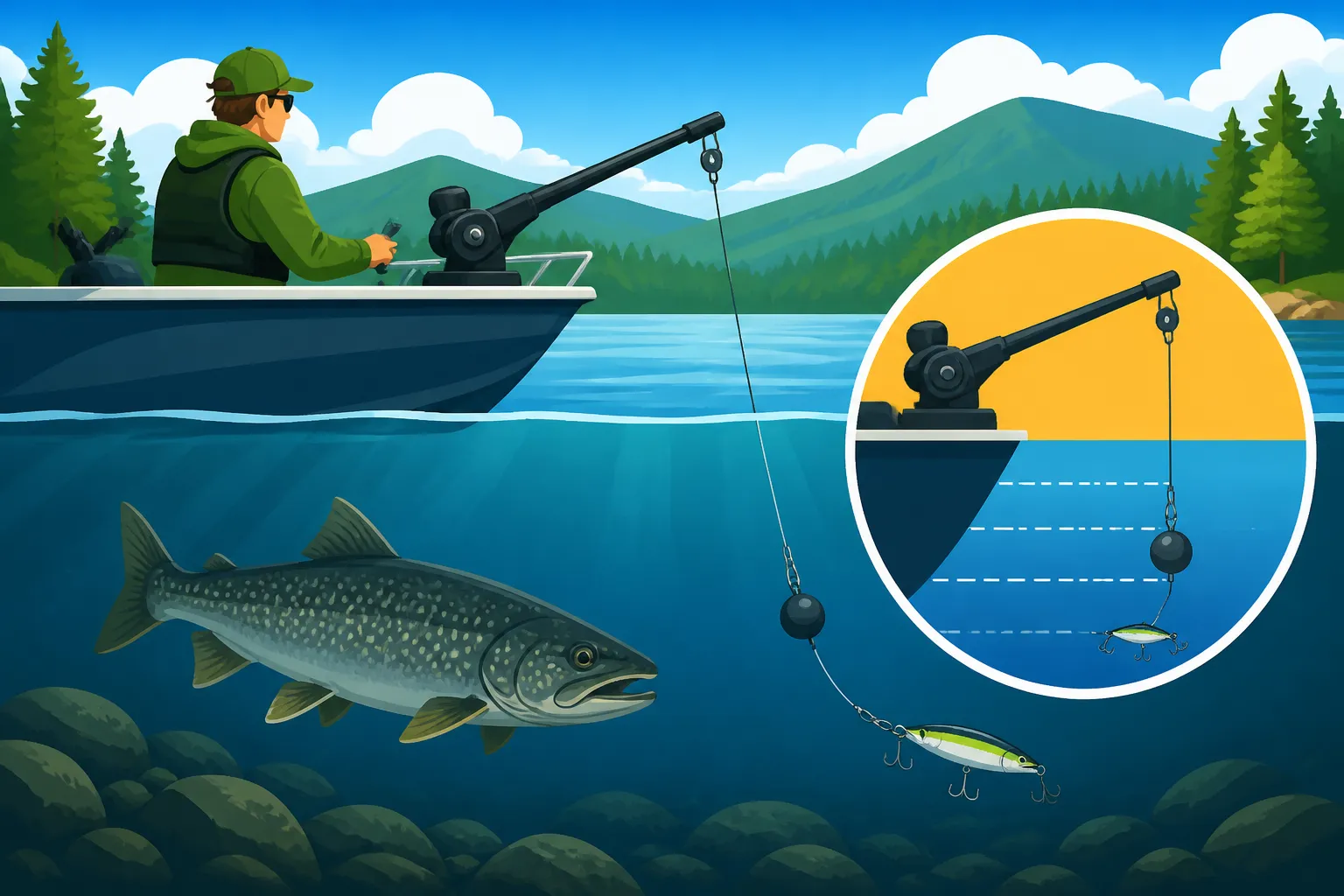
At its core, a downrigger setup consists of several key parts:
- The Downrigger Unit: This is the mechanical arm mounted to your boat. It typically has a crank handle (manual) or an electric motor (electric) to raise and lower the downrigger cable.
- The Downrigger Cable: Usually braided stainless steel or sometimes a heavy-duty braid, this cable spools off the downrigger and holds the weight.
- The Downrigger Weight: A heavy lead ball or torpedo-shaped weight, typically ranging from 6 to 12 pounds, that pulls your line and lure down to the desired depth.
- The Release Clip: This crucial piece attaches your fishing line to the downrigger cable, just above the weight. When a fish strikes, it pulls your line free from the clip, allowing you to fight the fish directly without the weight.
- The Rod and Reel: You'll use a dedicated trolling rod, often with a soft tip to absorb the pressure of the downrigger weight, and a sturdy reel with a reliable drag. Line counters are a huge bonus here for keeping track of how much line you're letting out.
Each piece plays a vital role. The downrigger unit provides the control. The cable connects the unit to the weight. The weight achieves the depth. The release clip ensures your fishing line doesn't snap under the strain of the weight, and allows you to properly fight a fish. And your rod and reel, of course, are what you use to actually land that fish once it's on. For more general considerations on outfitting your boat, consider reading our guide on Best Boats for Vermont Lakes and Rivers.
Choosing Your Downrigger Weight and Release
The size of your downrigger weight matters for several reasons. A heavier weight (like 10-12 pounds) will track straighter and be less affected by boat speed or current, minimizing "blowback" (where the weight trails behind the boat at an angle rather than directly below). Lighter weights (6-8 pounds) are fine for slower speeds or shallower presentations but will blow back more significantly at higher speeds. For summer lake trout, where you're often trolling at 2-3 mph and going deep, an 8-10 pound cannonball or pancake-style weight is a good starting point. Torpedo weights cut through the water more efficiently, reducing blowback even further, which can be a real advantage when trying to present your lure precisely. You can find a good selection of these weights on platforms like Amazon, offering different styles and materials.
The release clip is arguably the most critical component for success. There are several types:
- Pinch-style clips: These are common and use friction to hold your line. You can adjust the tension by wrapping your line more times or using clips with different spring strengths.
- Stacker clips: These allow you to run multiple lines off a single downrigger weight, which can be very effective for covering more of the water column.
- Soft-jaw clips: These are very sensitive and perfect for light bites or delicate presentations.
The key is finding a release clip that holds your line firmly enough to withstand trolling speeds and lure action, but releases easily when a fish strikes. You don't want your line popping out constantly from wave action, but you also don't want a lake trout tugging for ages before the clip finally lets go. Experimentation is key; a clip that works for a big walleye on Lake Champlain might be too stiff for a subtle lake trout bite. You'll want to choose a clip that allows your line to pop free easily when a fish pulls on it. Some anglers even prefer to use a specific type of clip like the Offshore Tackle OR12 Side Planer boards, even just the release arm itself, due to its reliable and adjustable tension. These are often readily available on Amazon.
Dialing in Your Downrigger Settings for Summer Success
Now for the fun part: putting it all together and actively fishing! This involves a dynamic interplay of depth, speed, and lure choice, all fine-tuned with your downrigger.
Depth Management and Sonar Interpretation
This is where your fish finder becomes your best friend. In summer, you need to actively monitor water temperature and fish presence. Look for the thermocline—it often appears as a distinct, hazy layer on your sonar screen. This is a primary target zone. If your fish finder also has a temperature gauge, pay close attention to where the water temperature transitions into the ideal lake trout range (45-55°F). You'll typically find lake trout either directly in the thermocline, just above it, or suspended below it near deep structure. Our guide on How deep lake trout go in summer can give you some excellent insights here.
When setting your downrigger, aim to run your lure right at the depth where you're marking fish or baitfish. If you're marking fish at 60 feet, set your downrigger to 60 feet. If you're marking a dense bait ball at 55 feet, run your lure just above, in, or below that ball. Often, lake trout will be looking up for an easy meal. Don't be afraid to experiment with slight depth variations. Running one downrigger a few feet above the marked depth and another a few feet below can help you pinpoint the sweet spot. A good technique is to run a "stacker" clip on one downrigger, placing two lures at different depths but still within the productive zone. This is a common tactic also discussed when talking about Best Trolling Gear for Lake Champlain Walleye.
Boat Speed, Line Type, and Leader Length Considerations
Trolling speed is paramount for lake trout. Generally, a speed of 1.8 to 2.5 miles per hour (mph) is effective. This speed gives your lures good action and allows lake trout to chase them down. However, don't be afraid to experiment. Sometimes slowing down to 1.5 mph can entice a lethargic fish, while a burst up to 3 mph can trigger a reactionary strike. Use your GPS-enabled fish finder to maintain a consistent speed.
Your fishing line choice also impacts presentation. Monofilament line has stretch, which can be forgiving but also reduces sensitivity. Fluorocarbon line is virtually invisible underwater and has less stretch, offering better feel. Braid has no stretch and incredible strength but requires a fluorocarbon leader for stealth. For downrigger fishing, a good quality 12-20 pound test monofilament or fluorocarbon main line on your fishing reel is usually sufficient, combined with a 10-15 pound fluorocarbon leader for your lure. The leader length should typically be 6 to 15 feet. A longer leader provides more natural lure action, especially with spoons, allowing them to swim more freely away from the downrigger weight and cable, which can spook wary fish.
| Factor | Summer Lake Trout Downrigger Settings | Notes |
|---|---|---|
| Target Depth | 40-100+ feet | In or just below thermocline; check sonar for bait & fish. |
| Trolling Speed | 1.8-2.5 mph | Adjust based on lure action and fish activity; use GPS for consistency. |
| Downrigger Weight | 8-12 lbs | Heavier weights reduce blowback, especially at higher speeds or in current. |
| Leader Length | 6-15 feet | Longer leaders for natural lure action and to avoid spooking fish. |
| Release Clip Tension | Medium-light | Holds lure during trolling, releases easily on strike; adjust for lure weight/speed. |
| Lure Type | Spoons, stickbaits, dodgers/flies | Match forage; experiment with colors/sizes. |
| Line Type | 12-20 lb mono/fluoro (main) | 10-15 lb fluorocarbon leader for stealth and abrasion resistance. |
Setting the Release and Presentation Techniques
Once you've decided on your depth, speed, and lure, it's time to get everything in the water. Clip your fishing line into the release, ensuring it's snug but not overly tight. Then, slowly lower your downrigger weight to the desired depth. As you lower it, watch your rod tip. It should load up with a steady bend from the tension of the downrigger weight. This "loaded" rod tip is crucial; it tells you your lure is actively fishing at the set depth. If the rod tip springs back, it means your line has popped out of the release clip prematurely, or you've snagged something.
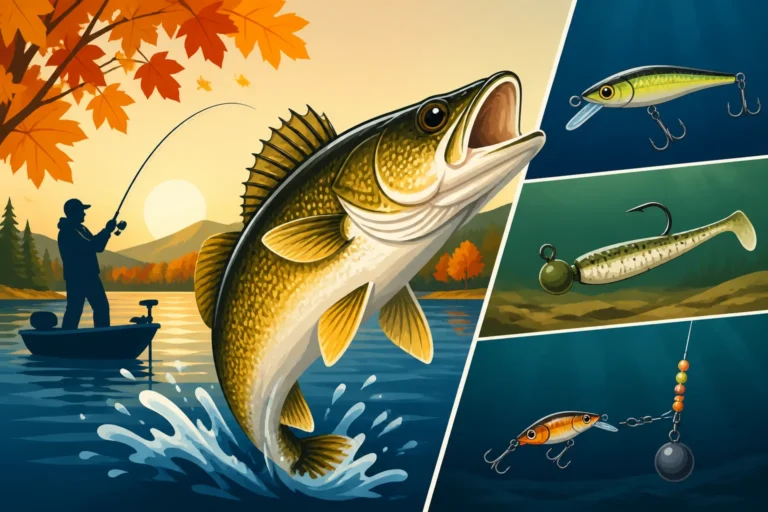
For lures, spoons are incredibly effective for lake trout. Brands like Mooselook Thinfish or Sutton Spoons in silver, blue, or chartreuse can be deadly. Long, slender stickbaits that imitate smelt, such as a Rapala Down Deep Husky Jerk or a Storm ThunderStick, are also excellent choices, especially when paired with a dodger or flasher to create attraction. When fishing with dodgers and flies, the dodger provides the action and attraction, and the short leader (18-36 inches) fly behind it seals the deal. Consider patterns that mimic the local baitfish, like the shiner or smelt pattern. For additional lure ideas that work well with trolling, you might find some crossover ideas in our guide on Best Lures for Walleye Trolling on Lake Champlain. Remember, the goal is to make your lure look as natural and enticing as possible at the precise depth where the fish are holding.
Troubleshooting Common Downrigger Issues and Advanced Tips
Even with the best gear and knowledge, downrigger fishing can present its quirks. Learning to troubleshoot on the fly and incorporate advanced techniques will significantly elevate your game.
Avoiding Tangles and Blowback
One of the most frustrating aspects of downrigger fishing is tangled lines or excessive blowback. Tangles can occur if your lures are running too close together, if one line pops out prematurely, or if you're making sharp turns. To avoid this:
- Stagger your depths: If running multiple downriggers, set them at slightly different depths (e.g., one at 60 ft, one at 65 ft) to create a broader presentation and minimize crossing.
- Stagger your distances: If your boat has multiple downriggers, run the ones furthest from the stern slightly higher, or use longer leads from the clip, to prevent tangling with inside lines on turns.
- Consistent speed and straight lines: Maintain a steady boat speed and try to troll in straight lines for as long as possible. Gradual turns are fine, but sharp turns can cause lines to swing and tangle.
- Monitor your rod tips: A sudden change in rod tip tension often indicates a tangle or a premature release.
Blowback, as mentioned, is when your downrigger weight trails significantly behind your boat rather than running vertically. This can make precise depth control challenging. To minimize blowback:
- Use heavier weights: As discussed, 10-12 pound weights are more resistant to blowback.
- Reduce speed: Slower trolling speeds mean less water resistance on the weight and cable.
- Use thinner cable: While less common, some anglers use thinner diameter braided downrigger cable to reduce drag, though this requires careful consideration of breaking strength.
Remember, even a slight blowback means your actual lure depth is shallower than what your downrigger counter reads. If you're marking fish at 60 feet and have significant blowback, you might need to drop your weight an extra 5-10 feet to truly get your lure to that depth. This is where experience and knowing your specific gear really come into play.
Adjusting for Changing Conditions
Lake conditions are rarely static, and successful downrigger anglers are those who constantly adapt.
- Wind and Current: On large bodies of water like Lake Champlain, wind and subsurface currents can dramatically affect your boat speed and lure presentation. If you're trolling into the wind, you might need to increase your engine RPMs to maintain speed. Conversely, going with the wind might require less power or even a drift sock to slow down. Currents can cause your downrigger weights to swing, so watch your sonar carefully for any deviations in your weight's position.
- Sunlight and Cloud Cover: On bright, sunny days, lake trout tend to be more sensitive to light and might hug deeper structure or the very bottom. Overcast days might see them rise a bit higher in the water column or become more active. Adjust your depths and lure colors accordingly. Bright, flashy lures often work well on sunny days, while more subdued or natural colors might be better under clouds.
- Fish Movement: Lake trout are not stationary. They move with baitfish, respond to barometric pressure changes, and will shift their preferred depths throughout the day. Don't be afraid to change your downrigger depths every 30-60 minutes if you're not getting bites or if your sonar starts showing fish at a different level. This active adjustment is key to consistent success. Our guide on Trolling Techniques for Vermont Lake Trout provides further strategies for adapting to varied conditions. Sometimes, it's the slight tweak that makes all the difference, so stay alert and keep experimenting!
Disclaimer
This article is for general informational purposes only and does not constitute professional advice. Laws, prices and regulations vary by location and change over time. Consult a qualified professional for guidance on your specific situation.