Best Wading Staff for Fast Current
There's nothing quite like the exhilarating pull of a strong trout in a fast-moving Vermont river, but that thrill can quickly turn to anxiety, or even danger, if you're not absolutely stable on your feet. Many of us have experienced that heart-stopping moment when a rock shifts underfoot, or a sudden surge of current threatens to sweep us off our balance. This comprehensive guide is here to walk you through everything you need to know about choosing and using the best wading staff to confidently navigate Vermont's challenging, yet incredibly rewarding, swift currents.
The Non-Negotiable Necessity of a Wading Staff in Vermont's Fast Currents
Let's be honest, for years, many of us, myself included, probably thought a wading staff was just for "older" anglers or those less steady on their feet. We felt invincible, or at least adequately balanced, with just two legs and a bit of courage. But then you encounter that slick, algae-covered boulder in the middle of a roaring section of the White River, or the unpredictable, shifting gravel bottom of the Lamoille, and suddenly, that confidence evaporates. A wading staff isn't a sign of weakness; it's a critical piece of safety gear, an extension of your body that can prevent a serious fall, injury, or worse, a lost day of fishing.
Why Vermont's Rivers Demand Extra Caution
Vermont's rivers and larger streams, like the legendary Battenkill or the powerful Winooski, aren't your average placid flows. They're often characterized by swift currents, particularly during spring runoff or after heavy rains, making footing incredibly treacherous. The riverbeds themselves are a mosaic of challenges: smooth, mossy bedrock, unstable cobble, softball-sized rocks that roll with the current, and hidden drop-offs that can catch you completely off guard. You might be standing in knee-deep water feeling perfectly secure, only for the riverbed to suddenly disappear, plunging you waist-deep in a blink.
Imagine trying to maintain your balance while casting a fly line or battling a strong fish, all while the river attempts to move your feet. It's a recipe for disaster. Unlike some western rivers with consistent, gravelly bottoms, Vermont's streams are wild and varied, often changing character within just a few feet. One moment you're on firm sand, the next you're sinking into slick clay or scrambling over submerged boulders. This constant variation is part of their charm, but it also means you can never take your footing for granted. That's why having a solid point of contact, a "third leg," is so incredibly valuable here.
Beyond a 'Third Leg': The Safety Benefits
Thinking of a wading staff as merely a third point of contact barely scratches the surface of its utility. It's truly a multi-purpose tool that significantly enhances your safety and confidence. First and foremost, it provides stability. When you're wading across a swift current, the force of the water against your legs can be immense. A staff allows you to distribute your weight, acting as a brace against the current, giving you crucial seconds to regain your footing if you stumble. It's like having an extra anchor.
Beyond preventing falls, a wading staff is an invaluable probing tool. Before taking that next step into murky water or an unfamiliar patch of riverbed, you can use your staff to feel for depth, obstacles, and stability. Is it a sudden drop-off? A slippery rock? A deep pocket? The staff tells you before your foot commits, reducing the element of surprise that often leads to falls. This proactive approach to wading can save you from a dunking, or worse, a serious injury. It also helps conserve energy. Constantly fighting the current without a staff can be exhausting, leaving you fatigued and less able to react quickly. With a staff, you can lean into it, using its support to ease the strain on your legs and core, allowing you to focus more on fishing and less on staying upright. For tips on navigating these tricky waters, check out Wading Techniques for Vermont Trout Streams.
The Hidden Costs of a Misstep
A fall in a fast-moving river isn't just embarrassing; it can have significant, sometimes lasting, consequences. The most obvious is physical injury. A twisted ankle, a bruised knee, a broken wrist – these are all very real possibilities when you lose your footing on uneven, slippery surfaces. The cold water can also be a factor, especially during early spring or late fall fishing. A sudden dunking in frigid water can lead to hypothermia, even on a seemingly mild day. You might be forced to cut your trip short, soaked and miserable, potentially far from your vehicle, which is a major bummer when you've finally found the perfect spot.
Beyond personal injury, there's the cost to your gear. Dropping your expensive fly rod or spinning outfit into a strong current often means it's gone for good, or at least significantly damaged. Your tackle box can spill, scattering lures and flies downstream. A soaked phone or camera is another common casualty. When you consider the investment we make in our fishing gear, preventing a fall suddenly becomes a very economical choice. A good wading staff is a small price to pay for protecting yourself and your valuable equipment. Think of it as essential insurance for your angling adventures in places like the Best Fly Fishing Rivers in Vermont.
Essential Features to Look for in a Wading Staff
When you're out there, battling a feisty rainbow in a roaring torrent, the last thing you want is for your wading staff to fail you. It needs to be an extension of your arm, reliable and ready. So, let's dive into what really makes a wading staff stand out, helping you pick one that's genuinely up to the task of Vermont's varied waters.
Material Matters: Durability vs. Weight
The construction material of your wading staff is a crucial factor, influencing both its strength and how easy it is to carry. You're typically looking at three main categories: aluminum, carbon fiber, and sometimes wood (though less common for modern folding staffs).
-
Aluminum: This is the workhorse option, often found in more budget-friendly staffs. Aluminum staffs are generally very durable and can take a beating against rocks and debris without much fuss. They offer excellent rigidity, which is exactly what you need when you're leaning heavily into a strong current. The trade-off is weight; aluminum staffs tend to be heavier than their carbon fiber counterparts. While not excessively heavy, every ounce counts on a long hike to a remote section of the Battenkill River Trout Fishing. If you prioritize ruggedness and affordability, aluminum is a solid choice. Many popular models available at stores like Bass Pro Shops are made from durable aluminum, offering a great balance of features for the price.
-
Carbon Fiber: If you're an angler who values lightweight gear and spends a lot of time trekking to hard-to-reach spots, carbon fiber is your friend. These staffs are significantly lighter than aluminum, reducing fatigue over a full day of wading and hiking. Despite their lighter weight, high-quality carbon fiber staffs are incredibly strong and rigid. They absorb vibrations well, making them comfortable to use. The primary downside is the cost; carbon fiber staffs typically come with a higher price tag. They can also be more susceptible to impact damage if struck directly on a sharp rock, though modern designs are very robust. For serious backcountry anglers or those with joint issues, the weight savings can be a game-changer.
-
Wood: While beautiful and traditional, wooden staffs are less common in the folding/collapsible category, usually being fixed-length. They offer natural buoyancy and a classic aesthetic but can be heavier and less convenient for packing. They require more maintenance to prevent rot or warping. For most anglers navigating Vermont's diverse waters, modern aluminum or carbon fiber options offer superior performance and practicality.
Grip and Handle Design for Vermont Anglers
A good grip isn't just about comfort; it's about control and safety. When your hands are wet, cold, or gloved, you need a handle that you can confidently hold onto.
- Ergonomics: Look for a handle that fits comfortably in your hand. Many staffs feature an ergonomic pistol-grip or a more traditional straight handle with a slight contour. The material matters too. EVA foam or cork handles offer a good balance of grip, comfort, and warmth, especially on chilly mornings. Some handles have textured rubberized sections for enhanced grip, even when slippery. Avoid overly smooth or hard plastic grips that can become slick.
- Wrist Leash/Lanyard: This is an absolute must-have. A strong, adjustable wrist leash ensures that if you momentarily lose your grip on the staff, it doesn't get swept downstream. Imagine reaching out to net a fish or adjust your reel, only for your staff to slip away. A good leash keeps it tethered to you, ready for immediate use. It should be comfortable and easy to adjust, allowing for quick detachment if necessary (though rarely advised in swift water). Some staffs integrate the leash directly into the handle for a seamless feel. The security of a good leash cannot be overstated; it's the difference between temporarily losing a staff and losing it for good down a fast river like the Winooski River Fishing Spots.
The Importance of a Secure Locking Mechanism
A wading staff is only as good as its ability to stay at the length you set it. A faulty locking mechanism can cause the staff to collapse or extend unexpectedly, leading to a loss of balance and potentially a serious fall.
- Flip-Lock/Lever Lock: These are incredibly common and generally very reliable. A small lever or clamp mechanism is used to tighten and secure the shaft segments. Look for designs that are easy to operate with cold or wet hands, even with gloves on. High-quality flip locks provide a very strong hold, preventing slippage under pressure. They often have an adjustment screw that allows you to fine-tune the clamping force over time.
- Twist-Lock: While common in some trekking poles, twist-lock mechanisms can sometimes be less reliable in fishing applications, especially if sand or grit gets into the mechanism, making them hard to tighten or loosen. When wet, they can also be difficult to get a firm grip on to twist securely. If you opt for a twist-lock, ensure it's a high-quality design with internal expanding components that provide a very firm lock.
- Push-Button/Spring-Loaded: Primarily found on folding staffs, these mechanisms quickly lock segments together when the staff is unfolded. They are fantastic for rapid deployment. However, it's crucial that the buttons engage fully and that there's no play or wobble once locked. A strong internal cord often holds the segments together when folded, and this cord needs to be durable and resistant to stretching.
Regardless of the mechanism, test it thoroughly. Assemble and disassemble it multiple times. Apply pressure to the staff once locked to ensure it doesn't slip. You need absolute confidence that your staff will hold firm when your safety depends on it.
Tip Options for Various Riverbeds
The tip of your wading staff is where the rubber meets the road—or, more accurately, where the metal meets the riverbed. Different riverbed compositions require different tip designs for optimal grip and stability.
- Carbide Tip: This is the most common and versatile option, often found as a standard on many staffs. Carbide is an extremely hard material that bites well into slippery rocks, gravel, and even ice. It provides excellent traction and durability, resisting wear and tear over time. For the diverse conditions of Vermont's rivers, a carbide tip is an excellent all-around choice.
- Rubber Tip: Some staffs come with a removable rubber tip or ferrule. This is ideal for wading on bedrock, pavement (like boat launches), or particularly delicate streambeds where you want to minimize impact. Rubber provides good grip on smooth, solid surfaces and can reduce noise, but it's less effective on loose gravel or in biting into algae-covered rocks. Often, anglers will carry a rubber tip as an accessory to swap out depending on the terrain.
- Basket/Mud Basket: While more common on trekking poles, some wading staffs include a small "basket" near the tip. This is designed to prevent the staff from sinking too deeply into soft mud, sand, or snow. In Vermont, where river margins can sometimes be silty or muddy, this can be a helpful feature, though it's less critical in fast-moving, rocky currents.
Ideally, your staff will have a durable carbide tip. Some models even feature interchangeable tips, allowing you to switch between carbide and rubber or other specialized tips for different conditions, offering maximum versatility for your Best Kayak Fishing Spots in Vermont or even just a walk along the shore.
| Feature | Aluminum Staffs | Carbon Fiber Staffs |
|---|---|---|
| Weight | Heavier, more robust feel | Lighter, reduces fatigue |
| Durability | Very durable, good impact resistance | Strong, but can be brittle with sharp impacts |
| Rigidity | Excellent | Excellent |
| Cost | Generally more affordable | Higher price point |
| Vibration Dampening | Moderate | Excellent |
| Best For | All-around use, budget-conscious, rugged | Backcountry, long treks, joint issues |
Types of Wading Staffs: Finding Your Perfect Companion
Just like fishing rods or reels, wading staffs come in different configurations, each designed with specific angling scenarios in mind. Understanding these types will help you choose the one that best suits your typical Vermont fishing adventures, whether you're hopping between pools on a small stream or traversing a wide, powerful river.
Folding and Collapsible Staffs: Portability for Backcountry Trips
Folding and collapsible staffs are arguably the most popular choice for modern anglers, and for very good reason: portability. These staffs are designed to break down into several shorter segments, often connected by an internal elastic cord, similar to a tent pole. When not in use, they fold up into a compact package that can easily be tucked away.
- How They Work: To deploy, you simply unfold the segments, and they snap together, often with a push-button or tensioning system. To collapse, you usually pull apart the segments, and the elastic cord guides them back into a folded bundle.
- Advantages: Their primary benefit is convenience. You can carry a folding staff in a small pouch attached to your wading belt, tucked into your Best Tackle Bag for Bank Fishing, or even stowed inside a backpack. This means it's out of the way when you're hiking to a remote spot or when you're in a section of river where wading is easy, but it's always there, ready to be deployed in seconds when you encounter tricky currents or deeper water. Many come with a small sheath or holster for easy storage. This is particularly valuable for anglers who explore Vermont's backcountry trout ponds or hike considerable distances along rivers like the Otter Creek Fishing Spots.
- Considerations: While incredibly convenient, folding staffs can sometimes have a slight amount of "play" or wobble at the joints compared to a fixed-length staff. This is usually minimal in quality models, but it's something to be aware of. Also, the elastic cord can degrade over many years of use, though it's often replaceable. Still, for the vast majority of anglers, the ease of transport outweighs these minor considerations.
Telescoping Staffs: Quick Adjustments on the Fly
Telescoping staffs operate much like a traditional telescoping trekking pole, with segments that slide into one another. They are extended and locked into place using twist-lock or lever-lock mechanisms.
- How They Work: You simply pull out the segments to the desired length and then twist or flip a lever to secure them. This allows for fine-tuned length adjustments.
- Advantages: The main advantage here is quick, customizable length adjustment. If you're moving between different depths or wading conditions, you can easily lengthen or shorten the staff without fully collapsing it. This can be very handy if you're crossing a wide, shallow flat and then immediately need to navigate a deeper channel. They also tend to be quite rigid when locked properly, as the overlapping segments provide good strength. Some anglers find them slightly quicker to deploy than folding staffs, as there's less "assembly" involved; it's more of a pull and lock motion. They strike a good balance between portability and robust construction.
- Considerations: While more compact than fixed-length staffs, telescoping staffs don't pack down quite as small as folding staffs. They can still be attached to a pack or wading belt, but they'll be longer. As mentioned earlier, twist-lock mechanisms can sometimes be problematic with grit or cold hands, so a good lever-lock system is often preferred for reliability in wet conditions.
Fixed-Length Staffs: Unmatched Stability (and Bulk)
Fixed-length staffs are the simplest in design: they are a single, solid piece of material, usually wood or a sturdy composite. They do not collapse or fold.
- How They Work: There's no mechanism to worry about; what you see is what you get. You simply pick it up and use it.
- Advantages: The absolute strongest and most rigid type of wading staff available. Because there are no joints or locking mechanisms to potentially fail, they offer unparalleled stability and a reassuringly solid feel. If you're consistently wading extremely difficult, fast-moving, deep water and don't need to carry your staff far, this could be a consideration. They're also often quite buoyant, which can be a small advantage if you drop it.
- Considerations: The biggest downside, by far, is their lack of portability. They are long and cumbersome to carry when not in use. You can't just clip it to your belt or put it in a pack; you have to carry it in your hand or find a way to secure it along the outside of your pack, where it can snag on brush or get in the way. This makes them impractical for most anglers who hike to their fishing spots. They are generally best suited for those who fish very close to their vehicle and only wade short distances in extremely challenging water. For most Vermont anglers, the convenience of a folding or telescoping staff makes them a far more practical choice for navigating varied terrain and carrying gear like a Best Cooler for a Fishing Boat or a simple tackle box.
How to Properly Use a Wading Staff for Maximum Stability
Having the best wading staff in the world won't do you much good if you don't know how to use it effectively. It's not just a stick to lean on; it's a tool that, when wielded correctly, can transform your confidence and safety in swift water. Let's talk about smart wading techniques that incorporate your staff seamlessly.
The Tripod Method: Your Foundation in the Current
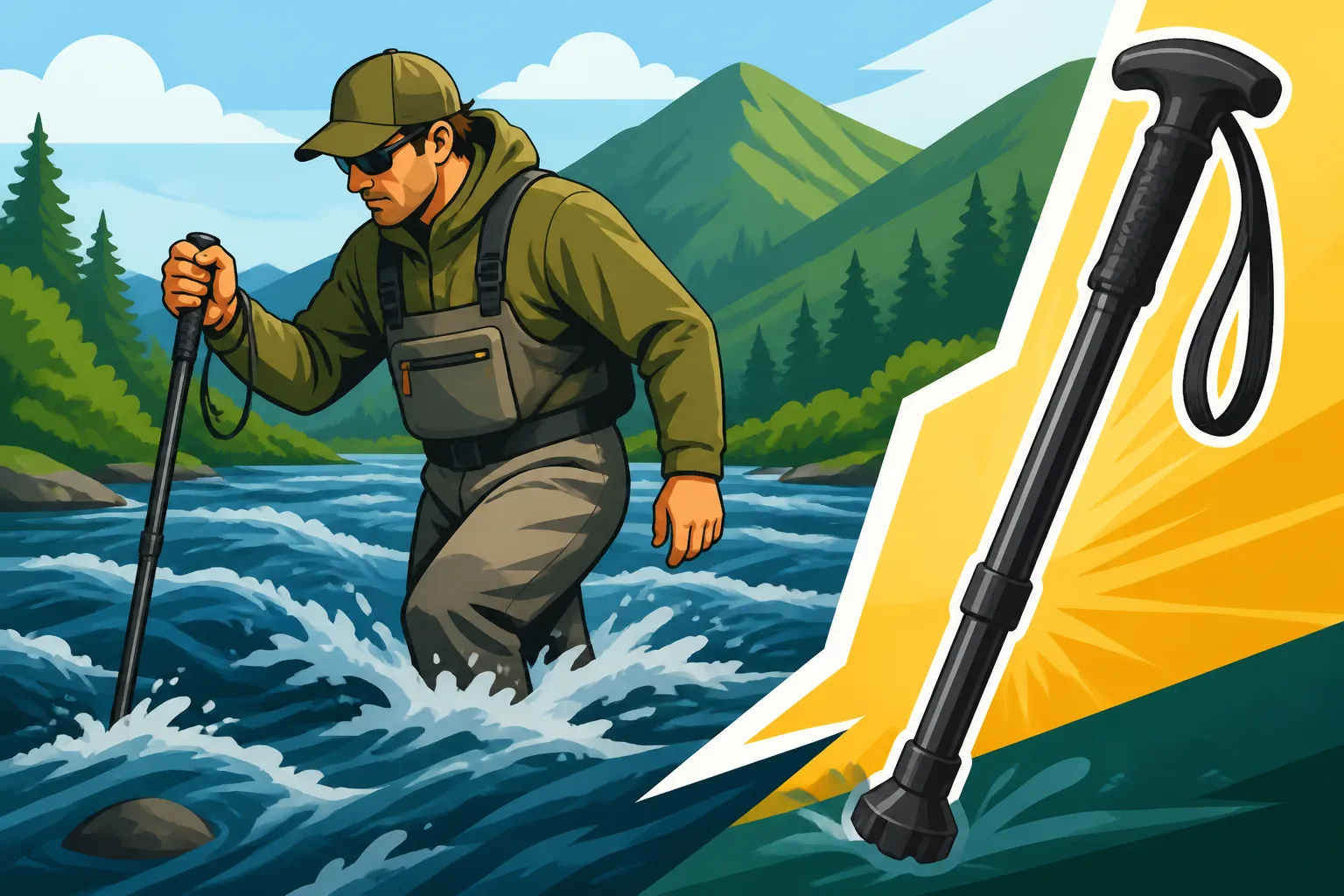
The "tripod method" is the golden rule of wading with a staff, and it's essential for maintaining stability in fast currents. The basic principle is simple: you always maintain three points of contact with the riverbed at all times. This means either both feet and your staff, or one foot and your staff, while the other foot is moving.
- Maintaining the Triangle: When you're stationary, set your staff firmly on the downstream side, slightly ahead of you. This position braces you against the current. Your two feet and the staff form a stable triangle. When you need to move, slide one foot forward, maintaining pressure on your other foot and the staff. Before you lift that second foot, plant your staff firmly again, either beside your first foot or slightly ahead, to re-establish your tripod. Only then do you move your second foot.
- Probing and Planting: Don't just swing your staff blindly. Use it to probe the riverbed ahead of you before you commit your weight. Feel for depth changes, slippery rocks, or unstable ground. Once you find a solid spot, plant the staff firmly with conviction, leaning into it if necessary to test its stability, before you shift your weight or move a foot. This isn't a race; slow and deliberate movements are key. Imagine you're taking a series of mini-steps, each one verified by your staff.
- Facing the Current: When crossing or moving through a strong current, it's almost always best to face slightly upstream and into the current. This presents a smaller surface area for the water to push against your body. Your staff should be planted on the upstream side or directly ahead, acting as a forward brace against the flow, while your body maintains that slight angle. Never turn your back to a strong current unless absolutely necessary; it can act like a sail and instantly destabilize you. For more advanced techniques, consider reading up on How to fish a run and pool trout stream.
Reading the Water and Anticipating Your Next Step
Effective wading isn't just about balance; it's about understanding the river itself. The water tells a story, and learning to read it can make all the difference in where and how you wade.
- Understanding Flow: Look for seams, eddies, and slower currents. The strongest currents are often found in the deepest parts of the channel or where the river narrows. If you can avoid these powerful zones by finding a slightly shallower, less turbulent path, do so. Sometimes, wading a few extra feet upstream or downstream to find a safer crossing is far better than battling the main current directly. Areas behind large boulders or logs often provide brief breaks in the current where you can regroup.
- Surface Clues: Ripples, boils, and swirling water indicate changes in depth, submerged obstacles, or strong subsurface currents. Smooth, glassy stretches often signify deep, slow pools, while choppy, aerated water can mean fast, shallow rapids over rocks. Use these visual cues to anticipate what the riverbed might hold. If you see white water ahead, assume it's shallow and rocky. If you see a dark, smooth patch, assume it's deep.
- Anticipating Obstacles: Trees and branches snagged in the river can indicate deep holes or areas where debris collects. Gravel bars and riffles often mean shallower, but potentially unstable, footing. Always be scanning ahead, not just where your next step will land, but several steps beyond that, to plan your route. If you see a particularly difficult section, sometimes it's better to get out and walk around it on the bank, even if it's a bit of a bushwhack, than to risk a fall. This is especially true on Vermont's Special Regulation Waters in Vermont which can sometimes have unique features.
When and How to Advance with Your Staff
Moving through the water efficiently and safely requires a deliberate rhythm, especially with your staff.
- Slow and Deliberate: Rushing is your enemy in fast water. Each step should be slow, controlled, and intentional. Before lifting a foot, ensure your other foot and the staff are firmly planted. Once your moving foot is down, feel for stability before transferring your weight fully. Your staff should lead the way, probing and securing the path.
- Shuffling vs. Stepping: In particularly slick or fast-moving water, sometimes a shuffle, rather than a full step, is safer. Keep your feet closer to the bottom, dragging them slightly as you move, minimizing the chance of losing contact entirely. Your staff is still your primary probe and brace in this scenario.
- Crossing Strategy: When crossing a river, diagonal downstream is generally the safest approach. This allows the current to assist your momentum slightly, rather than pushing against you directly. Keep your staff planted upstream and slightly ahead, bracing against the flow, and slowly shuffle or step your feet across, maintaining that tripod contact. Never try to fight the full force of the current by wading directly perpendicular to the flow; you'll exhaust yourself and risk losing your footing.
- Using Your Body: Don't just rely on your legs. Engage your core. Keep your knees slightly bent to act as shock absorbers. Keep your body loose but controlled. Your center of gravity should be low. The staff provides the third point, but your core strength and body awareness are equally critical. Remember, wearing the right wading boots also plays a huge role; consider options discussed in Best wading boots with felt vs rubber soles.
Maintenance, Care, and Safety Beyond the Staff Itself
Your wading staff is a critical piece of gear, and like any other tool, it needs a little love to stay reliable. But beyond just caring for your staff, real safety in Vermont's rivers comes from a holistic approach to your gear and your habits.
Keeping Your Wading Staff in Top Condition
A well-maintained wading staff is a trustworthy wading staff. Neglect can lead to frustrating failures when you need it most.
- Rinse After Use: This is probably the most important step. After every trip, especially in saltwater or murky river water, rinse your staff thoroughly with fresh water. Pay extra attention to the locking mechanisms and any folding joints. Sediment, sand, and fine grit can build up, hindering smooth operation and eventually causing wear or corrosion. A quick rinse under a garden hose or in a sink is usually sufficient.
- Dry Completely: After rinsing, extend your staff fully and allow it to air dry completely before collapsing or storing it. Trapped moisture, especially in the internal sections of telescoping or folding staffs, can lead to corrosion, mildew, and degradation of internal cords or elastic. Store it in a cool, dry place.
- Check Locking Mechanisms: Regularly inspect the locking mechanisms. For flip-locks, check that the lever is tight and provides a firm clamp. If it feels loose, there's usually a small screw (often a Philips head) you can tighten to restore tension. For twist-locks, ensure they engage smoothly and hold securely without slipping. For folding staffs, check the elastic cord for any signs of fraying or stretching; if it's weak, it might be time for a replacement.
- Inspect the Tip: Over time, carbide tips can wear down, or rubber tips can become smooth. Check for excessive wear or damage. If the tip is replaceable, consider keeping a spare on hand, especially if you fish frequently on rocky bottoms. A worn tip won't give you the grip you need.
- Lubricate (Sparingly): If your telescoping or folding joints feel sticky or stiff, a very small amount of silicone-based lubricant can help. Be incredibly sparing and wipe off any excess. Avoid oil-based lubricants as they can attract dirt and degrade rubber or plastic components. Never lubricate the locking mechanisms themselves unless specifically instructed by the manufacturer, as this can reduce their grip.
Complementary Safety Gear for Swift Water
A wading staff is a fantastic tool, but it's part of a larger safety system. Here's other gear that works in tandem to keep you safe on Vermont's waters:
- Wading Belt: Absolutely essential. A snugly cinched wading belt around your waist can prevent your waders from filling with water if you fall, which is crucial for preventing being dragged downstream. Instead of filling entirely and becoming a huge drag, the belt helps contain the water in the lower half of your waders, giving you a chance to regain your footing or swim to safety. Many modern waders come with them, but always double-check that yours is properly secured.
- Wading Boots with Good Traction: Your footwear is your first line of defense. Felt soles offer excellent grip on wet, slimy rocks, but they can be less effective on mud, snow, or dry ground. Rubber soles with aggressive lug patterns are versatile and perform well in a variety of conditions, especially when paired with studs or cleats. Consider what kind of riverbeds you'll encounter most often. For a deep dive into boot choices, see Best Wading Boots for Rocky Streams.
- Life Jacket/PFD: For truly deep, fast-moving rivers, or if you're boating in addition to wading, a personal flotation device (PFD) is a non-negotiable. Even if you're an excellent swimmer, the shock of cold water, combined with heavy waders and boots, can quickly incapacitate you. A lightweight, comfortable fishing-specific PFD can provide peace of mind and literally save your life. Remember to review Life Jacket Requirements for Vermont Boaters.
- Knife or Line Cutter: In an emergency, if you get tangled in line or submerged brush, a sharp knife or line cutter attached to your vest or pack can be vital for freeing yourself. Make sure it's easily accessible with one hand.
- Communication Device: While not directly gear, having a fully charged phone in a waterproof case or a small personal locator beacon can be crucial if you find yourself in serious trouble in a remote area. Cell service can be spotty in many parts of Vermont.
Practicing Good Wading Habits
Beyond the gear, your personal habits and judgment are paramount to safe wading.
- Know Your Limits: Be honest with yourself about your physical capabilities and experience level. Don't attempt to wade water that looks too fast, too deep, or too treacherous for you. There's no shame in turning back or finding another spot. Many of us have tried to push it, only to find ourselves in a hairy situation.
- Buddy System: Whenever possible, fish with a buddy, especially in unfamiliar or challenging waters. Having someone else there can make a huge difference in an emergency. They can help you out of a tough spot or go for help.
- Scout Ahead: Before you even step into the water, take a few minutes to observe the river. Look for the easiest and safest crossing points. Identify potential hazards. Plan your route.
- Slow and Steady: As mentioned before, never rush. Deliberate, controlled movements are your best friend.
- Consider the Conditions: River levels, water clarity, and recent weather can all dramatically change wading conditions. What was an easy crossing last week might be a raging torrent today. Always assess current conditions before wading.
- Carry a Dry Bag: Even if you don't plan to fall, assume you might. Keep essentials like your phone, wallet, car keys, and a spare layer of clothing in a dry bag to protect them. This way, even if you take an unexpected dunk, you won't be stranded.
By combining a well-chosen, well-maintained wading staff with smart safety gear and responsible wading practices, you'll be well-prepared to enjoy all the incredible fishing experiences Vermont's currents have to offer, minimizing risk and maximizing your time on the water.
Choosing the Right Staff for Your Vermont Adventures: Brand Considerations and Where to Look
So, you're convinced a wading staff is a wise investment for your Vermont fishing exploits – excellent! Now comes the fun part: figuring out which one is right for you. With so many options out there, it can feel a little overwhelming. Let's talk about what truly matters and where you can find quality gear.
What to Consider Before Buying
Before you pull the trigger, take a moment to think about your personal fishing style and the types of water you typically encounter. This self-assessment will guide you to the best choice.
- Where Do You Fish Most Often? Are you a dedicated river angler, constantly navigating the challenging flows of the Lamoille or the Otter Creek? Or do you mainly fish calmer lake shores, occasionally venturing into a tributary? If swift, rocky rivers are your primary playground, prioritize extreme durability, excellent grip, and a secure locking mechanism. If you mostly stick to calmer waters, portability might be a higher concern, allowing you to tuck it away when not strictly needed.
- How Far Do You Hike? If you're frequently trekking miles into the backcountry for Best High-Elevation Trout Streams in the Green Mountains or remote wild trout waters, then a lightweight, compact folding staff (likely carbon fiber) will be your hero. Every ounce matters on those long hikes. If your fishing spots are usually a short walk from the car, the slightly heavier but perhaps more robust aluminum telescoping or folding staffs might be perfectly adequate.
- What's Your Budget? Wading staffs range in price. You can find perfectly functional aluminum models that won't break the bank, while high-end carbon fiber options can be a significant investment. Determine what you're comfortable spending, keeping in mind that this is a piece of safety gear, not just an accessory. Sometimes, spending a little more upfront for reliability and durability is a wise choice.
- Personal Preference for Deployment: Do you prefer the quick unfolding action of a folding staff, or the simple extension of a telescoping one? Try out different styles if possible. The ease of deployment and collapse can greatly impact how often you actually use your staff, so choose a system you're comfortable with.
- Length: Most staffs are adjustable to fit a range of heights. As a general rule, when standing upright with the staff planted firmly on the ground beside you, the top of the handle should reach somewhere between your armpit and your chin. This allows for comfortable use while wading and provides enough length to probe deeper spots.
Where to Find Quality Wading Staffs
Once you have an idea of what you're looking for, it's time to shop around. While you might not find a huge selection at every local bait shop, several reliable retailers, both brick-and-mortar and online, carry excellent wading staffs.
- Specialty Fly Shops: Your local fly shop is often an incredible resource. The staff there are usually experienced anglers who understand the local conditions and can offer personalized recommendations. They'll carry high-quality brands known for durability and functionality. You can often try out different models, get a feel for the weight, grip, and deployment mechanism. This is my top recommendation for getting expert advice tailored to Vermont fishing.
- Major Outdoor Retailers: Stores like Bass Pro Shops or other large sporting goods retailers will have a broader selection, often encompassing various brands and price points. While the staff might not be as specialized in fly fishing, they can still help you compare features and find a staff that fits your budget. You can usually physically examine the products, which is a big plus.
- Online Retailers: Websites like Amazon offer an enormous selection, often with competitive pricing and user reviews that can be very informative. You'll find a wide range of brands, from well-known fishing gear manufacturers to smaller, niche companies. The downside, of course, is that you can't physically handle the staff before purchasing. When buying online, pay close attention to customer reviews, especially those that mention durability, locking mechanism reliability, and performance in fast water. Make sure the retailer has a good return policy in case the staff doesn't meet your expectations. Look for models explicitly designed for wading rather than just general trekking.
Some reputable brands that often produce quality wading staffs include Simms, Orvis, Folstaf, and various hiking pole manufacturers who have adapted their designs for fishing. Don't be afraid to read reviews, ask questions from experienced anglers, and choose a staff that feels comfortable and secure in your hand. Ultimately, the best wading staff is the one you'll actually use, reliably, every time you step into Vermont's fast, exhilarating currents.
Disclaimer
This article is for general informational purposes only and does not constitute professional advice. Laws, prices and regulations vary by location and change over time. Consult a qualified professional for guidance on your specific situation.