Best deep water structure spots on Lake Champlain
Lake Champlain, with its expansive waters and diverse underwater topography, can feel overwhelming for even seasoned anglers. Trying to pinpoint where the fish are hiding, especially in the vast deep-water expanses, can quickly lead to frustration and wasted hours. This comprehensive guide is here to unravel the mysteries of Lake Champlain's deep-water structure, helping you identify those elusive spots where trophy walleye, lake trout, and even monster smallmouth bass love to congregate.
Understanding Deep Water Structure on Lake Champlain
When we talk about "structure" in fishing, we're not just talking about random rocks or weeds. We're referring to any change in the lake bottom or water column that differs from the surrounding area. In deep water, these features become absolute magnets for fish, offering them food, cover, and comfortable thermal zones. On a massive body of water like Lake Champlain, understanding and locating this structure is the key to consistent success.
Why Structure is Key for Deep Water Angling
Imagine yourself as a fish in a vast, featureless desert. Where would you go for food, safety, or shelter from the elements? You'd seek out an oasis, a patch of vegetation, or a rock outcrop. Fish are no different, especially in the deeper, often barren stretches of Lake Champlain. Deep water structure provides precisely these "oases" – contours, humps, ledges, and channels that break up the monotony of the lakebed. These areas concentrate baitfish like alewives, rainbow smelt, and yellow perch, which in turn attract the larger predatory species we love to target.
Furthermore, deep water structure can influence currents and create subtle thermal breaks, especially during the warmer months when a distinct thermocline forms. Fish, particularly cold-water species like lake trout, will hug the cooler waters below the thermocline, but they'll still relate to structure for feeding opportunities. Even smallmouth bass, known for shallow-water prowess, will retreat to deep-water humps and ledges when summer heat or heavy boat traffic pushes them off the banks. Focusing your efforts on these structural elements drastically increases your chances of finding actively feeding fish.
Reading Your Electronics for Deep Structure
Modern marine electronics are your best friend when it comes to deciphering Lake Champlain's underwater landscape. Simply driving around blindly hoping to stumble upon a deep-water hotspot is a recipe for frustration. Instead, learn to effectively use your fish finder, side imaging, and GPS mapping to identify and exploit these crucial areas. A good understanding of your sonar display can show you not just the depth, but also the hardness of the bottom, baitfish clouds, and of course, the big arcs that indicate game fish.
Start by setting your fish finder to a high-frequency chirp sonar for the best target separation and clarity. When you see a sudden change in depth, a hump rising from the bottom, or a sharp drop-off, mark it immediately on your GPS. Side imaging, if you have it, is invaluable for scanning wider areas off to the sides of your boat, revealing hidden ledges, rock piles, or even sunken timber that traditional 2D sonar might miss. Many seasoned anglers will spend considerable time simply "scouting" new areas with their electronics before even dropping a line, meticulously mapping out potential fishing spots. Knowing Best Fish Finders for Vermont Lakes can give you an edge here.
Top Deep Water Structure Types and How to Fish Them
Lake Champlain boasts a variety of deep-water structures, each attracting different species and requiring specific fishing approaches. Understanding what each type looks like and how fish relate to it is paramount for successful angling.
Submerged Humps and Reefs
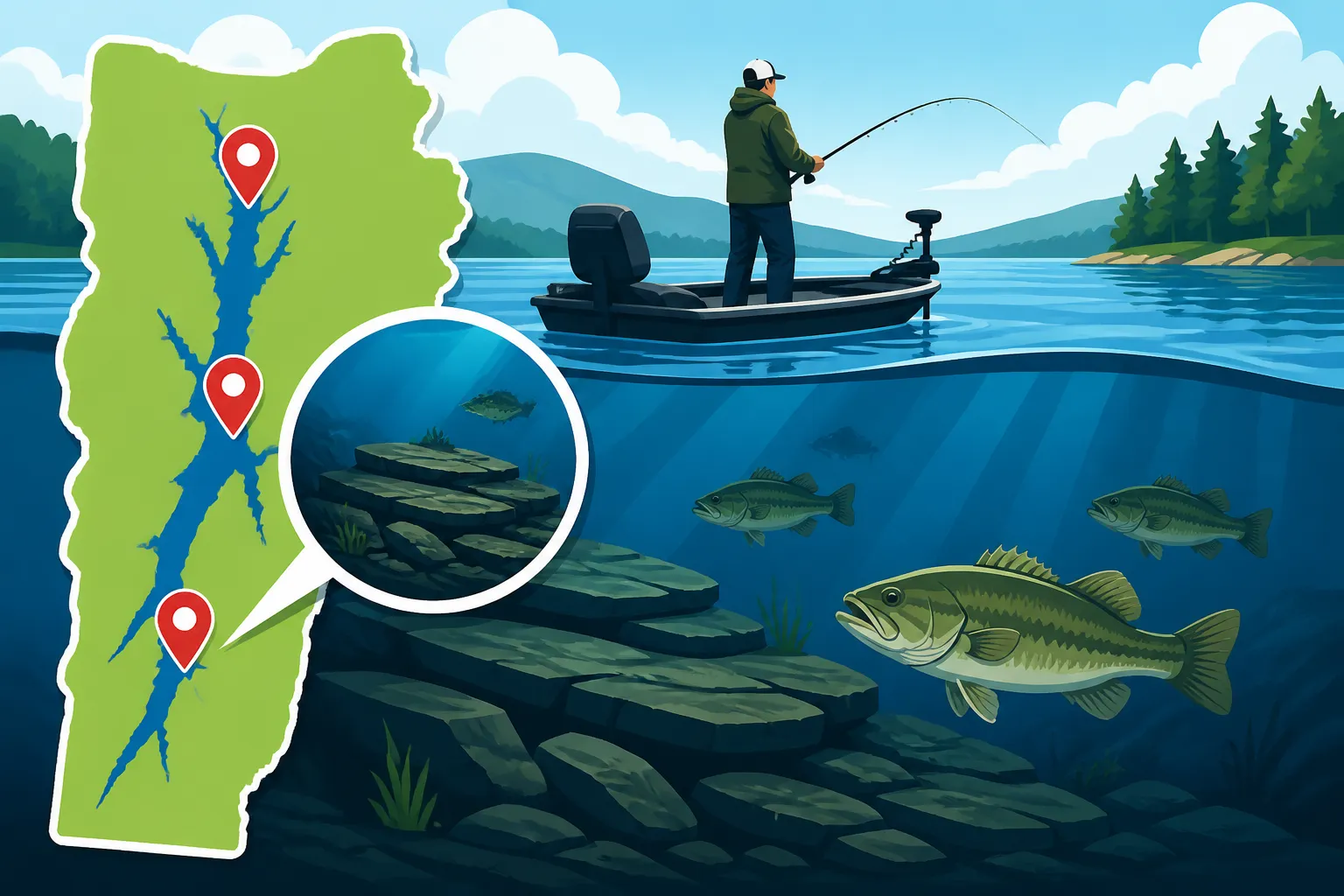
These are underwater mountains or hills that rise significantly from the surrounding lakebed, sometimes coming within a few feet of the surface, or other times topping out 30-60 feet down. On Lake Champlain, these features are absolute magnets for walleye, lake trout, and especially large smallmouth bass, particularly when fishing How to Catch Smallmouth Bass in Vermont Lakes. The sides and tops of these humps act as feeding stations where baitfish gather, and predators ambush.
To effectively fish a submerged hump, approach it carefully, ideally using your trolling motor to maintain boat control. Start by marking the highest point (the crown) and the edges where it meets the main lake basin. Often, the fish won't be right on top, but rather positioned on the "shoulders" or along the base where they can easily move up to feed. Try vertical jigging with heavy spoons or blade baits directly over these spots, or use a drop-shot rig to present a soft plastic bait just off the bottom. If trolling is your preferred method, run crankbaits or spoons that dive to the depth of the hump's productive zone, making sure to hit the contours rather than just passing over the top.
Ledges and Drop-Offs
Ledges and drop-offs are essentially underwater cliffs or steep inclines where the lake bottom rapidly changes depth. These can range from subtle slopes to dramatic, vertical walls. These features are prime real estate for walleye, who love to cruise these edges looking for prey, and lake trout, which often suspend along them. Smallmouth bass will also use ledges extensively, especially during post-spawn and summer periods, seeking cooler water and bait.
Fishing ledges requires a precise approach. Many anglers prefer to drift or troll parallel to the ledge, keeping their baits at the desired depth. For walleye, a bottom-bouncing rig with a crawler harness or a deep-diving crankbait can be incredibly effective when worked along the base or just above the lip of the ledge. When targeting lake trout, consider Trolling Techniques for Vermont Lake Trout with spoons or stickbaits, varying your depth to find where they're actively feeding. For smallmouth, casting jigging spoons or football jigs down the face of the ledge, letting them bounce and fall naturally, can elicit aggressive strikes. Pay close attention to your electronics for any irregularities on the ledge, such as small rock piles or breaks in the contour, as these often hold the most fish.
Deep Water Points and Channel Edges
Deep water points are land formations that extend far out into the lake, eventually dropping into deeper water. These act like underwater highways, funneling baitfish and providing ambush points for predators. Channel edges, particularly in areas like the Main Lake or sections of Malletts Bay where the old river channel runs, create distinct pathways and current breaks that walleye and lake trout exploit. These are crucial elements of the Lake Champlain Fishing Guide.
When fishing a deep point, focus your efforts on the very tip and along the "breaks" – the areas where the slope changes. These spots often concentrate fish that are moving in and out of shallower water. Trolling crankbaits or stickbaits around these points, making wide turns that cover varying depths, can be highly productive. For channel edges, especially if there's a discernible current, walleye will often face into the flow, waiting for food to be swept past. Use a precise boat control to drift or slow troll jigs or bottom-bouncers right along the edge of the channel. Understanding the subtleties of current and how fish orient themselves to it can make a huge difference in your catch rates.
Identifying and Accessing Productive Deep Water Zones on Lake Champlain
Lake Champlain is a huge body of water, stretching over 120 miles and covering hundreds of square miles. Knowing where to start looking for these deep-water structures can be daunting. Luckily, some regions of the lake are historically known for their productive deep-water zones.
Key Regions for Deep Structure Fishing on Lake Champlain
While Lake Champlain offers fantastic fishing across its entire length, some areas are particularly renowned for their deep-water structure and the species that inhabit them. The "Broad Lake" section, particularly the waters offshore from Burlington, Charlotte, and across to Port Kent, New York, is famous for its abundant deep humps, ledges, and vast lake trout populations. Here, you'll find impressive underwater topography, often with significant depth changes that hold both lake trout and opportunistic smallmouth. Many anglers target these areas for Lake Champlain Lake Trout Fishing.
Further north, towards the Islands and the Main Lake's northern stretches, you can find excellent deep walleye structure. Areas around the Sandbar Causeway and extending north of Mallets Bay offer deep channels and rocky humps that are perfect for walleye. Even the southern end, although generally shallower, has its deep pockets and channel swings that can hold impressive fish, especially closer to the deep water of the Main Lake basin. Exploring these diverse areas, sometimes with the help of a knowledgeable local guide you might find through FishingBooker, can unlock incredible fishing opportunities.
Leveraging Nautical Charts and Local Knowledge
Before you even launch your boat, spend time studying detailed nautical charts of Lake Champlain. Services like Navionics, C-MAP, or even traditional paper charts from NOAA (National Oceanic and Atmospheric Administration) are invaluable. Look for contour lines that are tightly spaced, indicating steep drop-offs and ledges. Pay attention to isolated humps or rock piles that rise from deeper water. These charts provide a "blueprint" of the underwater world and can help you pre-plan your fishing strategy and identify potential hotspots. Mark these areas on your GPS before you go.
Beyond charts, local knowledge is golden. Talk to anglers at bait shops, visit online forums focused on Lake Champlain, or consider hiring a fishing guide for your first few trips. A guide, especially one found via platforms like FishingBooker, will not only know the prime deep water structure spots but can also teach you the specific techniques that work best for that time of year and those particular fish. They can save you years of trial and error and significantly shorten your learning curve on such a vast and complex fishery. This is especially useful when trying to figure out Where to Find Walleye on Lake Champlain.
Essential Gear and Tactics for Deep Water Structure Fishing
Successfully targeting fish on deep water structure requires specific gear and honed tactics. Your everyday shallow-water setup might not cut it when you're dealing with depths of 40, 60, or even 100+ feet.
Rods, Reels, and Lines for Deep Applications
For deep water jigging or drop-shotting, you'll want a sensitive yet powerful spinning or baitcasting rod, typically in the 6'6" to 7'6" range with a medium-heavy or heavy action. This provides the backbone needed to effectively work heavier lures and fight big fish, while the sensitive tip helps detect subtle bites that often occur when your bait is far below the surface. Pair this with a robust reel spooled with braided line (20-30 lb test is common) for its no-stretch properties, which vastly improve sensitivity and hook-setting power in deep water. Always add a fluorocarbon leader (10-20 lb test, 6-10 feet long) for abrasion resistance and invisibility in clear Lake Champlain waters.
When trolling, especially for species like lake trout or deep walleye, a longer, more moderate action rod (7-10 feet, medium to medium-heavy) is often preferred. These rods absorb the shock of a strike and help keep fish pinned during the fight. Line choice can vary from monofilament to lead core or even wire line, depending on the desired depth and lure presentation. Many anglers utilize downriggers or heavy divers to get their lures down to the exact depth of the structure they are targeting. You'll want to ensure you're using the Best Line Weight for Muskellunge Fishing if you happen to hook into one of those toothy critters while deep trolling, although they're not typically found in the same deep water structure as trout and walleye.
Baits and Lures for Deep Structure
The choice of baits and lures for deep water structure fishing is critical. You need presentations that can reach depth efficiently, effectively imitate baitfish, and stand up to aggressive strikes.
- Vertical Jigs and Spoons: These are staples for walleye, smallmouth, and lake trout. Heavy jigging spoons (like Swedish Pimples, Kastmasters, or Northland Fishing Tackle Buck-Shot Rattle Spoons) in weights from 1/2 to 2 ounces are excellent for mimicking dying baitfish. Drop them to the bottom, give them a sharp rip, and let them flutter back down. Jigging Rapalas or blade baits are also incredibly effective, especially for walleye, for a similar presentation.
- Drop Shot Rigs: For finesse presentations, particularly when smallmouth bass are finicky, a drop shot rig is unbeatable. This rig allows you to suspend a small soft plastic bait (like a minnow imitation or a worm) off the bottom, directly in the fish's strike zone, while your weight maintains contact with the deep structure. This is often the Best Drop Shot Rig for Vermont Smallmouth.
- Deep-Diving Crankbaits: When trolling, deep-diving crankbaits are a go-to for walleye and smallmouth bass. Look for models that can reach depths of 20-30 feet or more, depending on the structure you're targeting. Color patterns that mimic perch, smelt, or alewives are often highly effective on Lake Champlain. Consider what are the Best Lures for Walleye Trolling on Lake Champlain for optimal success.
- Tube Jigs and Football Jigs: For smallmouth bass hugging rocky deep structure, heavy tube jigs or football jigs with soft plastic trailers are deadly. The heavy weight allows for efficient bottom contact and bouncing over rocks, mimicking crawfish or gobies – primary forage for smallmouth in Lake Champlain.
- Live Bait: Don't underestimate the power of live bait, especially for walleye and lake trout. Live shiners or smelt on a bottom-bouncing rig or suspended under a float (if currents allow) can be incredibly effective, particularly during periods when fish are less aggressive.
By combining the right gear with these proven tactics, and a thorough understanding of Lake Champlain's underwater geography, you'll be well on your way to discovering the incredible fishing opportunities that lie within its deep water structure.
Deep Water Structure Fishing Summary
| Structure Type | Primary Species (Deep Water) | Best Techniques | Key Considerations |
|---|---|---|---|
| Submerged Humps | Walleye, Lake Trout, Smallmouth Bass | Vertical Jigging (spoons, blade baits), Drop-shotting, Deep Trolling | Find shoulders and breaks; baitfish presence; mark contours on GPS |
| Ledges/Drop-Offs | Walleye, Lake Trout, Smallmouth Bass | Parallel Trolling (crankbaits, spoons), Jigging, Bottom Bouncing (live bait) | Precise boat control; identify depth breaks; target irregularities on the ledge |
| Deep Points | Walleye, Lake Trout, Smallmouth Bass | Trolling (wide turns, varied depths), Jigging, Bottom Bouncing | Fish the tip and breaks; watch for baitfish schools being funneled |
| Channel Edges | Walleye, Lake Trout | Drift/Slow Troll (jigs, bottom bouncers), Live Bait | Understand current flow; orient bait to current; fish edges meticulously |
Disclaimer
Fishing conditions and regulations in Vermont can change, and it's always your responsibility to check the latest rules and advisories from the Vermont Fish and Wildlife Department before heading out. Be aware of weather conditions, practice safe boating, and always prioritize conservation and responsible angling practices.