Best paddle length for a fishing kayak
One of the most common frustrations when getting into kayak fishing, or even upgrading your current setup, is figuring out the right gear – and a paddle is often overlooked until you're out on the water, struggling. You might find yourself splashing too much, feeling exhausted after just an hour, or simply not having the control you need to position yourself perfectly for that elusive Vermont trout. This guide is here to cut through the confusion and help you pinpoint the best paddle length for your fishing kayak, ensuring your time on the water is spent reeling in fish, not fighting your paddle.
Why Paddle Length Matters More Than You Think for Fishing Kayaks
It might seem like a small detail, just a stick with blades, right? But for kayak fishing, your paddle is an extension of your body, crucial for everything from silent approaches to battling unexpected currents. The wrong length can turn a peaceful outing into an exasperating workout, while the right length makes all the difference in comfort, control, and ultimately, your fishing success.
The Impact on Efficiency and Endurance
Imagine trying to push a heavy grocery cart with a stick that's either too short, forcing you to bend awkwardly, or too long, making you overreach. That's what paddling with the wrong length feels like. A paddle that's too short means you have to lean further over the sides of your kayak, pulling the blade in a wide, inefficient arc. This wastes energy, causes undue strain on your shoulders and back, and creates more splash, which can spook fish. Conversely, a paddle that's too long forces you to lift your hands higher than necessary, creating a higher center of gravity and an uncomfortable, fatiguing stroke that again, isn't getting you maximum propulsion. The sweet spot allows for a natural, comfortable stroke, maximizing the power transferred to the water with each pull and preserving your energy for fighting fish or covering more water, especially if you're exploring Best Fishing Lakes in Vermont.
Steering, Control, and Presentation
Beyond just moving forward, a properly sized paddle gives you nuanced control. When you're trying to hold a precise position against a gentle current on the Winooski River, or quietly maneuver around a fallen tree in a back cove, every inch of your paddle's length affects your ability to react. A paddle that's too short can make it harder to make quick, powerful rudder strokes to correct your drift or to spin your kayak quickly to present a lure to a rising fish. On the other hand, an excessively long paddle might feel unwieldy in tight spots, making precise draws or sweeps difficult. The right length allows for fluid, powerful strokes that translate directly into better boat control, letting you focus on the fish, not on wrestling your kayak. This control is paramount whether you're sight fishing for bass in clear waters or navigating tricky currents.
Key Factors Influencing Your Ideal Paddle Length
Determining the "perfect" paddle length isn't a one-size-fits-all situation. It's a combination of personal ergonomics and the specific characteristics of your kayak. Understanding these variables is the first step to making an informed choice that will enhance your time on the water.
Your Height and Torso Length
This is arguably the most critical personal factor. Taller paddlers generally need longer paddles, not just because of arm length, but more importantly, because of torso length. A longer torso means your body sits higher relative to the kayak's gunwales (the sides), requiring a longer shaft to comfortably reach the water without overstretching or hunching. It's less about your overall height and more about the distance from your seat to your shoulders. If you're a taller angler, a standard recreational kayak paddle might feel cramped, leading to inefficient strokes and quick fatigue. Conversely, a shorter paddler with a very long paddle will find themselves lifting their hands too high and struggling for control.
Kayak Width and Seat Height
Your kayak's dimensions play an equally crucial role. Fishing kayaks, by design, tend to be wider and often have higher seating positions than their recreational or touring counterparts. This added width provides stability, which is great for standing and casting, but it also means you have a greater distance to reach from your seated position over the gunwales to the water. A wider kayak, therefore, almost always demands a longer paddle. Similarly, if your fishing kayak features an elevated "stadium-style" seat – a common feature in many popular fishing models for better visibility and comfort – you'll be sitting higher off the water. This increased elevation, combined with the kayak's width, necessitates a significantly longer paddle to ensure the blade enters the water at an effective angle without your knuckles scraping the sides of the boat. Think about the stable platforms offered by models like those available at Bass Pro Shops; their stability comes with width, and width requires more paddle.
Type of Kayak and Fishing Style
Not all kayaks are created equal, and neither are all fishing styles. A narrow, sit-inside touring kayak used for light fishing will need a much shorter paddle than a wide, stable, sit-on-top fishing behemoth designed for standing and battling large Muskellunge Fishing on Lake Memphremagog.
- Sit-on-Top (SOT) Fishing Kayaks: These are typically wider and often have elevated seats, making longer paddles (240 cm+) the norm. If you have a Best sit-on-top kayak for lake fishing, you'll definitely need a longer paddle to comfortably reach the water.
- Sit-in Fishing Kayaks: While less common for dedicated fishing, some anglers use wider sit-in kayaks. These might require slightly shorter paddles than SOTs due to the lower seating position relative to the water.
- Pedal Drive Kayaks: Even if your kayak has a pedal drive (like many from Old Town or Hobie), you'll still need a paddle for launching, landing, navigating shallow water, or as a backup. The same length rules apply based on the kayak's width and your seat height. Having a Best pedal kayak for hands-free fishing doesn't mean you can ignore paddle length; it's just used less often.
Your fishing style also matters. Are you primarily trolling, where a steady, efficient stroke is key? Or are you constantly making short, powerful strokes to reposition for casting into tight pockets? For trolling, a slightly longer paddle can sometimes offer a more relaxed, lower-angle stroke. For active casting and rapid repositioning, a paddle that allows for quick, responsive changes in direction is essential.
How to Measure and Determine Your Perfect Paddle Length
With all those factors in mind, how do you actually figure out what length is right for you? While charts and recommendations are a good starting point, nothing beats a hands-on approach and understanding the underlying principles.
The "Sitting Test" Method
This is a great, practical way to get a real-world feel for paddle length. If you can, visit a local outfitter or a store like Bass Pro Shops that sells kayaks and paddles.
- Sit in your kayak (or a similar model): The key is to replicate your actual on-water seating position. If your seat adjusts, put it where you'd typically have it for fishing.
- Hold a paddle (or a broomstick/dowel if you're at home): Hold the paddle with your hands roughly shoulder-width apart.
- Place the middle of the paddle on top of your head: The shaft should be vertical.
- Observe your arms:
- If your elbows are bent at roughly a 90-degree angle, that paddle length is likely a good fit.
- If your elbows are locked straight, the paddle is probably too long.
- If your elbows are bent at a much sharper angle, or your hands are far from your shoulders, it's likely too short.
This method gives you a general idea of a comfortable grip and stroke angle relative to your body and kayak height. Remember, this is a starting point, and subtle adjustments might be needed for comfort.
Using a Paddle Length Chart
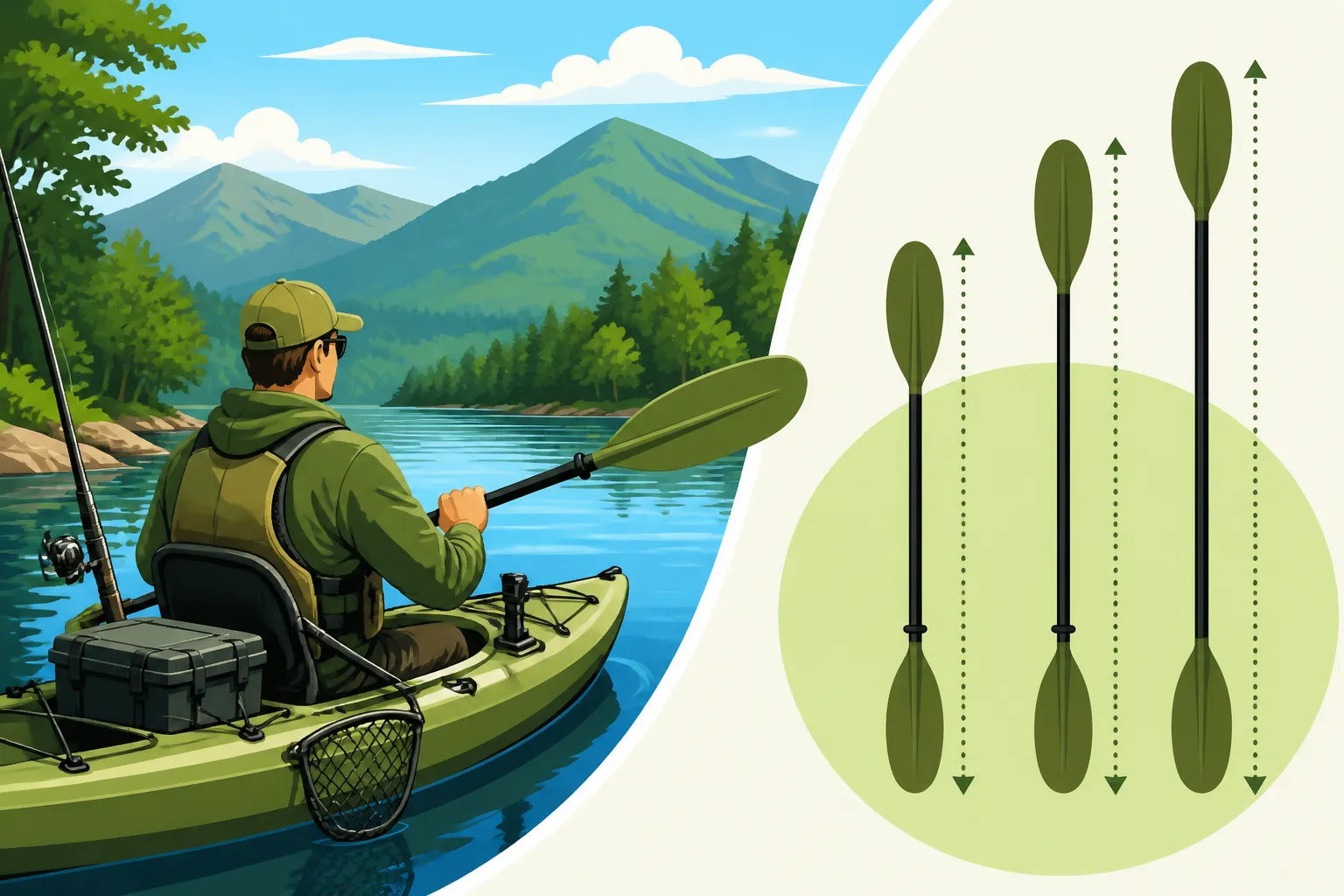
While the sitting test is great, charts offer a quick reference. These charts typically correlate kayak width and paddler height to a recommended paddle length. Keep in mind these are guidelines, not rigid rules.
Here's a simplified guide to get you started:
| Paddler Height | Kayak Width (28-32 inches) | Kayak Width (32-36 inches) | Kayak Width (36+ inches) |
|---|---|---|---|
| Under 5'4" | 220-230 cm | 230-240 cm | 240-250 cm |
| 5'4" – 5'9" | 230-240 cm | 240-250 cm | 250-260 cm |
| 5'10" – 6'2" | 240-250 cm | 250-260 cm | 260-270 cm |
| Over 6'2" | 250-260 cm | 260-270 cm | 270 cm+ |
Note: If your kayak has an elevated seat (e.g., stadium-style), add 10-20 cm to the recommended length from the chart, especially for wider kayaks. This accounts for the extra height you're sitting at. Always refer to your kayak manufacturer's recommendations first, as they often have specific paddle length suggestions for their models.
Accounting for Adjustable Paddles and Blade Types
Many quality fishing kayak paddles, especially those found on Amazon or at specialized retailers, are adjustable. This is a huge benefit! An adjustable paddle allows you to fine-tune the length by 10-20 cm, which means you can:
- Experiment with different lengths on the water to find what feels best for various conditions (wind, current).
- Adjust for different seating positions (high vs. low seat).
- Share a paddle among paddlers of slightly different heights or in different kayaks.
Beyond length, blade design also plays a role in how a paddle feels and performs.
- High-Angle Blades: These are shorter and wider, designed for more powerful, vertical strokes. They excel in generating quick bursts of speed and maneuvering in choppy conditions. If you prefer a more aggressive, high-cadence stroke, you might find you can use a slightly shorter paddle with a high-angle blade.
- Low-Angle Blades: These are longer and narrower, designed for more relaxed, horizontal strokes that are parallel to the water. They are excellent for efficiency over long distances and reduce fatigue. Many kayak anglers prefer low-angle blades for their endurance benefits, and these usually require a slightly longer paddle overall.
Considering the interplay between blade design and desired stroke angle can help you further dial in your ideal paddle.
Common Paddle Lengths and When to Use Them
Let's break down the general ranges you'll encounter and who they're best suited for in the world of Vermont fishing.
Shorter Paddles (220-230 cm)
While less common for dedicated fishing kayaks, these lengths do have their place.
These are typically ideal for:
- NARROWER Kayaks: If you're using a recreational sit-in kayak that's under 28 inches wide, or perhaps a very sleek, specialized fishing model.
- SMALLER Paddlers: Anglers under 5'4" may find these lengths more comfortable, especially in narrower boats or if they prefer a higher, more vertical stroke.
- SPECIALIZED Uses: Sometimes used in very small, shallow water craft where quick, short strokes are needed for precise maneuvering rather than long-distance paddling.
It's rare to see a serious fishing kayak angler regularly using a paddle in this range, as the stability-focused designs of most fishing kayaks necessitate more length to comfortably reach the water.
Medium Paddles (230-240 cm)
This range is often the "sweet spot" for many general-purpose fishing kayaks and average-sized paddlers.
- AVERAGE Width Kayaks: Great for fishing kayaks ranging from 28 to 32 inches wide, which covers a good portion of the market, including many starter models.
- AVERAGE Height Paddlers: Anglers in the 5'4" to 5'9" range will often find this length comfortable and efficient.
- VERSATILE Strokes: These paddles support a balanced stroke, suitable for both covering moderate distances and making controlled maneuvers for casting.
If you're unsure where to start, and you have a moderately wide fishing kayak with a standard-height seat, a 230 cm or 240 cm adjustable paddle is a great option to try, allowing you to fine-tune it on your local waters, whether it's Lake Bomoseen Fishing Guide or a smaller pond.
Longer Paddles (240-260+ cm)
This is where most dedicated fishing kayak paddlers will find themselves, especially with today's wider, more stable fishing platforms.
- WIDE Fishing Kayaks: Absolutely essential for kayaks 34 inches wide and above, particularly those with higher, elevated seats. Models like the NuCanoe Flint or various Hobie Pro Angler series often call for paddles in this range. Without a longer paddle, you'll be constantly struggling to reach the water effectively, leading to frustration and inefficiency.
- TALLER Paddlers: Anglers 5'10" and above will almost certainly need a paddle of at least 240 cm, often pushing into the 250 cm or 260 cm range, especially if they are in a wide kayak with an elevated seat.
- OPEN WATER & WIND: On large bodies of water like Lake Champlain Fishing Guide, where you might encounter wind and chop, a longer paddle can provide more leverage and surface area for powerful, correcting strokes.
- STAND-UP FISHING: If you regularly stand up to fish, the added stability of your wide kayak means you'll need a longer paddle to cover the distance to the water even when sitting down.
Don't be afraid of a longer paddle if your kayak and height dictate it. It will dramatically improve your comfort and control.
Paddle Materials and Blade Designs: Beyond Just Length
While length is paramount, the construction and shape of your paddle's blades also profoundly influence its performance and your overall experience. Understanding these aspects will help you make a fully informed decision.
Material Matters: Weight, Durability, and Cost
Paddle materials vary widely, impacting weight, strength, and of course, price. When you're paddling for hours, even a few ounces can make a huge difference in fatigue.
- Aluminum: This is the most budget-friendly option, often found on entry-level paddles. Aluminum paddles are durable but tend to be heavier and colder to the touch in cool weather. They can also flex more than other materials. If you're just getting started and exploring places like Best family-friendly fishing spots in Vermont, an aluminum paddle might suffice, but for serious angling, you'll likely want to upgrade.
- Fiberglass: A popular mid-range option, fiberglass paddles offer a good balance of weight reduction, stiffness, and durability compared to aluminum. They are warmer to the touch and provide a more efficient stroke. They're a fantastic choice for most kayak anglers looking for a significant upgrade without breaking the bank. Many reputable brands offer excellent fiberglass paddles through retailers like Amazon.
- Carbon Fiber: The crème de la crème of paddle materials, carbon fiber is incredibly lightweight and stiff, offering maximum power transfer with minimal effort. This material is prized for long days on the water, reducing fatigue and making paddling a joy. The trade-off is typically a higher price point. If you spend countless hours pursuing Walleye Fishing on Lake Champlain or long-distance exploration, a carbon fiber paddle is a worthwhile investment. Some carbon fiber paddles also incorporate durable aramid or basalt fibers for added impact resistance.
Blade Shape: High Angle vs. Low Angle
We briefly touched on this, but it's worth a deeper dive as it directly relates to your paddling style and efficiency.
- High-Angle Blades: These blades are shorter and wider, designed for a more vertical, powerful stroke close to the kayak. Your top hand will be higher, and the blade will enter the water closer to the boat. This style provides quick acceleration and good maneuverability, making it ideal for aggressive paddling, navigating currents, or short bursts of speed to get to a hot fishing spot. The drawback is that this style can be more fatiguing over long distances if you're not conditioned for it, and it can cause more splash if your technique isn't precise.
- Low-Angle Blades: These blades are longer and narrower, favoring a more horizontal stroke where the blade enters the water further from the kayak and your top hand is lower. This style is generally more efficient for covering long distances with less fatigue, making it a favorite for many kayak anglers who spend hours on the water. It's often seen as a more relaxed, touring-friendly stroke. Because of the wider stroke arc, low-angle paddling typically benefits from a slightly longer paddle overall.
The best blade shape for you depends on your preferred paddling style, your physical conditioning, and the type of water you fish. Many fishing-specific paddles are designed with a hybrid blade that offers a balance of power and efficiency, catering to the varied needs of an angler.
Tips for Choosing and Maintaining Your Fishing Kayak Paddle
Making the right paddle choice is an investment in your comfort and fishing enjoyment. Here are some final tips to ensure you get the most out of your purchase and keep it in top condition.
Try Before You Buy (If Possible)
This is the golden rule for paddles. Just like you wouldn't buy a fishing rod without feeling its action, try to test paddles of different lengths and materials if you can. Many kayak shops or outfitters will have demo days, or at least allow you to sit in a kayak on their showroom floor with various paddles to get a feel for the length. Even borrowing a friend's paddle that's a different size can offer valuable insight. What looks good on paper (or a chart) might feel awkward on the water, and vice-versa. This hands-on experience is invaluable for confirming your choice, especially before committing to a higher-end paddle from a large online retailer like Amazon.
Investing in a Quality Paddle
It's easy to focus on the kayak, the fish finder, or the Best Tackle for Vermont Smallmouth Bass, but skimping on your paddle is a common mistake. A higher-quality paddle, especially one made of fiberglass or carbon fiber, will be lighter, stiffer, and more comfortable. The reduced weight means less fatigue over a long day of paddling and fishing, allowing you to stay on the water longer and fish more effectively. The improved stiffness translates to more efficient power transfer with each stroke, meaning you move further with less effort. Think of it as investing in your own energy and enjoyment. A good paddle is often one of the best upgrades you can make to your kayak fishing setup.
Proper Paddle Care and Storage
Your paddle is constantly exposed to UV rays, saltwater (if you venture to coastal areas, though less of a concern for Vermont Lake Champlain Fishing Rules), and impact. A little care goes a long way in extending its lifespan.
- Rinse After Use: Always rinse your paddle with fresh water after each outing, especially if you've been in brackish or salty conditions. This removes dirt, sand, and salt that can corrode components or damage the shaft.
- Protect from Sun: UV rays can degrade plastics and resins over time. Store your paddle out of direct sunlight when not in use. A garage, shed, or even a paddle bag will protect it.
- Avoid Impact: Try to avoid banging your paddle against rocks, concrete, or the sides of your kayak. While paddles are durable, repeated hard impacts can weaken the blades or shaft.
- Check Connections: If you have a two-piece or adjustable paddle, occasionally check the ferrule (the connection point) for sand or debris. Clean it if necessary to ensure a snug fit.
By carefully considering your personal dimensions, kayak characteristics, and fishing style, and by taking good care of your equipment, you'll choose a paddle that truly enhances your Vermont fishing adventures. A perfectly matched paddle will become an extension of you, quietly propelling you to your next big catch.
Disclaimer
This article is for general informational purposes only and does not constitute professional advice. Laws, prices and regulations vary by location and change over time. Consult a qualified professional for guidance on your specific situation.