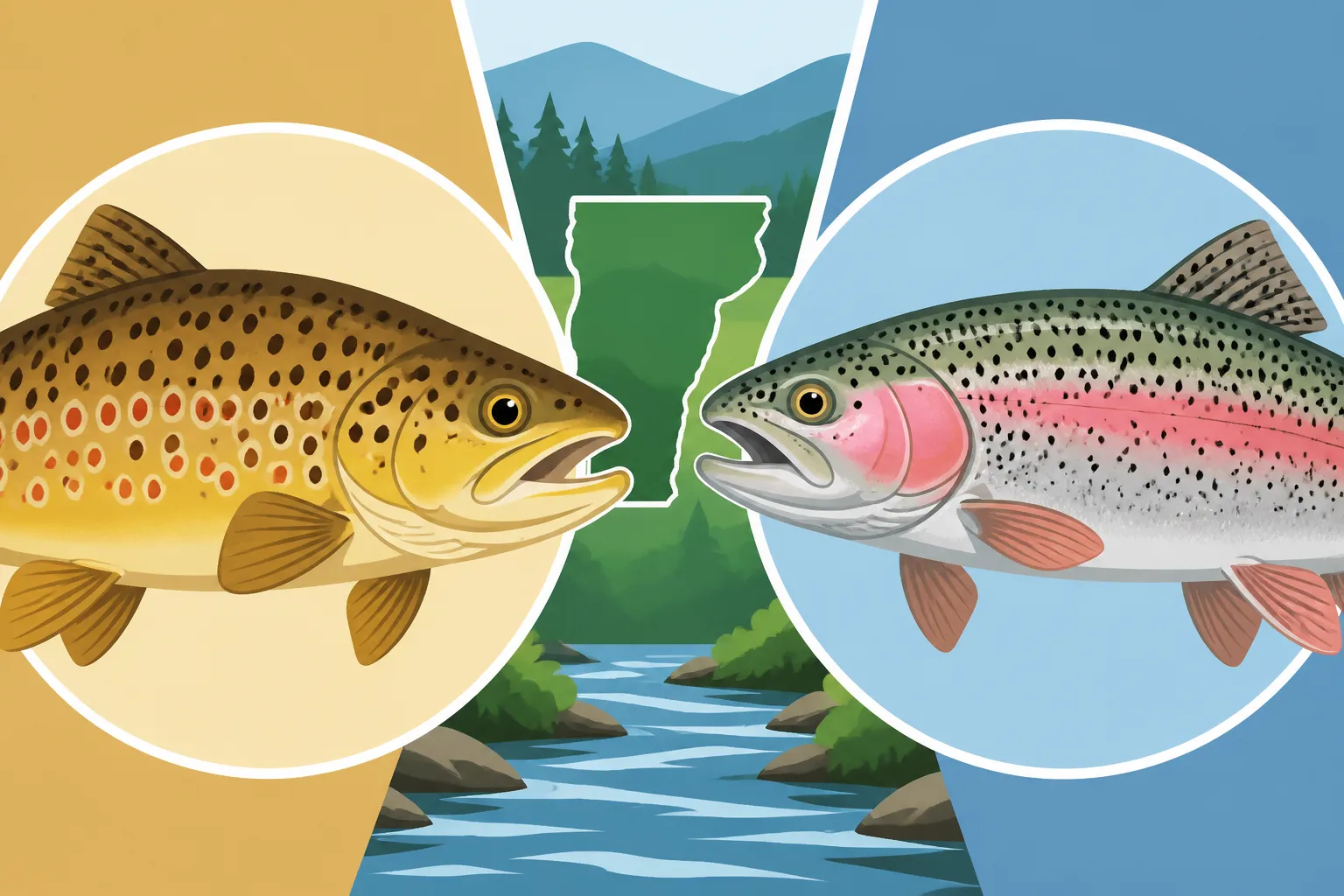
How to tell a brown trout from a rainbow trout
It's happened to every angler, myself included: you reel in a beautiful trout from a shimmering Vermont stream, and for a moment, you're not quite sure if it's a vibrant rainbow or a speckled brown. The confusion is real, especially when you consider how much coloration can vary even within the same species depending on diet, habitat, and even spawning phase. This guide is here to walk you through the distinct features that will help you confidently tell a brown trout from a rainbow trout, ensuring you're always in the know about your catch.
The Distinctive Features of a Brown Trout in Vermont
Brown trout ( Salmo trutta ) are truly magnificent fish, revered by many anglers for their cunning and fighting spirit. They're not native to Vermont, having been introduced from Europe, but they've certainly made themselves at home, thriving in many of our rivers and larger streams. Understanding their key characteristics is the first step to telling them apart from their rainbow cousins.
Coloration and Body Shape
When you first lay eyes on a brown trout, you'll likely notice a striking blend of bronze, gold, and often an olive-brown hue along their backs, fading into a lighter, creamy yellow or even white belly. This overall earthy palette is a strong indicator. Their backs are usually darker, sometimes appearing almost greenish-black, providing excellent camouflage against stream bottoms and rocky structures.
Think of them as built for ambush. Their body shape tends to be more elongated and somewhat stockier or thicker than a rainbow trout of similar length. This robust build often gives them a powerful, almost barrel-chested appearance, especially larger specimens that have spent years hunting in the deeper runs of rivers like the Battenkill or the White River. You'll rarely see a brown trout that looks overtly "sleek" in the way some rainbows do; they're more rugged.
The subtle shifts in their base coloration can be fascinating. A brown trout caught from a dark, tannin-stained pool might appear much darker and more olive, almost camouflaged against the murky water. Conversely, a fish from a clear, gravel-bottomed stretch might exhibit more vibrant gold and bronze tones. It's this natural variability that can sometimes throw anglers off, making a clear understanding of other features even more critical for positive identification.
Spotting Patterns and Haloes
This is often the most reliable visual cue for brown trout: their spots. Brown trout typically feature prominent dark spots on their flanks, sides, and gill plates. These spots are usually larger and less numerous than those found on a rainbow trout. But here's the kicker, the feature that truly sets them apart: many of these dark spots will have a lighter "halo" or ring around them, almost like a ghostly outline, particularly noticeable on the upper half of their body. These halos can range from a subtle shading to a clearly defined circle.
Beyond the dark spots, brown trout also possess distinctive red or orange spots scattered along their sides, often much brighter and more vivid than any red coloration you might see on a rainbow. These colorful spots are a hallmark of the species and really pop against their olive-brown backdrop.
Now, here’s a critical point for distinguishing them: look at the tail fin. Brown trout, in most cases, will have little to no spotting on their caudal (tail) fin. It will generally be a more uniform color, often a darker olive or brown, sometimes with a faint marbling but lacking the distinct spots you see on the rest of their body. This lack of tail spotting is a classic brown trout characteristic and often the quickest way to confirm your identification when you're holding the fish. You won't find those tiny, pepper-like spots covering the tail like you would on a rainbow.
Mouth and Jaw Structure
The mouth of a brown trout is another excellent identifier, especially for more seasoned anglers. They tend to have a larger mouth, one that often extends noticeably further back than the eye. When you look at their jaw, it has a more formidable, predatory appearance, almost like they're perpetually scowling. This larger mouth is well-suited for their diet, which can include a wide array of insects, crayfish, smaller fish, and even mice or frogs as they grow larger.
Consider a large brown trout caught from a deep pool in the Lamoille River; its jaw might seem quite robust and slightly underslung, giving it a powerful, intimidating look. This physical characteristic reflects their aggressive feeding habits and their status as a top predator in many Vermont waters. A good visual comparison is to imagine a fish that looks like it's ready to devour anything that crosses its path – that's often a brown trout.
Their teeth can also feel a bit more pronounced if you're carefully handling the fish (always with wet hands and minimal contact, of course!). While you shouldn't rely on feeling teeth for identification, the overall impression of a larger, more powerful jaw is a consistent trait. This robust mouth, combined with their spots and coloration, paints a clear picture of the brown trout's unique identity.
Unmistakable Marks of a Rainbow Trout in Vermont
Rainbow trout ( Oncorhynchus mykiss ) are beloved in Vermont for their acrobatic fights and their beauty. Many of the rainbows you encounter in Vermont waters are stocked fish, though wild populations do exist in some areas. Knowing their tell-tale signs is crucial for accurate identification, especially when distinguishing them from browns.
The Signature Pink/Red Stripe
Without a doubt, the most iconic and usually the most reliable feature of a rainbow trout is the distinct, iridescent pink or reddish stripe that runs horizontally along their side, from their gill plate all the way to their tail. This stripe is what gives them their name, and it's truly a sight to behold, often shimmering with a pearlescent quality when the light hits it just right.
The intensity of this stripe can vary significantly. Some rainbow trout will have a vibrant, almost neon-pink band, particularly healthy, actively feeding fish, or those in prime spawning coloration. Other times, the stripe might be more muted, appearing as a subtle rosy blush or a faint orange hue, especially on fish from different water conditions or during non-spawning periods. A rainbow caught from a shaded, deep pool in a spring-fed brook might have a softer stripe than one basking in the sun of a larger lake.
Even if the stripe isn't intensely colored, its presence – that distinctive lateral band – is a strong indicator. You'll find this stripe on most rainbow trout, whether they're a freshly stocked fish from a local pond or a robust wild specimen that has made a home in a remote mountain stream. This visual alone often eliminates the possibility of it being a brown trout.
Overall Color and Body Profile
In terms of overall color, rainbow trout typically exhibit a more silvery, olive-green, or even bluish-gray base coloration on their backs, transitioning to a bright silver or white belly. They often have a brighter, more metallic sheen compared to the generally earthier tones of a brown trout. Think of them as looking a bit more "polished" or "chromey."
Their body profile tends to be more streamlined and torpedo-shaped, giving them an athletic, sleek appearance. They are built for speed and acrobatic leaps, characteristics that make them such a thrilling catch. A rainbow trout usually feels slender and powerful in your hands, designed to cut through the water efficiently. You might notice this especially when comparing a rainbow and a brown of similar length; the rainbow will often look comparatively leaner.
The overall impression is one of elegance and agility. The silvery sides often catch the light beautifully, making them stand out in the water. This combination of brighter base colors and a more hydrodynamic body shape is a consistent feature that helps set them apart from the more robust and camouflaged brown trout.
Spotting on Body and Tail
Here's another crucial difference: rainbow trout are typically covered in numerous small, dark spots. These spots are usually more uniformly distributed across their body, from their head, along their flanks, and importantly, they extend distinctly onto their caudal (tail) fin. Think of it like a fine peppering rather than the larger, more scattered spots of a brown trout.
When you look at a rainbow trout's tail, you'll see those spots clearly visible, often in neat rows or a dense pattern. This is a key identifier and a direct contrast to the mostly unspotted tail of a brown trout. Whether the fish is small or large, these spots on the tail are a consistent trait for rainbows. They might be tiny, almost like pinpricks, but they're there.
These spots also lack the distinct "haloes" that are so common on brown trout. While some darker spots might appear on a rainbow's body, they generally don't have that lighter ring around them. The spots themselves are typically dark, solid, and circular or oval in shape. A fish like the wild rainbows in a cold, clear section of the White River will often display these spots with remarkable clarity, confirming its identity instantly. If you see spots running all the way out to the very edge of the tail, you've almost certainly got a rainbow trout. Trout Species Identification Guide for Vermont can offer even more visual references.
Subtle Clues and Habitat Differences that Aid Identification
Sometimes, the primary features alone aren't enough, or you're trying to make a quick identification from a distance or in challenging light. That's when some of the more subtle clues and an understanding of their preferred habitats can come into play.
Fin Characteristics
While not always a definitive differentiator, paying attention to the fins can sometimes offer additional hints. Both brown and rainbow trout possess an adipose fin (the small, fleshy fin between the dorsal and caudal fins), which is a common characteristic of salmonids. However, there can be subtle differences in the coloration or shape of other fins.
For instance, the pectoral and pelvic fins on a brown trout might sometimes have a yellowish or orange tint, especially around their edges, particularly noticeable on larger, older fish. The anal fin might also show a hint of this warmer coloration. For rainbow trout, their fins tend to be more translucent or silvery, often blending with their overall lighter body tone, though some can have darker edges. Again, these are not hard-and-fast rules, as fin coloration can be influenced by diet and water chemistry, but they can be part of a composite identification when other features are ambiguous. It’s definitely not the first place to look, but a secondary confirmation.
Another subtle observation can be the leading edge of the fins. Sometimes, particularly on stream-bred rainbows, the leading edge of the dorsal and pectoral fins might have a milky white or opaque appearance, a trait not typically as pronounced in brown trout. These minor details can be helpful if you're trying to distinguish between two fish with less distinct main features, perhaps younger individuals.
Habitat and Behavior Cues
Where you catch a trout can often give you a strong hint, though it's important to remember that both species can overlap considerably in their preferred waters. Generally speaking, brown trout tend to be more tolerant of warmer water temperatures and slightly lower water quality than rainbows. This means you might find them thriving in larger, slower sections of rivers, or even in some ponds that might be a bit too warm for a true wild rainbow in the height of summer. They are also notoriously elusive and often prefer holding in deeper, darker pockets, under cut banks, or near woody debris.
Rainbow trout, especially wild populations, often prefer colder, clearer, well-oxygenated streams and rivers. They can also be found in many lakes and ponds where they are regularly stocked. Rainbow Trout Stocking in Vermont happens across a variety of water bodies. When hooked, rainbows are known for their spectacular aerial acrobatics – leaping clear of the water, tail-walking, and generally putting on a show. Brown trout, while powerful fighters, tend to stay deeper, making strong runs and bulldogging rather than leaping as often.
If you're fishing a small, pristine mountain brook high in the Green Mountains with crystal-clear, frigid water, and you hook a trout that jumps repeatedly, it's more likely a rainbow (or even a native brook trout). If you're targeting a larger, slower river stretch known for its challenging fishing, and you pull out a fish that fought deep and hard, staying close to structure, it has a good chance of being a brown. These are general tendencies, of course, and not definitive, but they certainly add to the puzzle.
Genetic and Stocking Considerations
It's also worth briefly touching on the background of these fish in Vermont. Brown trout are an introduced species, meaning they are not native to North America. They were brought over from Europe and have been successfully established in many Vermont waters, both through stocking and natural reproduction. They are resilient and have found a niche in many environments. You can learn more about their patterns in Brown Trout Habits in Vermont Streams.
Rainbow trout, while native to the Pacific drainages of North America, are also largely a stocked species in much of Vermont, especially in easily accessible ponds and rivers that receive regular fish plantings. However, there are self-sustaining wild rainbow populations in various coldwater streams and rivers, particularly those with good spawning habitat. These wild rainbows tend to be more vibrant and harder fighting than their hatchery-raised counterparts.
Understanding this context is helpful because a freshly stocked fish from a hatchery might have slightly less pronounced features than a wild, stream-bred specimen. Hatchery fish, whether brown or rainbow, often have slightly worn fins due to rearing conditions, and their colors might be a bit subdued compared to a fish that has spent its entire life in a natural environment. This knowledge won't change the identification criteria, but it helps explain some of the variations you might observe in the wild.
Practical Tips for Anglers on the Water
Getting your trout identification skills down pat isn't just for showing off; it's essential for adhering to regulations, especially since size and bag limits can differ between species in some waters. Here are some actionable tips to help you become a trout identification pro.
Side-by-Side Comparison
Sometimes, seeing the differences laid out clearly is the best way to solidify your understanding. Here’s a quick comparison table of the most prominent features:
| Feature | Brown Trout | Rainbow Trout |
|---|---|---|
| Lateral Stripe | Absent | Distinct pink/reddish stripe along the side |
| Body Color | Earthy tones (gold, bronze, olive-brown) | Silvery, olive-green, or bluish-gray |
| Spotting | Dark spots, often with light "haloes" + red/orange spots | Numerous small, dark spots, no halos |
| Tail Fin Spots | Generally absent (unspotted) | Distinct spots clearly visible on the tail fin |
| Mouth Size | Larger, jaw extends past the eye | Smaller, jaw usually doesn't extend past the eye |
| Body Shape | More robust, stockier, elongated | More streamlined, torpedo-shaped, sleeker |
| Typical Habitat | Tolerates warmer water, rivers, larger streams | Prefers colder, clear, well-oxygenated water |
| Fighting Style | Strong, deep runs; less likely to jump | Acrobatic leaps, fast runs |
This table serves as a handy mental checklist you can quickly run through when you land a fish. Focusing on the presence or absence of the lateral stripe and the spotting on the tail fin will usually give you the definitive answer.
Photography and Reference Guides
In this day and age, your smartphone is one of your best fishing tools! When in doubt, quickly snap a clear photo of your catch before releasing it. Make sure to get a shot of its side, head, and especially its tail. Later, when you're back home or have better signal, you can compare your photo to reliable reference guides. Books like a comprehensive guide to North American freshwater fish, or online resources from reputable wildlife agencies (like the Vermont Fish & Wildlife Department) are invaluable. You can often find excellent field guides on platforms like Amazon that are specifically tailored to regional fish species, which can be an incredible asset for on-the-water identification.
There are also many excellent online forums and social media groups dedicated to Vermont fishing where experienced anglers are often happy to help with identification if you share a clear photo. Just remember to handle the fish minimally, with wet hands, and release it quickly. The clearer the photo, the easier it is for others (or yourself later) to identify it accurately.
When in Doubt: Practice Catch and Release
Above all, if you are truly unsure about the identity of a fish, especially if you're concerned about violating specific regulations for a certain species, the safest and most responsible course of action is to practice catch and release. This ensures that the fish can continue to thrive, and you avoid any potential issues.
Vermont's fishing regulations can sometimes have nuances, such as Vermont Trout Limit and Possession Rules which might vary depending on whether it's a wild or stocked fish, or even by specific water body. By releasing an unidentified fish, you're contributing to the health of the fishery and showing respect for the resource. It’s always better to be safe than sorry. Enjoy the moment of the catch, appreciate the beauty of the fish, and send it back to swim another day. After all, the goal is to enjoy Vermont's incredible fishing, and responsible angling ensures that enjoyment continues for generations to come.
Disclaimer
This article is for general informational purposes only and does not constitute professional advice. Laws, prices and regulations vary by location and change over time. Consult a qualified professional for guidance on your specific situation.