Best jon boat size for shallow rivers
Navigating Vermont’s beautiful, often rocky, and sometimes deceptively shallow rivers with a boat can be a real headache if you don't have the right equipment. Many anglers struggle with boats that are either too big to maneuver tight bends or too fragile for scraping over submerged rocks, leading to frustration and even damage. This guide is here to help you cut through the confusion and determine the best jon boat size for tackling the unique challenges and incredible fishing opportunities our Vermont rivers offer.
Understanding Vermont’s River Dynamics and Your Fishing Needs
Before you even start looking at boat specs, it's crucial to really think about where you'll be fishing and how you'll be fishing. Vermont rivers aren't all created equal. You have everything from the broad, somewhat deeper stretches of the Connecticut River to the winding, rock-laden flows of the Lamoille River or Otter Creek. Your perfect jon boat needs to match these realities.
The Reality of Shallow Water and Obstacles
Vermont's rivers, particularly after a dry spell or away from the main channels, can be incredibly shallow. We're talking inches, not feet, in some spots. This isn't like fishing a deep lake. You'll encounter sandbars, gravel beds, exposed rocks, and submerged logs or branches. A boat that draws too much water is simply going to get stuck, forcing you to get out and push, which is never fun, especially in cold water or strong currents.
Beyond just depth, the presence of obstacles dictates how easily you can navigate. Rivers like the White River or the West River have plenty of riffles and small rapids that require nimble handling. A longer, wider boat might offer more stability in open water, but it becomes a cumbersome beast when you're trying to thread the needle between two boulders or make a sharp turn around a bend choked with alders. It's a constant dance between navigating and actually fishing. You might find yourself wanting a boat that can be easily pulled over a shallow bar, or one that can handle a bit of scraping without compromising its integrity.
Your Target Fish and Fishing Style
The type of fishing you plan to do also heavily influences your ideal boat size. Are you primarily casting for smallmouth bass on the Missisquoi River, which often involves standing and precise casts to structure? Or are you drifting worms and bobbers for trout in slightly slower, deeper pools on the Winooski River? Perhaps you're looking to occasionally troll a fly for trout or chase fall salmon in tributaries.
If you're an avid stand-up caster, stability will be paramount. A wider beam (the boat's width) becomes more important than sheer length. If you often fish solo, a smaller, lighter boat is a breeze to launch and retrieve. But if you typically bring a buddy and a pile of gear—extra rods, a cooler, tackle boxes—you’ll need more space. Consider how many people will realistically be in the boat with you, and what gear you can't live without. This isn't just about weight capacity, but also about comfortable working space. Imagine trying to net a feisty bass with two people and all your gear crammed into a tiny boat – it's a recipe for chaos!
Sizing Up Your Options: Length, Beam, and Transom
When we talk about jon boat size, we're really talking about a combination of factors: length, width (beam), and the transom height (where your motor attaches). Each plays a critical role in how the boat performs on shallow Vermont rivers.
Optimal Length for River Maneuverability
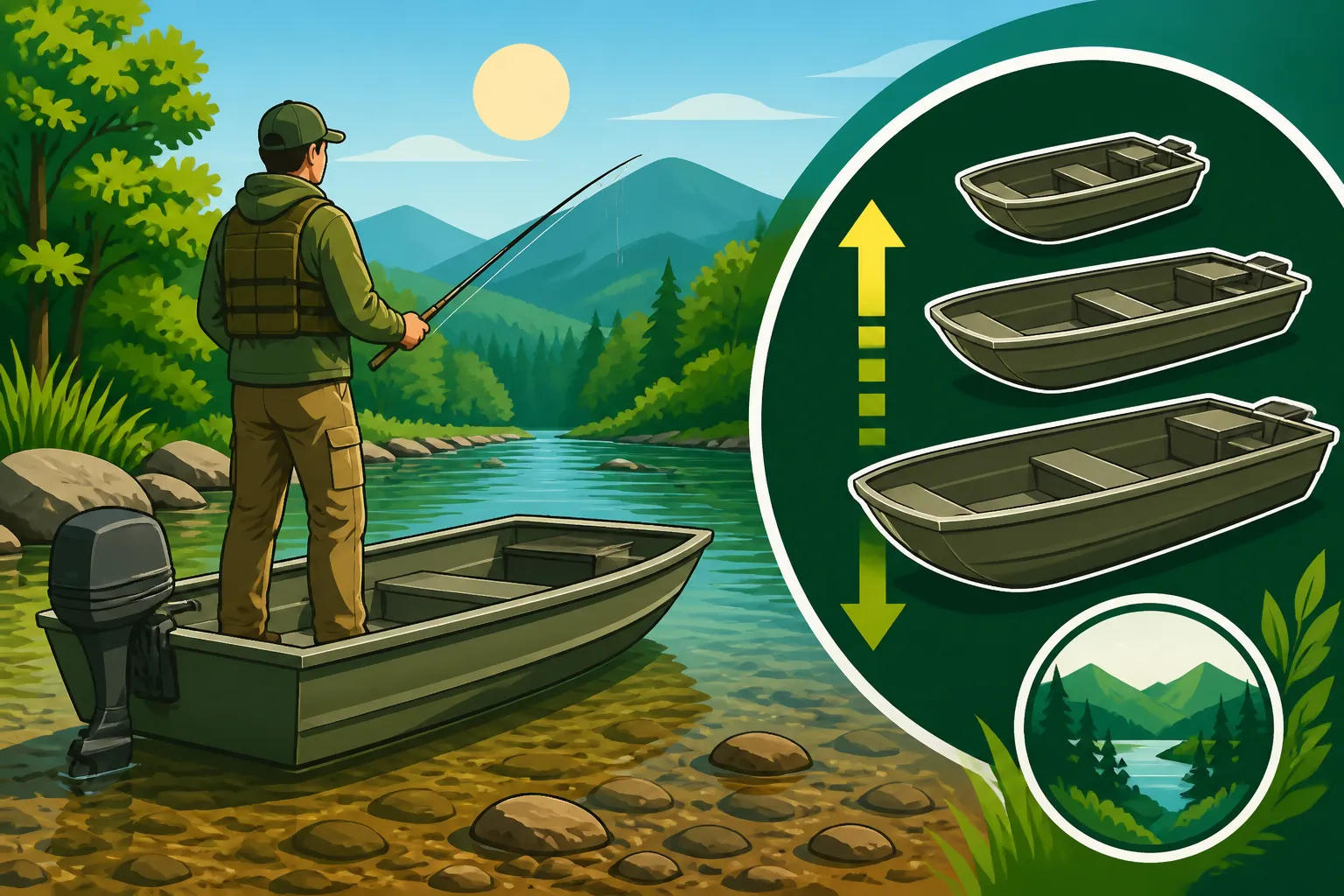
For shallow, winding Vermont rivers, a jon boat length between 10 to 14 feet is often considered the sweet spot.
- 10-12 Foot Boats: These smaller boats are incredibly agile. They're easy to launch, retrieve, and portage around obstacles or shallow rapids. They turn on a dime, making them ideal for tight river bends and navigating through dense cover. If you primarily fish solo or with one other person, and prioritize getting into the smallest, most remote stretches, a 10 or 12-footer is fantastic. Think about those hidden pockets on the Black River or the narrower sections of the Ottauquechee River. The downside is less deck space and potentially a less stable platform, especially if you like to stand and cast. They're also more susceptible to being pushed around by strong currents.
- 14-Foot Boats: This length offers a good balance of space and maneuverability. You get more room for a fishing partner and gear, plus increased stability. A 14-foot jon boat can still navigate many river sections, though it might feel a bit more cumbersome in extremely tight or swift areas compared to its shorter counterparts. This size is a good all-rounder if you're looking for something versatile enough for both larger river sections and smaller lakes. It can handle a bit more chop and provides a smoother ride on stretches where the river opens up, like parts of the Connecticut River.
Anything much longer than 14 feet, say 16 feet or more, generally becomes too large and unwieldy for the typical shallow Vermont river. You'll struggle with turning, portaging, and getting into those prime, hard-to-reach fishing holes.
The Importance of Beam (Width) for Stability
The beam, or width, of your jon boat directly impacts its stability. On a river, stability is not just about comfort; it's about safety, especially if you're standing to cast or moving around in the boat.
- Narrower Beams (Under 42 inches at the bottom): While these boats might cut through the water slightly faster with less horsepower, they can feel very tippy, especially when standing. This isn't ideal for active fishing where you're constantly shifting weight. They might also be less stable when loaded with gear.
- Wider Beams (42 inches to 50+ inches at the bottom): A wider beam offers significantly more stability, making it much safer and more comfortable for standing and casting. This is especially true for boats with a flat or nearly flat bottom, which is characteristic of most jon boats. For a 12 to 14-foot jon boat, aim for a bottom width of at least 42 inches, and ideally closer to 48 inches or more, if you value stability. This extra width is a game-changer when you're casting to Best Smallmouth Bass Spots on Lake Champlain tributaries or targeting Vermont Bass Minimum Length Limits. You'll feel much more secure moving around and fighting a fish.
Transom Height and Motor Compatibility
The transom is the flat back section of the boat where your motor mounts. Jon boats typically come with either a 15-inch (short shaft) or 20-inch (long shaft) transom.
- 15-inch Transom: This is the most common for smaller jon boats and is generally what you'll want for shallow river applications. It allows for the use of a short-shaft outboard motor, which keeps the propeller shallower in the water, reducing the chance of hitting rocks or the riverbed.
- 20-inch Transom: While sometimes found on larger jon boats, a 20-inch transom means your motor's propeller will sit deeper in the water, making it more prone to striking obstructions in shallow rivers. If you already own a long-shaft motor, you might consider a 20-inch transom boat, but for dedicated shallow river use, the 15-inch is usually preferred. Always match your motor's shaft length to your boat's transom height to ensure optimal performance and prevent damage.
Here's a quick comparison of common jon boat sizes and their general suitability for Vermont's shallow rivers:
| Feature | 10-foot Jon Boat | 12-foot Jon Boat | 14-foot Jon Boat |
|---|---|---|---|
| Length | 10 ft | 12 ft | 14 ft |
| Beam (Bottom) | 36-40 inches | 40-44 inches | 44-52 inches |
| Transom | 15-inch (Short Shaft) | 15-inch (Short Shaft) | 15-inch (Short Shaft) |
| Capacity | 1-2 people, light gear | 2-3 people, moderate gear | 3-4 people, substantial gear |
| Draft | Very shallow | Shallow | Moderate |
| Maneuverability | Excellent for tight turns, small obstacles | Very good, handles most river sections | Good, can be cumbersome in tight spots |
| Stability | Fair (can be tippy if standing) | Good (better for standing) | Excellent (very stable for casting) |
| Portability | Easiest to car-top, drag, launch | Easy to trailer, manageable to launch | Requires trailer, harder to drag |
| Best For | Solo angler, very shallow, tight rivers, small ponds | Solo/duo, versatile river fishing, small lakes | Duo/trio, larger river sections, medium lakes |
Powering Your Shallow River Jon Boat
Choosing the right motor for your shallow river jon boat is just as critical as the boat itself. You need power to get upstream, but also the ability to navigate through skinny water without destroying your prop.
Outboard Motors: Prop vs. Jet Drive
For most jon boat anglers on Vermont rivers, a traditional propeller-driven outboard motor is the standard. However, in shallow water, props are vulnerable.
- Propeller Outboards: These are cost-effective and efficient. For a 10-14 foot jon boat, a 9.9 HP to 25 HP motor is usually sufficient. On a 12-foot boat, a 9.9 HP can get you where you need to go, while a 14-foot boat might benefit from a 15 HP or 20 HP. The key is to run them with a shallow-water drive setting, if available, and to be extremely vigilant for submerged rocks. Even with careful operation, hitting something is almost inevitable, so carry a spare prop! Brands like Mercury, Yamaha, and Honda are popular choices. You can often find a good selection of smaller outboards at stores like Bass Pro Shops.
- Jet Drive Outboards: If you are serious about extremely shallow water and don't mind the added expense and reduced fuel efficiency, a jet drive outboard is the ultimate tool. Instead of a propeller, a jet drive sucks water in and expels it out the back, allowing the motor to run in just a few inches of water (often 4-6 inches). This means you can get into places a prop boat simply can't. They do, however, require more horsepower to achieve the same thrust as a prop motor (e.g., a 40 HP jet might perform like a 25-30 HP prop), and they are noisier and burn more fuel. For very rocky, skinny rivers with unpredictable depths, a jet drive can truly open up new fishing grounds.
Regardless of the type, remember that Vermont Boating Laws for Anglers will apply, and you'll need to be aware of regulations regarding motor size in certain waters.
Trolling Motors for Stealth and Precision
Even with a gasoline outboard, a bow-mounted electric trolling motor is a fantastic addition for river fishing.
- Stealth: Electric motors are quiet, allowing you to sneak up on fish without spooking them. This is invaluable when targeting wary trout or bass in clear water.
- Precision Boat Control: When drifting a river, a trolling motor allows you to subtly adjust your position, hold against a current, or precisely work a stretch of bank or a specific piece of structure. Many modern trolling motors have GPS anchoring features that can hold your boat in place even in current, freeing you up to focus on fishing. For example, a Minn Kota or MotorGuide model can make a huge difference in your ability to effectively fish a section of the Battenkill for Fly Fishing for Trout in Vermont.
- Accessibility: In some extremely shallow or ecologically sensitive areas, only electric motors might be permitted. Having one expands your access. You can find a wide range of trolling motors and accessories, often with customer reviews, on sites like Amazon.
When choosing a trolling motor, consider the thrust (measured in pounds) needed for your boat's weight and the strength of the river currents you'll be facing. For a 12-14 foot jon boat, something in the 55-80 lb thrust range is typically a good starting point. You'll also need a good deep-cycle marine battery to power it.
Balancing Portability and Stability: The Real-World Compromise
The decision on your jon boat size ultimately comes down to a trade-off between how easily you can get it to the water and how stable it feels once you're there.
Ease of Transport and Launch
Smaller jon boats (10-12 feet) are generally easier to transport. You can often car-top them on a truck or a larger SUV, or at least manage them on a small utility trailer. This makes them ideal for reaching those less-accessible spots where there might not be a proper boat ramp, forcing you to use undeveloped launch points. Imagine needing to launch on a grassy bank or drag your boat a short distance from the parking area to the water's edge – a lighter, smaller boat makes this far less of a chore. If you're fishing solo, this factor becomes even more critical.
Larger 14-foot jon boats will almost certainly require a dedicated trailer. While not a huge issue for public boat launches on bigger rivers, it limits your options for getting into those truly wild, backcountry stretches. However, for fishing on bigger waters like the Connecticut River or wide sections of the Lamoille, the stability and room of a 14-footer on a trailer are well worth the minor inconvenience. Ensure you check out Vermont Boat Registration Requirements and Vermont Out-of-State Boat Validation Sticker Rule if you're trailering.
Comfort and Safety for Your Fishing Adventures
No matter the size, safety should always be your top priority. Make sure your chosen jon boat has adequate space for you, your passengers, and all your gear without being overcrowded. Overloading a boat, especially a smaller one, significantly reduces its stability and can be extremely dangerous on a river with currents. Always wear a life jacket—it's not just a good idea, it's often a legal requirement, especially for children under 12, as outlined in Life Jacket Requirements for Vermont Boaters.
A wider, more stable boat (typically 12-14 feet with a good beam) will provide a much more comfortable fishing experience, especially if you plan on long days or like to stand and stretch. The last thing you want is to feel constantly on edge, worrying about tipping over. Consider adding some comfortable seating or even a casting brace if you plan to spend a lot of time on your feet. You might also want to look into a good Best Anchor System for River Fishing to hold your position safely.
Ultimately, the best jon boat size for shallow rivers in Vermont is one that perfectly balances your personal fishing style, the number of anglers you typically bring, and the specific river conditions you’ll encounter most often. Do your research, consider your needs, and you'll be well on your way to enjoying countless successful days on Vermont's beautiful waters.
Disclaimer
This article is for general informational purposes only and does not constitute professional advice. Laws, prices and regulations vary by location and change over time. Consult a qualified professional for guidance on your specific situation.