Best Anchor System for River Fishing
There’s nothing quite as frustrating as trying to hold your boat steady in a fast-moving Vermont river, only to have the current drag you downstream, spinning you around just as you’re about to make the perfect cast. We’ve all been there, battling the elements, wishing for a magical way to stay put and truly focus on the fish. This comprehensive guide will walk you through everything you need to know about choosing, setting up, and safely using the best anchor system for river fishing, so you can spend less time fighting the current and more time landing those beautiful Vermont catches.
Understanding River Dynamics and Your Fishing Needs
Before you even think about which anchor to buy, it's absolutely crucial to understand the environment you'll be fishing in and what you need that anchor to do for you. Vermont's rivers are incredibly diverse, from the gentle flows of smaller streams to the powerful currents of larger waterways, and each presents its own unique challenges for anchoring.
The Power of River Current and Bottom Composition
River currents are dynamic, constantly changing with recent rainfall, dam releases, and the natural flow of the watershed. A spot that was a calm eddy last week might be a raging torrent after a spring rain. You need an anchor system that can effectively counter this force without putting you or your boat in danger. Think about the horsepower of the water pushing against your hull – a tiny anchor designed for a pond simply won't cut it.
Equally important is the riverbed itself. Are you fishing the sandy, silty stretches of the Connecticut River? Or are you aiming for trout in the rocky, boulder-strewn sections of the Battenkill? Perhaps you're in an area with a lot of submerged logs and debris, like parts of the Winooski. Each bottom type requires a different approach. A traditional fluke anchor designed for mud or sand might just skip along a rocky bottom, while a grapnel anchor could get irretrievably wedged between boulders. Understanding the likely bottom composition where you plan to fish is the first step in selecting an effective anchor.
Matching Your Anchor System to Your Boat Type
Your boat's size and weight are paramount when considering an anchor system. A solo kayaker fishing a small brook needs a vastly different setup than two anglers in a drift boat on a wider river. The larger and heavier your craft, and the more surface area it presents to the current, the more holding power you'll need from your anchor.
For kayaks and canoes, portability and ease of deployment are key. You'll want something relatively light, yet effective enough to hold you in a moderate current. Jon boats and smaller aluminum fishing boats offer more stability and space, allowing for heavier, more robust anchor options. Larger drift boats or powered river boats will require substantial anchors, often with dedicated anchor winches or pulley systems, to safely hold their position. Never underestimate the strain the current can put on your boat and its anchoring points; using an undersized anchor or inadequate attachment can lead to dangerous situations, including snapping off cleats or even capsizing in extreme cases.
Types of Anchors for River Fishing
The world of anchors isn't just one-size-fits-all. For river fishing, a few specific types stand out for their effectiveness in current and varied bottom conditions. Let's break down the most common and how they perform.
Pyramid and River Anchors
These are arguably the most popular and often most effective anchors for river fishing, and for good reason. Pyramid anchors, also sometimes called mushroom or box anchors, are typically made of cast iron and feature a compact, heavy design. Their pyramid shape helps them dig into soft bottoms like mud or sand, and their flat sides resist being rolled by the current. River anchors, in particular, often have a more square or rectangular base, sometimes with "claws" or fins, specifically designed to dig into gravel or rocky bottoms without getting hopelessly stuck. They rely primarily on their weight and shape to embed themselves.
The beauty of these anchors lies in their simplicity and relatively good holding power across a range of typical riverbeds. They don't have moving parts that can break, and they're less prone to fouling than some other designs. While they excel in gravel, sand, and even light mud, they can still drag on slick rock or through heavy current if undersized for your boat. Many anglers find them to be a versatile choice for general river use, offering a good balance between holding power and ease of retrieval. You'll often see these anchors as the standard choice for drift boats and jon boats navigating Vermont's wider rivers.
Grapple or Folding Anchors
Grapple anchors, sometimes referred to as folding anchors, feature several prongs (usually four) that splay out. They are fantastic for digging into rocky bottoms, catching onto submerged logs, or wedging into crevices. Their design is also very compact when folded, making them a favorite for kayakers and canoeists who have limited storage space.
However, their strength is also their weakness. While excellent at grabbing onto structure, they are notoriously prone to getting snagged and irretrievably stuck, especially in rivers with lots of rocks, fallen trees, or heavy debris. This is why a breakaway rigging system (which we'll discuss later) is practically mandatory when using a grapple anchor in a river. They generally don't hold well in soft mud or sand, as the prongs don't offer enough surface area to embed deeply. If you're frequently fishing rocky sections of rivers like the White River or upper stretches of the Lamoille River where snags are common, a grapple anchor might be considered, but always with extreme caution and proper rigging.
Drift Anchors and Drag Chains
Sometimes you don't want to come to a complete stop, but rather slow your drift to a fishable speed. This is where drift anchors, often in the form of heavy chains or specifically designed drag chains, come into play. These aren't meant to stop your boat entirely, but rather to create friction with the riverbed, significantly reducing your speed. They are particularly effective when Drift Fishing for Trout in Vermont Rivers or How to Fish a River for Smallmouth Bass.
A simple, heavy chain, often 10-20 feet long and weighing 10-20 pounds, can be incredibly effective. It drags along the bottom, snagging on small irregularities and providing consistent resistance. The beauty is that if it does snag, a steady pull will usually free it as it simply "walks" over the obstruction. Some anglers will even use a mesh bag filled with rocks or concrete as a disposable alternative, especially in extremely snag-prone areas. These systems are invaluable for covering long stretches of river slowly and methodically, allowing you to present lures or flies precisely without battling the full force of the current. They offer a controlled drift that can be far more effective than simply floating downstream.
Anchor Deployment and Retrieval Techniques
Knowing which anchor to use is only half the battle; knowing how to use it safely and effectively in a river current is the other, equally critical half. River anchoring requires a different mindset and technique than lake anchoring due to the constant push of the water.
Upstream vs. Downstream Deployment
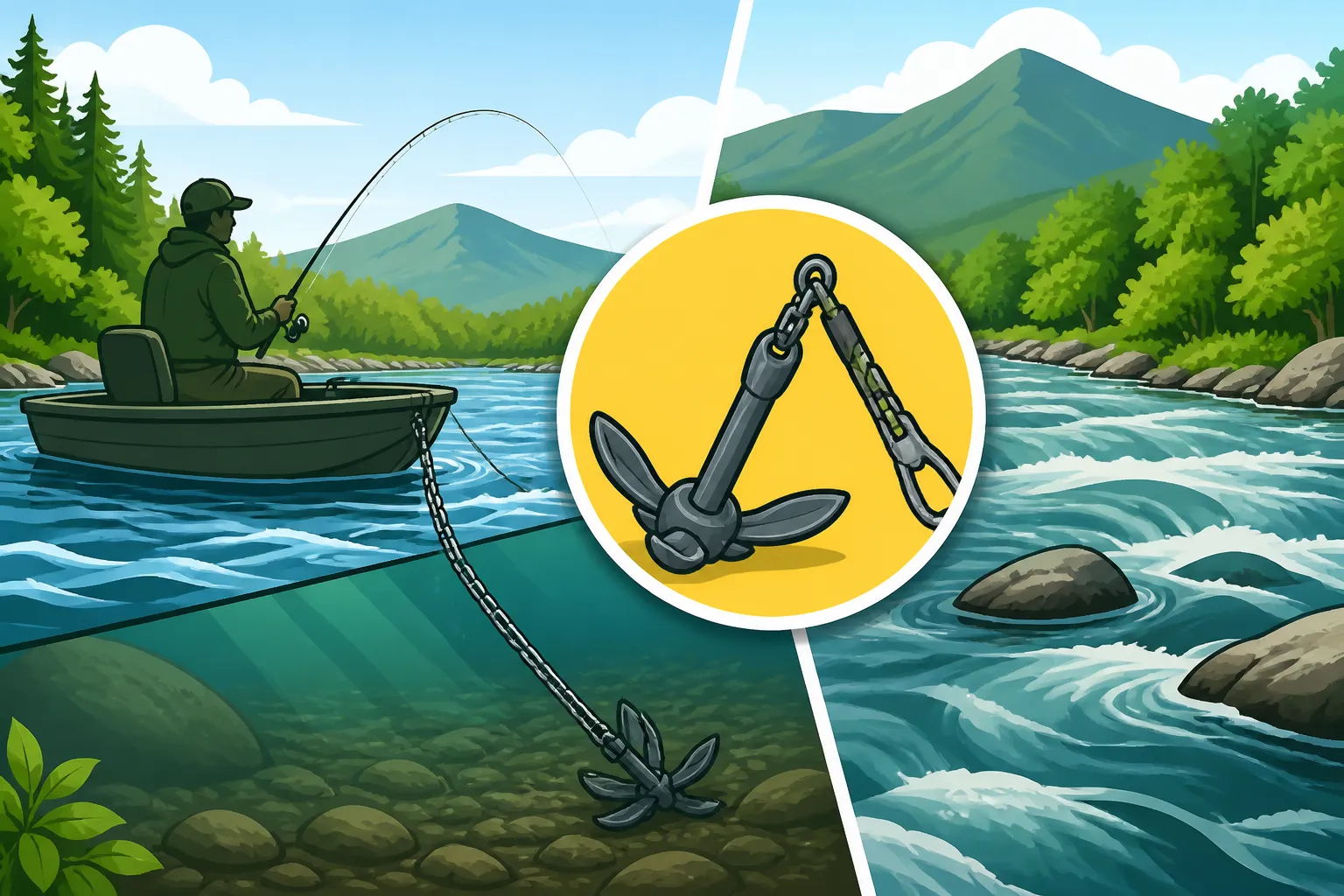
The golden rule of river anchoring is almost always to deploy your anchor upstream of your position. This allows the current to pull your boat back over the anchor, setting it firmly. If you drop your anchor downstream, the current will push your boat over the anchor, often causing it to drag or skip along the bottom before it can set, or even worse, potentially getting tangled in your motor or prop.
When approaching your desired fishing spot, motor or paddle upstream past it, then slowly lower your anchor. Let out enough rope to allow the current to pull your boat downstream to the desired location, allowing the anchor to set as the boat pulls against it. The longer the scope (the ratio of rope length to water depth), the better the anchor will hold. A 5:1 or 7:1 scope is ideal in a river, meaning for 10 feet of water depth, you'd want 50-70 feet of rope out. This low angle allows the anchor to dig in, rather than being pulled straight up and dislodged.
The Anchor Trolley System: A Game Changer
For smaller boats, especially kayaks and canoes, an anchor trolley system is an absolute must-have. This simple yet ingenious setup consists of a loop of rope that runs along the side of your boat, usually through a couple of pulleys, from bow to stern. Your anchor rope attaches to this loop with a carabiner or quick-release clip. This allows you to slide your anchor attachment point from the bow to the stern (or anywhere in between) without ever having to move your boat.
Why is this a game-changer? Imagine you're anchored from the bow, fishing downstream. If you hook a large fish that pulls you aggressively towards the bank, you can slide your anchor point to the stern, turning your boat around to face upstream and manage the fish with less risk of capsizing. It also allows you to adjust your boat's angle to the current to minimize wobble or precisely present your lure. Being able to quickly change your orientation to the current dramatically improves safety and fishing efficiency, giving you total control over your boat's position without ever having to retrieve and redeploy your anchor. Many anglers find quality anchor trolleys and associated hardware on platforms like Amazon or at dedicated outdoor retailers like Bass Pro Shops.
Breakaway Rigging and Quick Releases
No matter how careful you are, river anchors can and do get snagged. A breakaway rigging system is your best friend in this scenario. Instead of attaching your anchor rope directly to the anchor's eye, attach it to the bottom of the anchor. Then, run a lighter line (like heavy zip ties or a short section of fishing line) from the bottom attachment point up to the top eye of the anchor.
If your anchor gets irrevocably snagged, you can pull hard on your main anchor line. The zip ties or lighter line will break, allowing you to retrieve your anchor from the bottom, pulling it out by its fluke or prongs rather than trying to pull it free from its stuck position. You might bend a prong on a grapple anchor, but you'll save your anchor. Always have a few spare zip ties or lengths of sacrificial line on hand.
A quick-release mechanism for your anchor line is another critical safety feature. This could be a specialized cam cleat designed for quick release or even just a heavy-duty carabiner that can be unclipped in an emergency. If you find yourself in a dangerous situation – rapidly approaching rapids, a sudden increase in current, or if your boat starts to take on water – being able to instantly release your anchor line and move freely can be the difference between a minor scare and a serious incident. Practice using your quick release so it's second nature.
Essential Anchor System Components
An anchor isn't just a hunk of metal; it's part of a system. Each component plays a vital role in ensuring your anchor holds securely and can be deployed and retrieved safely. Overlooking any part of this system can lead to frustration or, worse, dangerous situations.
Anchor Rope and Chain
The quality and type of your anchor rope are just as important as the anchor itself. For river fishing, you want a rope that is strong, durable, and resistant to abrasion. Braided nylon or polypropylene ropes are common choices. Nylon offers good stretch, which can act as a shock absorber in heavy currents, reducing strain on your boat and anchor. Polypropylene floats, which can be a double-edged sword: good for visibility, bad if it floats into your prop. Choose a diameter that is easy to handle and matches the strength required for your anchor and boat size.
Many anglers make the mistake of using rope directly on their anchor. Always, always, always incorporate a length of heavy chain (typically 3-6 feet) between your anchor and your rope. This chain serves several crucial purposes:
- Weight: It adds weight directly to the anchor, helping it lie flat and dig into the riverbed at a lower, more effective angle.
- Abrasion Resistance: The chain protects your rope from rubbing against sharp rocks or debris on the river bottom, which can quickly fray and weaken even the strongest rope.
- Setting Power: The weight of the chain helps the anchor to "set" or dig in more effectively by keeping the anchor shank horizontal.
Without a chain, your rope will likely pull the anchor at too high an angle, causing it to skip or drag rather than bite.
Cleats, Pulleys, and Quick Releases
These are the hardware components that make your anchor system functional.
- Cleats: These are essential for securing your anchor rope to your boat. Ensure they are robust, securely mounted, and appropriately sized for your rope. For river use, a cleat that allows for quick release or adjustment is preferable.
- Pulleys: If you're using an anchor trolley, high-quality, corrosion-resistant pulleys are critical. Stainless steel or marine-grade plastic pulleys will stand up to the elements and provide smooth operation. Cheap pulleys can bind, fray ropes, or fail at the worst possible moment.
- Quick Releases: As mentioned, a dedicated quick-release mechanism or a method to rapidly free your anchor line is a non-negotiable safety feature. Some anglers simply use a sturdy carabiner clipped to an anchor point, allowing for immediate un-clipping if needed. Others install specific marine quick-release cleats that let you instantly drop the line. Make sure whatever you choose is within easy reach from your fishing position.
Storage and Organization
A tangled mess of rope and chain is not only annoying but can also be dangerous if you need to deploy or retrieve your anchor quickly. Invest in proper storage solutions. An anchor bag or a designated bucket can keep your rope and anchor neatly stowed, preventing snags on other gear. Many such accessories are available from outdoor retailers like Bass Pro Shops or various online stores, including Amazon.
Consider an anchor reel for kayaks or smaller boats, which keeps your line spooled and allows for easy, controlled deployment and retrieval. For larger boats, a dedicated anchor locker or a robust bow mount for the anchor itself can keep things tidy and safe. Maintaining an organized anchor system means less frustration on the water and faster response times in critical situations.
Safety Considerations for River Anchoring
River fishing is an amazing experience, but the power of moving water demands respect. Safety should always be your number one priority when anchoring in a river. Ignoring these considerations can quickly turn a pleasant day into a dangerous situation.
Snag Prevention and Emergency Release
As discussed, snagging your anchor is a common occurrence in rivers. Always use a breakaway rigging system on your anchor to improve your chances of retrieval. But beyond that, constant awareness of your surroundings is key. Look for visible snags like submerged trees, rock piles, or old tires before dropping anchor. If you know an area is particularly snag-prone, consider using a drag chain instead of a traditional anchor, or simply plan to drift through it without anchoring.
Even with breakaway rigging, there might be situations where you need to completely ditch your anchor and get out of dodge immediately. This is where your quick-release system comes into play. Ensure it's easily accessible and you've practiced using it. Imagine a sudden storm, a rapid increase in current, or another boater heading straight for you – being able to cut loose instantly can save your life. This is also why keeping a sharp knife handy and readily accessible is a good idea, as a last resort for cutting a fouled line.
Avoiding Capsizing and Swamping
Anchoring improperly in a strong current can lead to your boat taking on water or even capsizing. If you anchor from the stern (back) of your boat in a strong current, the water can easily come over the transom, swamping your boat. Always anchor from the bow (front) or use an anchor trolley to adjust your position, keeping your bow pointed upstream into the current. This allows your boat to "ride" the current, shedding water and minimizing resistance.
If your anchor snags and you can't immediately free it, the current will put immense pressure on your boat. This is where a proper scope (long line) and a boat that is appropriate for the river conditions are vital. If the boat starts to pull hard or turn sideways to the current, don't hesitate to activate your quick release. Your anchor is replaceable; your life and your boat are not. Always wear a Life Jacket Requirements for Vermont Boaters when river fishing, as conditions can change rapidly and unexpectedly.
Understanding River Hazards
Vermont's rivers, while beautiful, come with their own set of hazards.
- Dams and Hydroelectric Facilities: Always maintain a safe distance from dams. The currents below and above them can be unpredictable and extremely powerful, often with dangerous undertows or sudden surge releases.
- Rapids and Falls: Know the river section you're fishing. If there are rapids or falls downstream, ensure you have ample time and distance to retrieve your anchor and navigate away safely. Never anchor too close to a potential hazard.
- Strainers: These are obstacles like fallen trees or debris that allow water to pass through but can trap a boat or person. They are incredibly dangerous. If your boat gets pinned against a strainer by the current, it can quickly be swamped or even wrapped around the obstacle. Always be on the lookout for strainers and avoid anchoring or drifting near them.
- Other Boaters: Especially on larger rivers like the Connecticut River, be aware of other boat traffic, including larger motorboats or commercial vessels. Your anchor light or flag will make you more visible, but always remain vigilant. Always follow Vermont Boating Laws for Anglers.
Table: Anchor Type Suitability for Vermont River Bottoms
To help visualize which anchor might be best for different scenarios, here’s a quick overview:
| Anchor Type | Best For | Good For | Not Recommended For | Snag Risk | Holding Power (Relative) |
|---|---|---|---|---|---|
| Pyramid/River | Gravel, Sand, Light Mud | Mixed bottom, Moderate current | Heavy weeds, Deep silt, Very strong current | Moderate | Good |
| Grapple/Folding | Rocky bottoms, Wood/Debris | Snagging onto structure | Soft mud, Sand, Very strong current | High | Variable (Excellent on snags) |
| Drag Chain | Slowing drift, Mixed bottoms | Covering long stretches | Stationary anchoring, Very strong current | Low | Low (Drift Control) |
| Mushroom | Silt, Soft Mud, Flat bottoms | Calm currents, Small boats | Rocky bottoms, Strong current, Weeds | Low | Fair (Weight dependent) |
Note: Holding power and snag risk are highly dependent on anchor size, boat size, current strength, and proper deployment techniques.
Matching Your Anchor to Vermont's Rivers and Boats
Vermont offers such a diverse array of rivers, each with its own character. To truly optimize your fishing experience, it's helpful to consider the specific waters you'll be navigating.
Choosing for Smaller, Rocky Streams and Rivers
If your passion lies in fly fishing the intimate, rocky stretches of streams like the Battenkill River or some of the smaller tributaries of the Lamoille River for native brook trout, your anchoring needs will be quite specialized. Here, you're likely in a kayak, canoe, or even wading. For this kind of water, portability and snag resistance are paramount.
A small, lightweight river anchor (perhaps 3-5 lbs) or a grapple anchor (with breakaway rigging!) could be suitable if you absolutely need to hold a spot. However, many anglers in these environments prefer to use a short drag chain or simply rely on Wading Techniques for Vermont Trout Streams and strategic boat positioning to temporarily hold in eddies or behind large rocks. The goal here isn't usually to "stick" firmly, but rather to slow down, pivot, or hold for a quick cast before moving on. The bottom is often very rocky, making traditional anchors prone to getting wedged.
Anchoring on Medium-Sized Rivers: Winooski, Lamoille, Otter Creek
Rivers like the Winooski River, Lamoille River, and Otter Creek offer fantastic smallmouth bass and northern pike fishing, often from jon boats, larger kayaks, or smaller aluminum boats. These rivers present a mix of gravel bars, sandy stretches, and occasional rocky sections, with currents that can vary from mild to quite swift.
For these waters, a pyramid or dedicated river anchor in the 8-15 lb range (depending on your boat size and current) is often the sweet spot. It provides enough holding power for the varied bottoms and currents you'll encounter. Utilizing an anchor trolley on your kayak or jon boat will significantly enhance your ability to control your position. For a more extended drift, a drag chain system is invaluable, especially when working long stretches of bank or targeting specific submerged structures. You’ll find that a Best Jon Boats for Shallow Rivers pairs well with a solid river anchor here.
Tackling Large Rivers: The Connecticut River
The Vermont side of the Connecticut River presents a whole different ballgame. This is a big river with powerful currents, deep channels, and a mix of sand, silt, and rocky bottom compositions. Anglers here might be targeting walleye, smallmouth, or even pike from larger aluminum boats, pontoon boats, or even small bass boats. Connecticut River Fishing Access in Vermont often means significant ramp facilities, and boats suitable for Best Boats for Vermont Lakes and Rivers are commonly seen.
Here, a heavy river anchor (15-25 lbs or more) is often necessary, especially for larger boats or in strong currents. You'll need more chain and a longer, thicker anchor rope. Some anglers even employ two anchors for maximum stability, particularly if they plan to stay put for extended periods or if the wind is also a factor. A stern anchor can help prevent your boat from swinging, but remember the rule about not anchoring solely from the stern in a strong current. The emphasis here is on sheer holding power and robust components, as the consequences of dragging anchor can be much more severe on such a large, powerful waterway.
By understanding the specific characteristics of Vermont's rivers and matching your anchor system components and techniques accordingly, you'll not only fish more effectively but also ensure a safer and more enjoyable time on the water.
Disclaimer
This article is for general informational purposes only and does not constitute professional advice. Laws, prices and regulations vary by location and change over time. Consult a qualified professional for guidance on your specific situation.