Best technique for winter smallmouth bass
As the snow blankets Vermont's beautiful landscape and the ice begins to creep across our beloved lakes, many anglers hang up their rods, assuming the smallmouth bass bite is over. But that's a common misconception, and frankly, a huge missed opportunity! While it's true that winter smallmouth fishing presents a unique challenge compared to the lively summer bite, these aggressive bronze beauties are still very much catchable if you know where to look and, more importantly, how to coax a strike. This guide is all about equipping you with the specialized techniques to find and land those elusive winter smallmouth bass, turning a dormant season into an exciting fishing adventure right here in Vermont.
Understanding Winter Smallmouth Behavior in Vermont
Catching smallmouth bass in the winter isn't just about throwing a lure; it's about getting inside their cold, sluggish minds. Their entire world shifts when water temperatures plummet, and understanding these changes is the first step to successful winter angling. You can't just rely on your summer spots and tactics; you need a whole new playbook.
Deep Water Retreats
When the cold really settles in, smallmouth bass in Vermont's larger lakes, like Lake Champlain or Lake Bomoseen, undergo a significant behavioral shift. They're not going to be chasing bait in the shallow bays or cruising rocky points like they do in the warmer months. Instead, they seek out the most stable thermal environment available, which is almost always the deeper parts of the lake. We're talking about depths that might surprise you, often anywhere from 20 to 60 feet, sometimes even deeper, depending on the specific body of water and its thermal characteristics.
Imagine a large lake like Lake Champlain. As the surface water cools, it becomes denser and sinks, pushing the warmer, less dense water downwards. This process, known as thermal stratification or turnover, eventually leads to a more uniform temperature profile throughout the water column in winter, but the deepest water often retains a slightly more stable, albeit cold, temperature. Smallmouth bass gravitate to these deeper sanctuaries, not necessarily because the water is "warm," but because it's the most stable and consistent temperature they can find. This helps them conserve energy and survive the harsh conditions. They might congregate in large schools, sometimes stacked tightly together, making them challenging to locate but incredibly rewarding when you do. They'll hug the bottom or suspend just above it, waiting for an easy meal to come by.
Forage and Metabolism
Just like us, smallmouth bass tend to slow down significantly in winter. Their metabolism drops dramatically, meaning they require far less food to sustain themselves. This is why those aggressive, chasing bites of summer become subtle nudges or just added weight on your line in the winter. They're not expending much energy, so they're not going to chase a fast-moving bait for long distances. Instead, they become opportunistic feeders, waiting for an easy meal to swim directly into their strike zone.
Their diet still primarily consists of baitfish, but the species they target might shift slightly, or they might simply become less picky. In many Vermont lakes, yellow perch and rainbow smelt are key forage species, and these often school up in deeper water during the colder months. When you're searching for winter smallmouth, you're essentially looking for schools of these baitfish. Where the bait is, the bass will be close by, conserving energy and waiting for the right moment to strike. This is why having good electronics to identify bait balls and the larger predatory arches of bass is absolutely critical. They might not be actively hunting across vast areas, but rather holding tight to structure or baitfish schools, making them incredibly localized targets. How rainbow smelt affect Vermont lake fisheries sheds more light on this critical forage.
Essential Gear for Cold Water Smallmouth Bass Fishing
You wouldn't head out for a summer bass tournament with ice fishing gear, right? The reverse is just as true. Winter smallmouth fishing demands a specific setup that prioritizes sensitivity, control, and durability in freezing temperatures. Without the right tools, you'll be fighting an uphill battle against the elements and the fish's lethargy.
Rods, Reels, and Line
When it comes to winter smallmouth, sensitivity is paramount. Those soft, subtle bites require a rod that can transmit even the slightest tap. You'll want to lean heavily on light to medium-light power spinning rods, typically in the 6'6" to 7'2" range. Look for rods with a fast to extra-fast action, meaning the tip is very sensitive but the backbone is strong enough to handle a solid hookset and fight. Graphite rods are usually preferred over fiberglass for their enhanced sensitivity. The lighter power allows for better detection of those faint winter bites, while the fast action ensures you can set the hook efficiently, even with a lot of line out in deep water.
Pair these sensitive rods with small, smooth-operating spinning reels. A 1000 or 2000 series reel is often perfect, offering a good balance of line capacity and lightweight feel. Make sure the reel has a smooth drag system, as even in winter, a good smallmouth can put up a surprisingly strong fight, especially in cold water. Cold weather can be tough on gear, so ensure your reel is well-maintained and lubricated with cold-weather grease if you anticipate truly freezing conditions. For line, fluorocarbon is your best friend. Its low stretch provides incredible sensitivity, allowing you to feel those subtle bites better than monofilament. Plus, fluorocarbon is nearly invisible underwater, which is crucial for spooky winter bass in clear water. A 6-8 pound test fluorocarbon main line is a great starting point, possibly dropping to 4-pound test in exceptionally clear water or for extremely finicky fish. Sometimes, combining a braided main line with a long (8-15 foot) fluorocarbon leader can offer the best of both worlds: casting distance and sensitivity from braid, with invisibility from fluoro. When picking a reel, considering your target fish size helps, for example, Best spinning reel size for lake smallmouth can offer more specific advice.
Electronics and Boat Control
If you're serious about winter smallmouth fishing, particularly on larger bodies of water like Lake Champlain, advanced electronics aren't just a luxury—they're an absolute necessity. You're not going to blindly cast and hope to stumble upon these deep-dwelling, often tightly schooled fish.
A high-quality fish finder equipped with side imaging, down imaging, and traditional 2D sonar is your primary tool for locating winter smallmouth. Side imaging allows you to scan wide swaths of the bottom, identifying humps, rock piles, and baitfish schools that might be off to the sides of your boat. Down imaging provides a photographic-like view directly beneath your boat, helping you discern specific structures and even individual fish. Traditional 2D sonar is excellent for marking fish arches in the water column and understanding bottom hardness. You'll want to spend a significant amount of time idling over likely areas—deep points, offshore humps, rock ledges, and transition zones—scanning for baitfish and the tell-tale arches or clusters of smallmouth. Learning to interpret these sonar signals is a skill that takes practice, but it's invaluable for winter success.
Once you've located a school of fish, precise boat control is vital. A reliable trolling motor with GPS capabilities, specifically a "spot-lock" or virtual anchor feature, is a game-changer. This allows you to hold your boat precisely over the target area, even in wind or current, keeping your bait directly in the fish's strike zone. Without it, you'll be constantly drifting off target, spending more time repositioning than fishing. Being able to effortlessly stay on top of a deep school of fish or a subtle piece of structure means more time with your lure in the zone and ultimately, more fish in the boat. For navigating these complex structures, articles like How to read structure for walleye on Lake Champlain offer transferable skills for understanding deep-water fish habitat.
Top Techniques for Winter Smallmouth Bass in Vermont
Now that we understand where winter smallmouth hide and what gear we need, let's dive into the actual fishing techniques. Remember, subtlety and precision are the keys to success when these fish are at their most sluggish.
Vertical Jigging
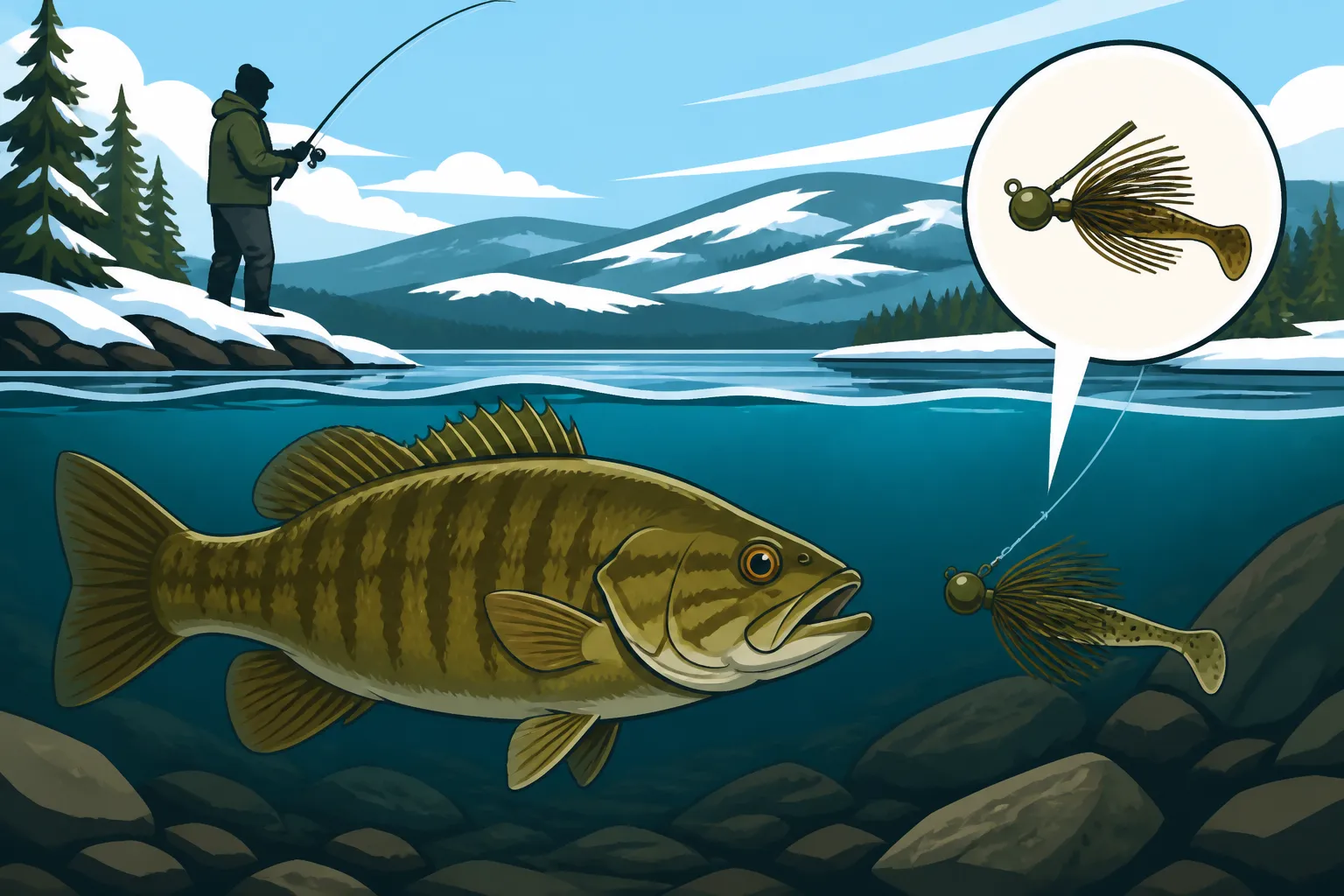
When smallmouth bass are congregated in deep water, often tightly schooled on or near the bottom, vertical jigging is arguably the most effective technique. This involves positioning your boat directly over the fish (using that spot-lock feature!) and dropping a lure straight down to them. The beauty of vertical jigging is that it keeps your bait in the strike zone for extended periods and allows for incredibly precise depth control, matching exactly where the fish are holding.
- Lure Types:
- Blade Baits: These thin metal lures like the Sebile Vibe Machine or Heddon Sonar are phenomenal. They vibrate aggressively on the lift and flutter enticingly on the fall, mimicking a dying baitfish. Common sizes for winter smallmouth are often 1/4 to 1/2 ounce.
- Small Spoons: Classic jigging spoons such as the Kastmaster or Crippled Herring are also excellent. Their erratic wobble on the fall can trigger reaction strikes. Again, smaller sizes (1/4 to 3/8 ounce) are usually preferred.
- Tube Jigs: A favorite for smallmouth year-round, a small tube jig (2.5 to 3.5 inches) rigged on a lead head is deadly. The soft plastic imitation of a crayfish or baitfish, with its subtle tentacle movement, can be irresistible. A 1/4 to 3/8 ounce jig head is typical.
- Technique: Drop your lure to the bottom, then lift your rod tip a short distance (6 inches to 2 feet) and let the lure fall back on a semi-slack line. The bite often occurs on the fall or when the lure is resting on the bottom. Focus on subtle lifts and pauses. Sometimes, just holding the lure perfectly still a foot or two above a marked fish is enough to draw a strike. The colder the water, the more subtle and slower your movements should be. You're not trying to provoke a chase, but rather present an easy, vulnerable meal. For similar finesse, consider methods like Best jig color for winter perch if your target is also finicky.
Drop Shotting
When vertical jigging isn't quite cutting it, or if the fish are incredibly lethargic and suspended slightly off the bottom, drop shotting shines. This finesse technique excels at presenting a small, natural-looking bait in a stationary or subtly moving presentation directly to reluctant fish. It’s perfect for those super light bites that are barely perceptible.
- The Rig: The drop shot rig involves tying a hook directly to your main line (or fluorocarbon leader), typically using a Palomar knot, leaving a tag end of line below the hook. You then tie a specific drop shot weight to this tag end. This setup allows your bait to suspend at a precise depth above the weight, which sits on the bottom.
- Bait Choices: Small soft plastics are key here. Think about what baitfish or invertebrates might be moving slowly or dying in the cold water.
- Minnow Imitations: Small (2-4 inch) fluke-style baits or straight-tail worms in natural colors like ghost minnow, smoke, or green pumpkin.
- Worm or Creature Baits: Tiny worms, grubs, or creature baits that offer a very subtle profile.
- Technique: Drop your weight to the bottom, allowing your bait to hover at the desired depth. Once the weight is down, simply hold your rod tip still or impart very small twitches. The idea is to make the bait look alive but not actively swimming away. The weight keeps your bait exactly where the fish are, and the buoyancy of the plastic, combined with the lack of resistance from the weight, makes it incredibly natural. Bites often feel like just a bit of added weight or a slight tick. Setting the hook is more of a sweep than a hard jerk. This technique is also excellent for countering current, as highlighted in Best drop shot weight for lake current.
Deep Cranking and Trolling
While less common for deep winter smallmouth when they are tightly schooled and inactive, there are specific situations where deep cranking or slow trolling can be effective, particularly during periods of slightly milder weather or when fish are scattered over larger areas just before or after true ice-up. This method allows you to cover more water in search of those fish that might be slightly more active or less concentrated.
- When it's Effective:
- Early Winter/Late Fall: Before the water gets truly frigid and fish are still somewhat scattered but heading deep.
- Brief Warm Spells: If you get a couple of unseasonably warm days, fish might briefly become a little more inclined to chase.
- Pre-Ice-Up: Just as lakes are about to freeze, fish can sometimes be found slightly shallower, feeding up.
- Lure Types:
- Deep-Diving Crankbaits: Look for crankbaits designed to reach depths of 15-30 feet, depending on your target depth. Colors that imitate perch, smelt, or crawfish are good choices.
- Small Swimbaits: Soft plastic paddle-tail swimbaits rigged on a weighted jig head can also be slowly retrieved or trolled effectively.
- Technique: For deep cranking, cast your bait out, let it sink, and slowly retrieve it, allowing the crankbait to dig into the bottom or tick off structure. The slower the retrieve, the better. For trolling, use your boat's electric motor to move at a very slow pace (0.5 to 1.5 mph), trailing your deep-diving lures behind you. Pay close attention to your fish finder to match your lure depth to where the fish are marked. The occasional stop-and-go or subtle turn can often trigger a strike from a following fish. While the specific retrieve might differ, the principle of slow, deliberate action for crankbaits is explored in Best crankbait retrieve for Champlain smallmouth.
| Technique | Pros | Cons | Ideal Conditions | Lure Examples |
|---|---|---|---|---|
| Vertical Jigging | Highly precise, excellent for schooled fish, good sensitivity | Can be labor-intensive, requires precise boat positioning | Deep, tightly schooled fish, moderate current | Blade baits, jigging spoons, tube jigs |
| Drop Shotting | Extreme finesse, natural presentation, great for finicky fish | Slower fishing, requires specific rigging | Lethargic, suspended fish, very clear water | Small soft plastics (minnows, worms) |
| Deep Cranking/Trolling | Covers water, can trigger reaction bites | Less precise for individual fish, requires active fish | Early/late winter, scattered fish, warmer spells | Deep-diving crankbaits, small swimbaits |
Reading the Water and Conditions for Winter Success
Winter fishing is as much about reading the environment as it is about casting. The colder temperatures amplify the subtle cues that tell you where the bass might be and how they might react. Ignoring these signs is a surefire way to come back empty-handed.
Interpreting Sonar Signals
Your fish finder isn't just a pretty screen; it's your window into the underwater world. Learning to accurately interpret its signals is arguably the most critical skill for finding winter smallmouth. You're not just looking for "fish"; you're looking for patterns and specific types of marks.
First, identifying bait balls is paramount. These often appear as dense clouds or clumps of small dots on your screen. Where there's bait, there are usually predators nearby. Look for larger, distinct arches or even solid masses of fish either directly within these bait balls or lurking beneath or to the sides of them. Smallmouth will often stage below or around bait, waiting for an opportunity. Remember, in winter, they won't chase far, so they need to be close to their food source.
Secondly, you need to understand bottom contours, humps, and breaks. Smallmouth are structure-oriented fish, and this doesn't change in winter, only the type of structure they prefer shifts. They'll relate to deep rock piles, sharp drop-offs, ledges, and offshore humps. Your sonar helps you map these features, revealing hidden transition zones where deep water meets shallower structure, or where rock changes to mud. Look for fish suspended just off these features, or directly on them. Don't just motor over; actively use your side imaging to scan around, noting any irregularities. How to read structure for walleye on Lake Champlain offers invaluable insights that directly translate to smallmouth fishing in similar deep-water environments.
Weather and Water Temperature
The impact of weather and water temperature on cold-water bass fishing cannot be overstated. Unlike summer, where small temperature fluctuations might not make a huge difference, in winter, even a degree or two can mean the difference between biting and dormant fish.
Stable weather patterns are generally better. A few consecutive days of consistent, mild-for-winter temperatures and calm winds tend to make fish slightly more comfortable and potentially more willing to bite. Conversely, a sudden cold front will typically shut the bite down hard. After a front passes, the fish often become even more sluggish, retreating deeper and becoming less inclined to move for a meal. You might need to scale down your baits even further and slow your presentation to an almost agonizing crawl.
The target water temperature for winter smallmouth is usually in the mid to upper 30s to low 40s (Fahrenheit). While you can catch them in colder water, activity levels generally increase slightly as temperatures climb above 38-40 degrees. On very rare, exceptionally sunny and calm winter days, a smallmouth might briefly move up onto a sun-warmed deep flat or rock pile for a short feeding window. Pay attention to surface temperatures if you have a gauge, and correlate that with your catch rates. Don't be afraid to fish colder water, but adjust your expectations and techniques accordingly. Think slow, methodical, and precise.
Targeting Specific Structures
As mentioned, winter smallmouth are still structure-oriented, but they're focused on deep-water structures that offer stability and proximity to forage. Forget about the shallow weed beds or docks you targeted in July.
- Deep Rock Piles and Humps: These are prime real estate. Smallmouth will often stack up on the sides or tops of these structures, especially if there's bait nearby. Look for distinct changes in bottom composition or elevation.
- Ledges and Breaks: Any sharp drop-off or ledge where the bottom quickly descends into deeper water is a magnet. Smallmouth will often patrol these edges or sit just off them, waiting for bait to pass by.
- Offshore Islands and Reefs: In larger lakes, these underwater features can hold vast schools of smallmouth. The key is to find the deeper edges and surrounding contours.
- Adjacent to Deep Flats with Baitfish Schools: Sometimes, smallmouth won't be directly on hard structure but rather holding close to large schools of baitfish suspended over deep, soft-bottomed flats. They're following their food source, ready to pick off stragglers.
Think of it this way: winter smallmouth fishing is like a treasure hunt. You're using your map (charts), your metal detector (sonar), and your careful technique to find and extract the treasure from its hidden vault. It's challenging, but the reward of a hard-fighting winter smallmouth is truly special. Remember, safety first on the cold water – dress warmly, tell someone where you're going, and always be prepared for changing conditions. With the right approach and perseverance, you might just find that winter smallmouth fishing becomes your new favorite obsession!
Disclaimer
This article is for general informational purposes only and does not constitute professional advice. Laws, prices and regulations vary by location and change over time. Consult a qualified professional for guidance on your specific situation.