Best trailer hitch setup for a small boat
There’s nothing quite like the freedom of trailering your small boat to a new fishing spot in Vermont, whether it's a quiet pond in the Northeast Kingdom or a bustling launch on Lake Champlain. But that excitement can quickly turn to frustration if your trailer hitch isn't properly set up, leading to stressful towing, safety concerns, or even damage. This guide will walk you through everything you need to know to assemble the perfect trailer hitch setup for your small boat, ensuring smooth travels and confident hauls across the Green Mountain State.
Understanding Your Boat and Trailer's Weight Needs
Before you even think about specific hitch components, the absolute first step is to get a clear picture of what you'll actually be towing. Many folks make the mistake of guessing or just looking at the boat's weight, completely forgetting about the trailer itself and all the gear. This oversight can lead to an undersized hitch, a dangerous situation on the road, or simply a system that wears out much faster than it should.
Gross Vehicle Weight Rating (GVWR) of Your Trailer
The most critical number you need to know is your trailer's Gross Vehicle Weight Rating, or GVWR. This isn't just the weight of your boat; it's the combined weight of your boat, the trailer itself, the motor, fuel, battery, tackle boxes, coolers, life jackets, and anything else you load onto or into the boat and trailer. You can usually find the GVWR on a sticker or plate somewhere on the trailer frame. If not, you'll need to weigh your fully loaded trailer at a truck stop or local weigh station. For most small fishing boats – think a 14-foot aluminum jon boat, a modest fiberglass runabout, or a couple of personal watercraft – the GVWR will likely fall into the lighter categories, but it’s still crucial not to underestimate. Getting this right is fundamental to safety and compliance with Vermont Boating Laws for Anglers.
Calculating Tongue Weight for Stable Towing
Beyond the total weight, tongue weight is another incredibly important factor for safe towing. This is the downward force your trailer applies to the hitch ball on your tow vehicle. Ideally, your tongue weight should be 10-15% of your trailer's GVWR. Too little tongue weight, and your trailer can sway wildly, becoming a dangerous projectile on the highway. Too much, and it puts excessive strain on your vehicle's rear suspension and brakes, making steering light and potentially causing handling problems. You can measure tongue weight with a specialized scale or, for smaller trailers, by using a bathroom scale with a clever lever setup (just be sure not to exceed the bathroom scale's capacity!). Adjusting the load on your trailer, or even moving the boat slightly forward or backward on the bunks, can help you achieve the correct tongue weight. This balance is key to a comfortable and safe towing experience, especially when navigating Vermont's winding roads.
Matching Hitch Classes to Your Towing Capacity
Vehicle hitches are categorized into classes, typically from Class I to Class V, based on their maximum gross trailer weight (GTW) and tongue weight (TW) capacities.
- Class I (Light-Duty): Up to 2,000 lbs GTW, 200 lbs TW. Perfect for very light utility trailers, kayak trailers, or small canoes. Many smaller cars or crossovers might be equipped for this class.
- Class II (Mid-Range): Up to 3,500 lbs GTW, 350 lbs TW. This is often the sweet spot for many small fishing boats, jet skis, and smaller runabouts. Many mid-size SUVs and trucks fall into this category.
- Class III (Heavy-Duty): Up to 5,000 lbs GTW, 500 lbs TW. While many small boats won't require this much capacity, it offers a good margin of safety for slightly larger vessels or if you plan to upgrade your boat in the future. Full-size SUVs and pickup trucks typically have this capability.
It's absolutely essential that your hitch class, your vehicle's towing capacity, and your trailer's GVWR are all compatible. Never exceed the lowest rating of any component in your towing system. If your small boat and trailer weigh 2,500 lbs, you'll need at least a Class II hitch, and your vehicle must be rated to tow at least that much. You can often find your vehicle's specific towing capacity in the owner's manual.
Essential Components of a Trailer Hitch System
A complete trailer hitch setup is more than just a ball on the back of your vehicle. It's a system of interconnected parts, each playing a crucial role in safely connecting your tow vehicle to your boat trailer. Understanding each piece will help you choose the right equipment and troubleshoot any issues that might arise when you're heading out to fish Lake Champlain Fishing Guide or a mountain pond.
The Receiver Hitch
The receiver hitch is the core component, a strong steel frame that bolts directly to the chassis of your tow vehicle. It features a square opening, or receiver tube, designed to accept a ball mount or other hitch accessories. Receiver hitches are specifically designed for different vehicle makes and models to ensure a proper fit and distribution of towing forces. When you’re looking to buy one, whether from a local garage or through an online retailer like Amazon, make sure it’s specifically listed for your year, make, and model of vehicle. There are often "hidden" hitches that sit mostly out of sight behind the bumper, and more visible ones. The important thing is that it's securely attached to your vehicle's frame, not just the bumper.
Ball Mount and Hitch Ball
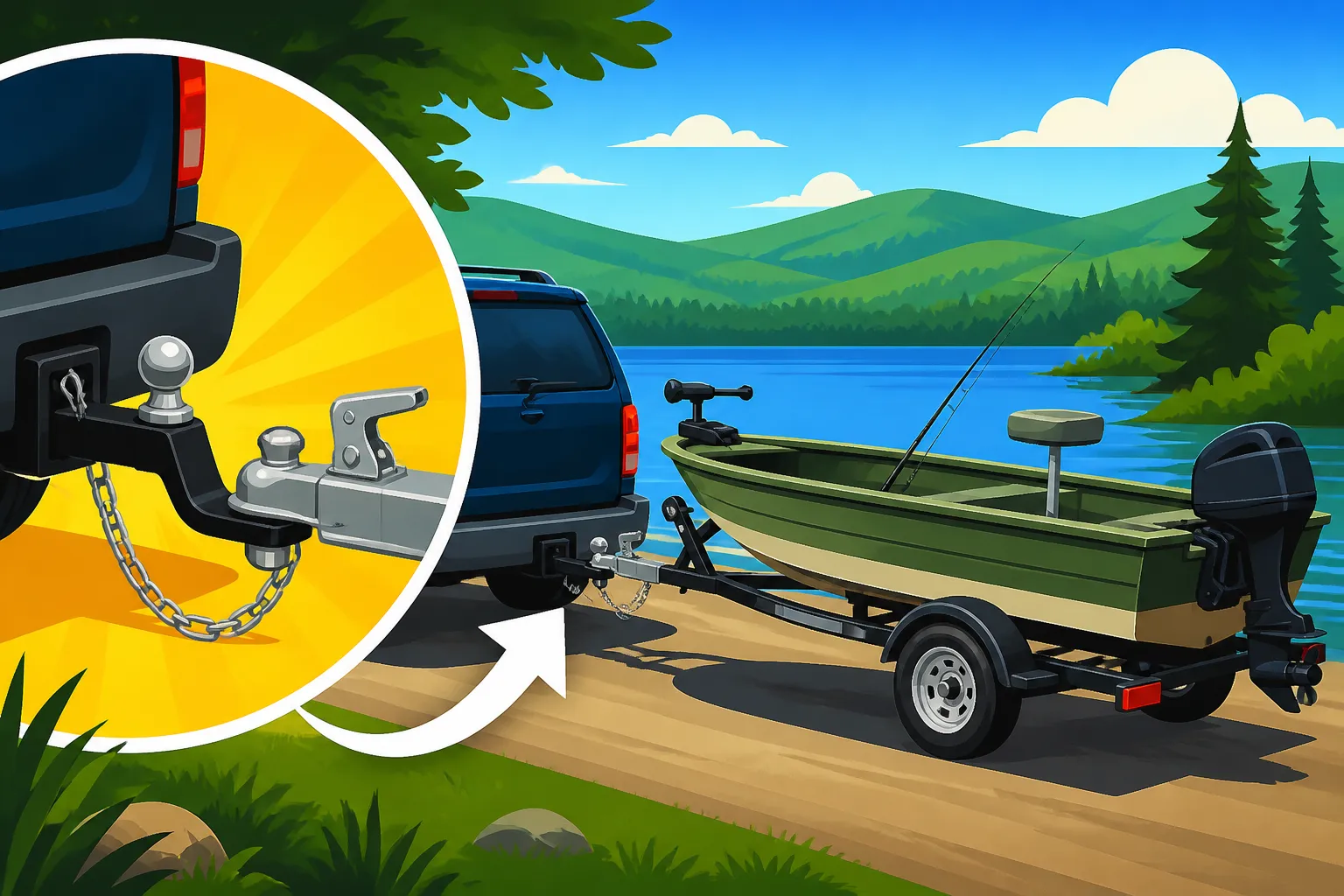
The ball mount is the removable piece that slides into the receiver hitch and is secured with a hitch pin and clip. It's designed to raise or lower the hitch ball to the correct height for your trailer. Since tow vehicles and trailers have varying heights, you’ll likely need a ball mount with a specific "rise" or "drop" to ensure your trailer tows level. A level trailer is critical for even weight distribution and stable towing. If your trailer is nose-up or nose-down, it can negatively impact tongue weight and overall handling.
Attached to the ball mount is the hitch ball, the spherical connection point between your vehicle and trailer. Hitch balls come in various diameters (most commonly 1-7/8 inch, 2 inch, and 2-5/16 inch). You absolutely must match the hitch ball diameter to the size of the coupler on your trailer. Trying to force an incompatible ball into a coupler is incredibly dangerous and could lead to your trailer detaching while in motion. You'll find these at any auto parts store, Bass Pro Shops, or online.
Trailer Wiring and Lights
This is where many first-timers get stumped, but it’s absolutely non-negotiable for safety and legality. Your trailer needs functioning brake lights, turn signals, and running lights that mirror your tow vehicle's. This requires a wiring harness that connects your vehicle's electrical system to the trailer.
Common wiring connectors include:
- 4-Way Flat: The most common for small boat trailers, providing basic functions (tail lights, brake lights, left turn, right turn).
- 5-Way Flat: Similar to 4-way, but includes a reverse wire, sometimes used for trailer surge brakes or a reverse lockout on boat trailers to prevent the brakes from engaging when backing up.
Many modern vehicles come with a factory towing package that includes the necessary wiring. If yours doesn't, you can purchase a universal wiring harness or a vehicle-specific one. Installation can be a simple plug-and-play for some vehicles, while others may require tapping into existing wiring. Regardless, ensure all connections are secure and weatherproof, especially given Vermont's varied weather conditions. Vermont Boating Laws for Anglers will certainly cover the requirement for proper trailer lighting.
Selecting the Right Hitch for Vermont Boating
When you're outfitting your vehicle for boat towing in Vermont, thinking about how you'll use it day-to-day, beyond just the boat, is important. You'll encounter different road conditions, from paved highways to unpaved access roads leading to a favorite trout pond, and the type of hitch can make a difference.
Fixed vs. Removable Ball Mounts
Most trailer setups for small boats use a receiver hitch with a removable ball mount. This is largely for convenience. When you're not towing your boat to Lake Bomoseen best bass coves or hauling your kayak to a new river section, you can simply pull the hitch pin and remove the ball mount. This prevents you from banging your shins on it, keeps it clean, and deters theft. It also improves your vehicle's departure angle if you're navigating steep driveways or rough terrain. Some older or more basic setups might have a fixed hitch ball directly on the bumper, but these are generally less versatile and not recommended for anything beyond the lightest loads due to the lack of frame-mounted support.
Adjustable Ball Mounts for Versatility
If you own multiple trailers, perhaps one for a fishing boat and another for a utility trailer, or if you frequently change tow vehicles, an adjustable ball mount can be a real game-changer. These mounts allow you to quickly change the drop or rise height without needing a completely different ball mount. Some even have multiple ball sizes on a single unit, letting you swap between a 2-inch and a 2-5/16-inch ball with ease. While they might be a bit pricier initially, the convenience and flexibility they offer can save you money and hassle in the long run. Just ensure any adjustable components are securely fastened before each trip.
Anti-Rattle Devices and Locking Pins
There's nothing more annoying than the constant clunking and rattling of your ball mount in the receiver hitch as you drive down the road, especially on a bumpy Vermont back road. Anti-rattle devices, often called hitch tighteners or anti-rattle clamps, are designed to eliminate this play by snugging up the ball mount inside the receiver. They can make a surprising difference in towing comfort and reduce wear on your hitch components.
For added security, consider investing in a locking hitch pin. Instead of a standard metal pin and clip, a locking pin uses a key to secure the ball mount in the receiver. This helps prevent theft of your ball mount and, more importantly, keeps someone from easily detaching your trailer when it’s parked. These small additions provide peace of mind, whether you're grabbing a quick bite after a long day of fishing or leaving your setup overnight.
Here's a quick comparison of common hitch classes for small boats:
| Hitch Class | Max GTW (lbs) | Max TW (lbs) | Common Applications | Typical Vehicle Type |
|---|---|---|---|---|
| Class I | 2,000 | 200 | Kayak, Canoe, Small Skiff | Small car, Crossover |
| Class II | 3,500 | 350 | Jon boat, Bass boat, Jet Ski | Mid-size SUV, Truck |
| Class III | 5,000 | 500 | Larger runabout, Dual PWC trailer | Full-size SUV, Truck |
Note: Always consult your vehicle's owner's manual and trailer documentation for exact weight ratings and capacities.
Installation and Safety Tips for Peace of Mind
Getting your hitch installed and understanding the basic safety protocols are just as important as choosing the right components. A properly installed hitch and a routine safety check can prevent serious problems down the road. This is especially true when navigating the varying terrain and seasons that Vermont throws your way.
Professional Installation vs. DIY
For the receiver hitch itself, professional installation is often the best route, especially if you're not comfortable working under your vehicle. A professional will have the right tools, knowledge, and experience to ensure the hitch is securely bolted to your vehicle's frame according to manufacturer specifications. They can also handle any complex wiring for trailer lights and ensure everything is up to code. Many auto shops, trailer dealers, or places like Bass Pro Shops or U-Haul offer installation services.
However, once the receiver hitch is in place, installing the ball mount, hitch ball, and connecting the trailer wiring are typically straightforward DIY tasks that any angler can handle. Just follow the instructions that come with your components, use the right size wrenches, and don't overtighten bolts. If you're buying components from Amazon, make sure to read reviews and confirm compatibility.
Safety Chains and Breakaway Systems
Never, ever tow a trailer without safety chains. These are a non-negotiable requirement for good reason. They act as a backup in case your primary hitch connection fails. Safety chains should be crossed under the trailer tongue (forming an "X" shape) and securely attached to designated points on your tow vehicle's hitch or frame. This crossing prevents the tongue from dropping to the pavement if it detaches and helps keep the trailer centered behind your vehicle.
For heavier trailers, often those with their own braking systems, a breakaway system is also required. This system consists of a small battery and a pin that connects to your tow vehicle. If the trailer ever detaches, the pin is pulled, activating the trailer's brakes, bringing it to a safe stop. While many small fishing boats might not require a full breakaway system, it's always worth checking the specific Vermont Fishing Regulations Explained for trailer requirements to be sure.
Pre-Trip Checks Every Time
Before you head out to launch your boat, make a quick habit of performing a thorough pre-trip check. This ritual can save you a lot of grief and potential danger:
- Hitch Connection: Is the hitch ball fully seated in the coupler? Is the coupler latch securely closed and pinned?
- Hitch Pin: Is the ball mount secured in the receiver with a hitch pin and clip (or a locking pin)?
- Safety Chains: Are they crossed and securely attached to the tow vehicle?
- Wiring: Is the wiring harness securely connected?
- Lights: Test all trailer lights – running lights, brake lights, and turn signals – to ensure they're all working correctly.
- Tires: Check the air pressure in your trailer tires and ensure they look good (no low spots, bulges, or cracks). Don't forget to check your tow vehicle's tires too!
- Boat Security: Is your boat securely strapped down to the trailer? Are bow and stern straps tight?
- Drain Plug: Is your boat's drain plug in? (This is the most common mistake and always worth a double-check!)
By diligently performing these checks, you'll ensure your setup is safe and ready for the road, making your journey to the water as enjoyable and stress-free as the fishing itself. Knowing you're properly equipped and prepared means more time enjoying Vermont's beautiful waters, like those on Lake Willoughby Fishing Guide, and less time worrying about your gear.
Disclaimer
This article is for general informational purposes only and does not constitute professional advice. Laws, prices and regulations vary by location and change over time. Consult a qualified professional for guidance on your specific situation.