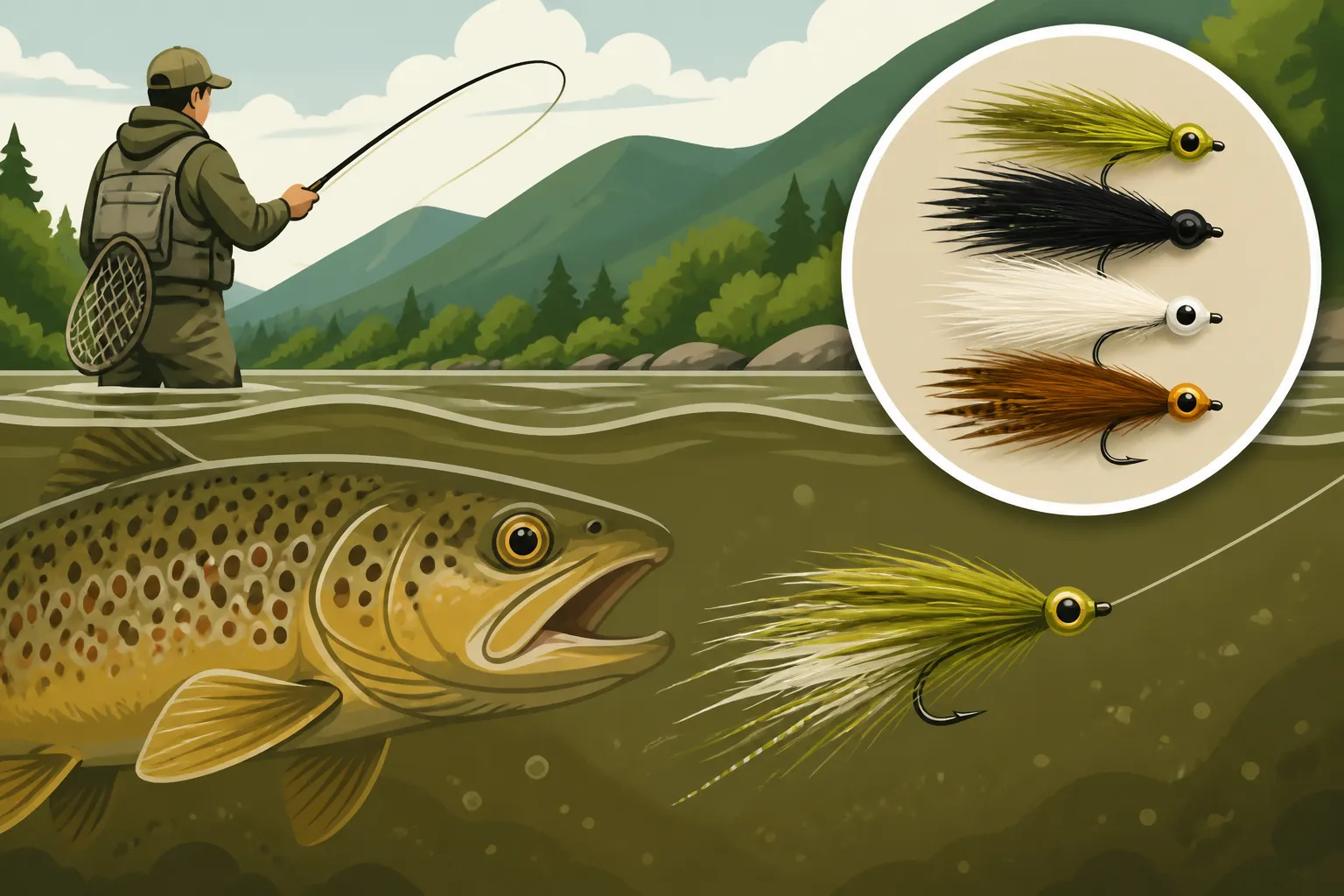
Best streamer color for muddy water trout
There's nothing quite as disheartening as waking up to perfectly planned trout fishing conditions, only to find your favorite Vermont stream swollen and chocolate brown from a recent downpour or heavy snowmelt. We've all been there, staring at that opaque water and wondering if it's even worth tying on a fly. The good news is, you absolutely can catch trout in muddy water, but it requires a shift in strategy, especially when it comes to your streamer colors. This guide is all about helping you cut through the murk and discover the best streamer colors to entice those elusive Vermont trout when visibility is at its worst.
Understanding Muddy Water and Trout Behavior
Before we even talk about specific colors, it's crucial to understand why rivers and streams get muddy, and how these conditions impact the trout you're trying to catch. It's not just about the color of the water; it's about what that color signifies for the fish.
Why Water Gets Muddy in Vermont
Vermont's landscape is beautiful, but it's also prone to changes that make our beloved fishing waters cloudy. Think about our seasons: heavy spring rains, rapid snowmelt events that turn gentle brooks into raging torrents, or even intense summer thunderstorms. All these can lead to increased runoff, carrying silt, clay, and organic debris from stream banks and surrounding land into the water column. Construction projects, agricultural runoff, and even natural erosion can contribute to the murkiness. When the water gets "muddy," it means there's a high concentration of suspended particles, drastically reducing light penetration and visibility for everything in the water. This can last hours, or even days, depending on the severity of the event and the size of the water body.
How Trout React to Low Visibility
When their world turns into a cloudy soup, trout, like most fish, become a little disoriented and rely less on their eyesight. Their primary sense for hunting in clear water—vision—is severely hampered. Instead, they lean heavily on their other senses: their lateral line and their sense of smell. The lateral line, a sensory organ running along each side of a fish's body, detects vibrations and pressure changes in the water. This is how they "feel" their environment, sense obstacles, and detect prey. In muddy water, trout will often move closer to structure, like submerged logs, undercut banks, or large rocks, where they feel more secure and can ambush prey that gets too close. They're less likely to chase a fast-moving, subtle fly and more inclined to react to something large, slow, and vibrating heavily in their immediate vicinity. Their feeding window might shrink, and they become more opportunistic, taking advantage of anything that presents itself as an easy meal. This is where your streamer choices become critical, as you need to appeal to those non-visual senses first and foremost.
The Science of Color in Murky Waters
It's easy to think that if you can't see the color, neither can the fish. But it's a bit more nuanced than that. Understanding how light interacts with water and suspended particles is key to choosing the right streamer.
Light Penetration and Color Absorption
Water, even clear water, filters light. As light penetrates deeper, certain colors are absorbed more quickly than others. Red, for example, is the first color to disappear, followed by orange and yellow. Greens and blues penetrate much deeper. Now, add a heavy load of suspended sediment, and this light absorption is greatly amplified. The particles scatter and absorb light, making the water appear brown, gray, or even reddish-brown. This means that many "natural" streamer colors that look great in clear water, like browns, olives, and tans, simply blend into the background in muddy conditions. They become practically invisible, no matter how perfectly they imitate a baitfish. The goal isn't necessarily to show the true color of your fly, but to create a visual stimulus that can be detected through the murk.
Contrast is Key: Dark vs. Bright
In muddy water, the actual hue of your streamer becomes less important than its ability to create contrast against the murky background. Think of it like this: in a dark room, a bright white object stands out, but so does a deep black object against a lighter wall. The same principle applies underwater. You're trying to create a silhouette or a distinct visual "pop" that the trout's limited vision can pick up. This often means opting for colors that are either extremely dark (like black) or extremely bright and fluorescent (like chartreuse or hot pink, though pink is less common for trout streamers). Dark colors create a strong silhouette against any ambient light, even minimal, filtering through the water. Bright, fluorescent colors, especially those that reflect UV light, can appear more vibrant or "glow" even in low light conditions, helping them stand out. The goal is to avoid anything that simply matches the color of the water.
Top Streamer Colors for Muddy Water Trout in Vermont
Now that we understand the "why" behind the choices, let's dive into the "what." These are the colors and combinations that tend to perform best when Vermont's waters are less than pristine.
Black and Dark Patterns
When the water is truly churning and visibility is measured in inches, black is your best friend. A black streamer creates the strongest silhouette against any available light, making it easily detectable by trout. It doesn't imitate a specific baitfish color as much as it imitates a shape that says "food" to a fish. Think about how a dark object looks against a cloudy sky – it stands out, right? That's the effect you're going for. Patterns like a black Woolly Bugger, a black Zonker, or a black Marabou Muddler are phenomenal choices. They present a clear, dark profile that fish can sense with their lateral line and dimly see with their eyes. Don't be afraid to go large with these patterns; a bigger silhouette means more displacement and vibration, further alerting trout to its presence. You can find excellent selections of black streamers at local tackle shops or even online retailers like Bass Pro Shops.
For example, a big, heavy black Woolly Bugger fished slowly along the bottom of a swollen stream can be incredibly effective. The marabou tail pulsates, sending out vibrations, and the black profile is unmistakable against the murky flow. Try swinging it through eddies or stripping it slowly through deeper pools.
White and Chartreuse: The High-Vis Options
On the opposite end of the spectrum from black, we have the super bright, high-visibility colors: white and chartreuse. These colors excel in conditions where there's still some light penetration, but the water is stained. White streamers, like a White Marabou Clouser Minnow or a simple White Woolly Bugger, offer a stark contrast, almost glowing in the dim light. They stand out beautifully against a dark, muddy background.
Chartreuse, a fluorescent yellow-green, is another powerhouse. It's an unnatural color in many ways, but its ability to reflect light and create a visual "hot spot" is undeniable. Many anglers swear by chartreuse in off-color water for everything from bass to walleye, and trout are no exception. A chartreuse streamer, perhaps with a little flash, can scream "eat me" to a trout struggling to see its next meal. Fly Patterns for Vermont Trout Streams often include these vibrant options for specific situations.
Consider a white or chartreuse streamer when the water is stained but not completely opaque. Perhaps after the initial flush of a rainstorm, or in sections of a river where sediment settles a bit more quickly. They provide a beacon for trout, especially those holding in slightly clearer pockets or on the edges of currents.
Two-Tone Combinations for Maximum Impact
Why choose just one color when you can combine for even greater effect? Two-tone streamers that pair a dark color with a bright one can offer the best of both worlds. The dark portion provides a strong silhouette, while the bright section gives that critical pop of visibility. Think black and white, black and chartreuse, or even olive and chartreuse.
A classic example is a black-and-white Clouser Minnow. The dark top and light belly create a natural-looking contrast that mimics many baitfish, even if the overall color is lost in the murk. Similarly, a streamer with a black head and a chartreuse body, or vice versa, can be incredibly effective. The contrasting elements allow the fly to be seen from multiple angles and under varying light conditions within the muddy water column. This design leverages the "contrast is key" principle to its maximum potential. When buying materials or pre-tied flies, check out places like Bass Pro Shops or Amazon for a wide variety of these two-tone options.
Natural-ish Tones with Flash
Sometimes, the water isn't totally opaque; it's just "stained" or "off-color." In these situations, trout might still be looking for something that vaguely resembles their natural prey, but they need help spotting it. This is where natural-ish tones like olive, brown, or gray, combined with a healthy dose of flash, can shine. The flash, typically Mylar or Krystal Flash, catches and reflects even the smallest amount of light, creating sporadic glints that can draw a trout's attention.
The key here is more flash than you'd typically use in clear water. A small strip of flash that might be subtle in clear conditions will likely disappear in the murk. You want enough to create a distinct flicker as the streamer moves through the water. While the base color might not be perfectly visible, the flash creates movement and an irresistible shimmer. This can be particularly effective in larger Vermont rivers where the water might be less violently churned but still cloudy, such as sections of the Lamoille or Winooski. Just be mindful of how much flash you add – too much can sometimes deter fish if it looks unnatural.
Beyond Color: Other Factors for Muddy Water Streamer Fishing
While color is a huge piece of the puzzle, it's not the only factor. To truly succeed when fishing streamers for trout in muddy Vermont waters, you need to consider presentation, size, and location.
Streamer Size and Profile
In muddy water, trout aren't sight-feeding from a distance. They're waiting for something to come close, something they can feel with their lateral line. This often means bigger flies. A larger streamer displaces more water, sending out stronger vibrations that a trout can detect from further away. Don't be shy about tying on a streamer that's 3-4 inches long, or even larger if the conditions are exceptionally bad.
The profile of the streamer also matters. A bulky, scruffy fly like a beefy Woolly Bugger or a Marabou Muddler pushes more water than a sleek, sparsely tied pattern. While those sparse patterns are fantastic in clear water for their realism, in the murk, you want something with presence. Think about the profile of a wounded baitfish struggling in the current – that's the kind of substantial meal you want to represent. This isn't the time for dainty flies; you want to make a statement. Best Tackle for Vermont Trout Fishing often recommends a range of streamer sizes.
Retrieval Techniques and Speed
Trout in muddy water are typically less aggressive and less willing to chase. This means your retrieval needs to slow down. A fast, erratic strip that works wonders in clear water will likely be ignored in the murk. Instead, think slow, deliberate, and sometimes even a dead drift. You want to give the trout ample time to detect your fly, orient itself, and make a move.
Experiment with different retrieve speeds, but generally, a slow, steady strip-pause retrieve works well. Let the current do some of the work, swinging your fly through likely holding lies. Sometimes, just letting the streamer dead drift for a few feet, then giving it a short strip, is all it takes. The goal is to keep the fly in the strike zone for as long as possible and present it as an easy, slow-moving target. The vibrations from the fly, combined with its silhouette, will be your primary attractant.
Weight and Depth Control
Getting your streamer down to where the fish are is paramount, especially in muddy, fast-moving water. Trout will often hug the bottom, seeking refuge from the heavy current and relying on subsurface structure. If your fly isn't getting deep enough, you're simply casting into empty water. Use heavily weighted streamers, or add split shot to your leader. Sink-tip lines or even full sinking lines are incredibly effective when streamer fishing in these conditions.
The faster the current and the deeper the water, the more weight you'll need. Don't be afraid to add several split shot above your fly to get it tumbling along the bottom. You might snag occasionally, but you're also putting your fly in front of fish that wouldn't see it otherwise. Fly Fishing for Trout in Vermont provides general guidance on weighting. Knowing the contours of the river bottom can help you choose the right amount of weight to bounce along without constantly snagging.
Reading the Water: Where to Find Trout
Even in muddy water, trout still hold in predictable places. In fact, these holding spots become even more critical. Look for areas where the current slows down, offering fish a break from the relentless flow. This includes:
- Eddies and current seams: The calmer water behind large rocks, logs, or bends in the river.
- Undercut banks: These offer cover and a slower current directly beneath the bank.
- Deep pools: Trout will drop into the deepest parts of pools to escape the current.
- Confluence of tributaries: Where a smaller, clearer stream joins a muddy main stem can create a clearer "seam" that trout will key into.
- Behind large structure: Boulders, submerged trees, or bridge abutments.
These are the places where trout expend less energy and have a better chance of ambushing prey. Focus your casts on these areas, allowing your heavily weighted streamer to get down quickly and drift through the strike zone. You might not see the fish, but understanding their likely haunts increases your chances dramatically. Best Fly Fishing Rivers in Vermont outlines where to find these structures.
Here’s a quick reference table for muddy water streamer colors:
| Water Clarity/Condition | Primary Streamer Colors | Why It Works | Key Considerations |
|---|---|---|---|
| Extremely Murky/High Flow | Black, Dark Brown | Strongest silhouette, maximum contrast against limited light | Use larger sizes, heavy weight, slow retrieve |
| Moderately Stained/Cloudy | Chartreuse, White, Hot Pink | High visibility, stands out against darker background, UV reflective | Use with adequate weight, experiment with retrieve speed |
| Stained with Some Clarity | Black/White, Olive/Chartreuse | Combines silhouette with high-vis pop, versatile for varying light | Good starting point when unsure of exact conditions |
| Slightly Turbid/Off-Color | Olive/Brown with Flash | Mimics natural baitfish, flash provides attraction in dim light | More flash than usual, focus on natural movement |
Remember that conditions can change rapidly in Vermont. What works one day might not work the next, so always be ready to adapt. Don't be afraid to try different combinations or even different patterns altogether if you're not getting any bites. A well-placed, properly weighted streamer in the right color, even in muddy water, can still lead to a fantastic day of trout fishing.
This article is for general informational purposes only and does not constitute professional advice. Laws, prices and regulations vary by location and change over time. Consult a qualified professional for guidance on your specific situation.