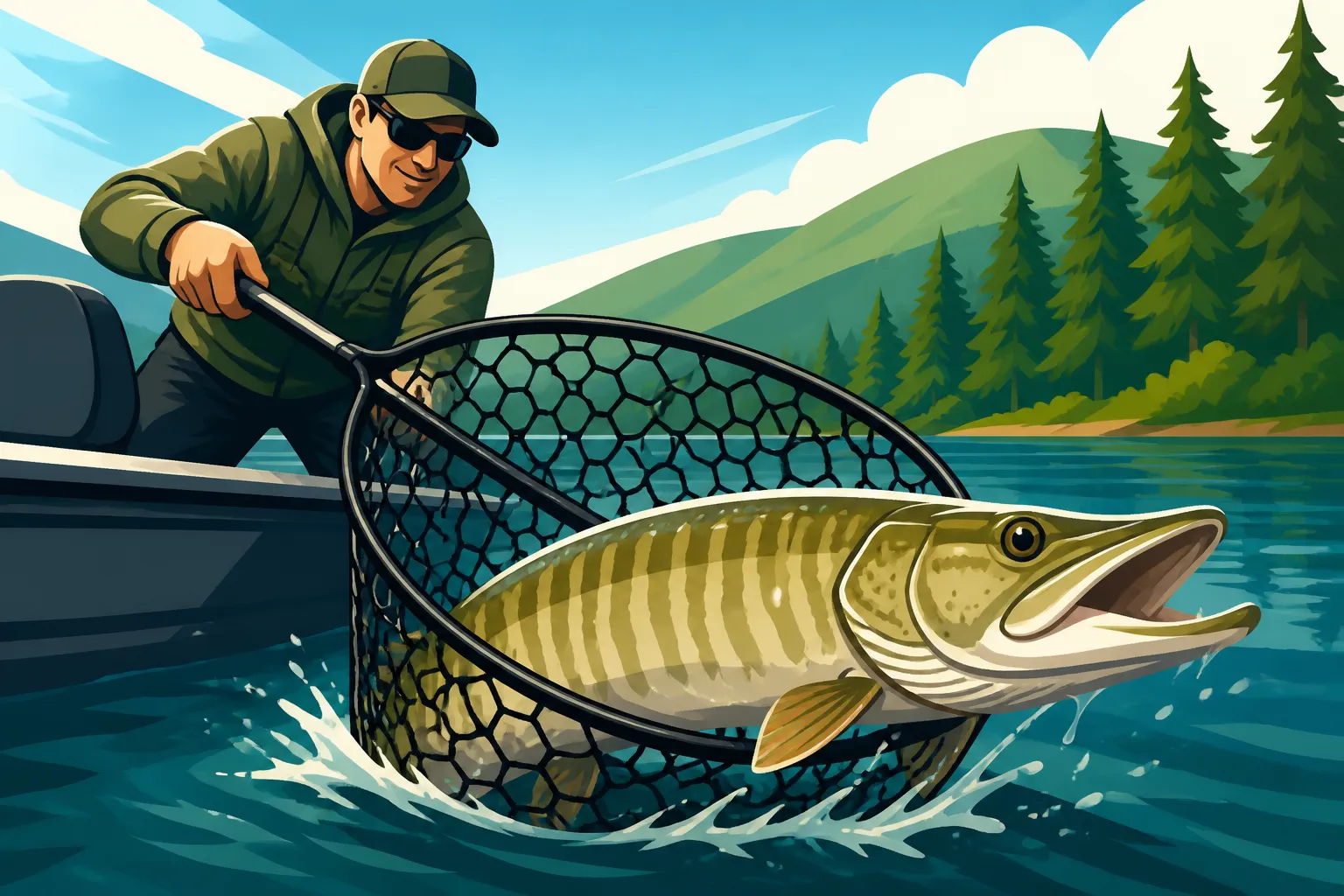
Best net for landing a big muskellunge from a boat
Picture this: you've spent hours, maybe even days, casting, reeling, and hoping. Suddenly, your line goes tight, your rod bends double, and you're battling a true monster from the depths of Lake Memphremagog. It's a massive muskellunge, thrashing, leaping, and testing every ounce of your tackle and skill. You've worked it boatside, heart pounding, but then comes the critical moment – how do you get this toothy, powerful fish safely into the boat without losing it, hurting yourself, or, most importantly, harming the fish? This guide is going to walk you through exactly what makes a fishing net suitable for landing one of Vermont's biggest freshwater predators, ensuring your triumphant catch doesn't end in disappointment.
Why a Specialized Musky Net Isn't Just "Nice to Have" It's Essential!
Trying to land a trophy muskellunge with a standard bass or trout net is like bringing a butter knife to a sword fight. It’s simply not going to cut it, and you're likely to end up frustrated, potentially injured, or worse, losing that fish of a lifetime. Vermont's waters, especially places like Lake Memphremagog, are known for producing truly impressive muskies, and respecting these incredible fish, and yourself, starts with having the right equipment.
The Sheer Size and Power of Vermont Muskies
Muskellunge, often called "the fish of 10,000 casts," are apex predators. When you finally connect with one, you're not just fighting a fish; you're fighting a primal force of nature. These fish can easily stretch over 40-50 inches and weigh upwards of 30, 40, or even 50 pounds. Imagine trying to scoop a feisty, angry torpedo of that size into a net designed for a 5-pound bass. The hoop would be too small, the handle too weak, and the mesh would likely tangle in its razor-sharp teeth or simply tear under the strain. The sheer force of their head shakes and body rolls can snap flimsy handles or bend small hoops right out of shape. You need something robust, something that can withstand the incredible power these giants possess. When you're dreaming of landing a record-breaker from Lake Memphremagog Fishing Guide, you absolutely need a net that can handle the reality of that dream.
Protecting the Fish and Yourself: Safety First
Muskies are a highly sought-after sport fish in Vermont, and responsible angling dictates a strong emphasis on catch and release, especially for the larger, older fish that contribute significantly to the fishery. A proper musky net is crucial for ensuring the fish's survival after release. Standard nylon nets with knotted mesh can severely abrade a musky's delicate slime coat, remove scales, and damage its fins – all of which can lead to infection and mortality. The knotless, rubberized mesh of a good musky net cradles the fish, minimizing damage to its protective layer.
Beyond fish welfare, your own safety is paramount. A thrashing musky, with its mouthful of sharp teeth and multiple treble hooks from your lure, is a dangerous combination in the confined space of a boat. A large, deep net allows you to quickly and securely contain the fish, preventing hooks from swinging wildly and potentially embedding themselves in your hands, arms, or even worse. It also provides a moment of control, allowing you to calm the fish slightly before attempting hook removal. Trying to unhook a frantic musky without proper containment is an open invitation to a trip to the emergency room.
Key Features to Look for in a High-Quality Musky Net
When you're ready to invest in a serious musky net, there are several non-negotiable features you need to prioritize. This isn't a piece of gear where you want to cut corners; the frustration of losing a trophy fish at the boat or injuring a magnificent creature due to inadequate equipment is simply not worth it. Thinking about Vermont Muskellunge Regulations on Lake Memphremagog for catch and release, a proper net is part of being a responsible angler.
Hoop Size and Shape: Go Big or Go Home
This is arguably the most critical feature. A musky net needs an enormous hoop. We're talking about a minimum of a 30-inch by 32-inch opening, and many seasoned musky anglers prefer even larger, like 36×40 inches. Why so big? Because a musky, especially a big one, won't just slide gently into a small opening. They fight, they thrash, and they often try to roll. A large, wide, and deep hoop allows you to encompass the entire fish quickly, often tail-first, reducing the chance of it flopping back out or getting caught awkwardly. The depth of the net is just as important; you want a basket deep enough to fully contain the fish once it's inside, preventing it from jumping out. A common mistake is using a net that's wide enough but not deep enough, leading to fish escaping over the top.
Handle Length and Construction: Reach, Leverage, and Durability
The handle of your musky net needs to be long and incredibly sturdy. Most quality musky nets feature telescoping handles that extend from around 4 feet up to 8 or even 10 feet. The telescoping feature is vital for versatility, allowing you to reach out when a musky makes a last-ditch run away from the boat, or shorten it for tighter boat-side maneuvers. The handle material is typically heavy-gauge aluminum or a robust composite. It needs to withstand immense pressure; a large musky can generate significant torque against the handle, so flimsiness is not an option. Look for handles with a comfortable, non-slip grip, especially since your hands might be wet and adrenaline-fueled. A strong, secure locking mechanism for the telescoping sections is also crucial – you don't want the handle collapsing mid-net. For those who frequently fish larger bodies of water like Lake Memphremagog from bigger boats, a longer handle is definitely an advantage.
Netting Material: Knotless and Fish-Friendly
Forget about the old green knotted nylon nets. For muskies, you absolutely need a net with a rubberized or rubber-coated mesh. This specialized mesh offers several key benefits:
- Fish Protection: The smooth, flexible rubberized material is far gentler on a musky's delicate slime coat, gills, and fins. It prevents scales from being scraped off and significantly reduces the risk of eye damage. This is critical for the health and survival of released fish.
- Hook Resistance: Those big musky lures often have multiple treble hooks. Knotted nylon mesh is a magnet for these hooks, leading to frustrating, time-consuming tangles that stress both you and the fish. Rubberized mesh is far less prone to snagging hooks, allowing for quicker, safer unhooking.
- Durability and Maintenance: Rubberized mesh is incredibly durable and resistant to cuts and tears from teeth. It also doesn't absorb water, making it much lighter to lift out of the water and less prone to odor and mildew. Cleaning is a breeze – just a quick rinse.
Overall Build Quality: Investing in Your Success
A musky net is an investment, and you want it to last. Look for a net where every component speaks to heavy-duty construction. The yoke (where the hoop meets the handle) should be solid aluminum or reinforced composite, with heavy-duty rivets or bolts securing the hoop. The hoop itself should be thick-gauge aluminum, capable of holding its shape under the weight and power of a large fish. Don't overlook the hinges on folding nets either; they need to be robust and built to withstand the rigors of musky fishing. This isn't a piece of gear you want breaking down when you're fighting a fish that could be a Vermont state record muskellunge weight.
Popular Musky Net Brands and Where to Find Them
When it comes to specialized musky nets, there are a few brands that have earned their stripes among serious anglers for their robust construction and fish-friendly designs. While I can't give specific model numbers or prices, I can guide you on what to expect and where to look.
What to Expect from Top-Tier Options
Brands that cater to musky, pike, and even large saltwater fish often produce the kind of nets you need. These nets will typically feature:
- Massive Hoop Sizes: As discussed, expect hoops in the 30×32 inch to 40×40 inch range, often with depths exceeding 40 inches.
- Extendable Handles: Heavy-duty telescoping handles, usually 4-8 feet, sometimes longer, made of thick-walled aluminum.
- Rubber-Coated or Fully Rubber Mesh: This is standard for fish-friendly and tangle-free operation.
- Strong Yokes and Frames: Built to withstand substantial loads without bending or breaking.
You'll find these high-quality, specialized musky nets at major fishing retailers. Think big box stores like Bass Pro Shops, which often have dedicated sections for musky and pike gear, or online marketplaces like Amazon, where you can often compare various models and read reviews from other anglers. These larger retailers tend to stock a wider variety of specialized equipment that might not be available at smaller local tackle shops. When considering Best Techniques for Muskellunge on Lake Memphremagog, having the right net is just as important as the right lure.
Considering Your Budget and Boat Type
Musky nets are not inexpensive. Expect to pay a premium for the robust construction and specialized materials. However, consider it an investment in successful, ethical angling. The cost of a lost trophy fish or a damaged piece of gear can far outweigh the initial price of a quality net.
Your boat type can also influence your net choice. If you're fishing from a smaller bass boat or a kayak (though landing a musky from a kayak is a whole other adventure!), a slightly shorter or more compact extendable handle might be more manageable. For larger boats, especially those with high gunwales, a longer handle provides the necessary reach. Always consider the space you have available for storing the net while not in use; some models fold, while others are fixed. This might seem like a small detail, but a cumbersome net can be a real pain on the water.
| Feature | Description | Benefit for Musky Anglers |
|---|---|---|
| Hoop Size | Extra large (e.g., 30"x32" to 40"x40") and deep | Easily encompasses entire large fish, prevents escape. |
| Handle Type | Heavy-duty telescoping aluminum (4-10 ft) | Provides crucial reach, leverage, and durability under stress. |
| Netting Material | Rubberized or fully rubber, knotless mesh | Protects fish's slime coat, prevents hook tangles, easy to clean. |
| Build Quality | Reinforced yoke, thick-gauge frame, robust hardware | Withstands immense power of large muskies, ensures longevity. |
| Storage | Folding or fixed design, depending on boat space | Important for ease of transport and storage in confined boat spaces. |
Tips for Successfully Netting and Handling a Vermont Musky
Landing a musky is often more challenging than fighting it. The boat-side battle is where many fish are lost. Having the right net is only half the battle; knowing how to use it effectively is the other. This is crucial for both successful catches and ensuring the fish's well-being, especially with species like the muskellunge that have specific handling requirements. Understanding Muskellunge Habits on Lake Memphremagog will give you an edge in the fight, but knowing how to net will seal the deal.
Teamwork Makes the Dream Work (Often)
If you're fishing with a partner, designate a "net man" before you even start fishing. This person's sole job is to net the fish when it's ready. Communication is key. The angler fighting the fish needs to guide it towards the net man, ideally bringing the fish in head-first, sliding it over the side of the boat into the waiting net. The net man needs to be patient, waiting for the musky to be tired and positioned correctly. Don't chase the fish with the net; let the angler bring it to the net. Once the fish is over the hoop, a swift, deliberate scoop is needed, lifting the net directly upwards to capture the fish. A common mistake is to try and lift the net forward, which often results in the fish sliding out.
Post-Net Care and Release
Once the musky is securely in the net, keep the net in the water if possible. This keeps the fish oxygenated and calm. Have your release tools — long-nosed pliers, bolt cutters (for cutting hooks if necessary), and a hook-out tool — ready. Unhook the fish while it's still in the water, or, if absolutely necessary, lift the net briefly into the boat while minimizing its time out of the water. Avoid holding the fish vertically by the jaw or gills; support its body horizontally. Take any photos quickly, then gently guide the fish back into the water, holding it by the tail and supporting its belly until it swims away under its own power. You can learn more about specific regulations and best practices in How to Catch Muskellunge on Lake Memphremagog.
Practice Makes Perfect (Even Without a Fish)
It sounds silly, but if you're new to musky fishing or using a large net, practice deploying it and maneuvering it in your boat. Get a feel for its weight, its reach, and how it handles. Simulate a net shot without a fish. Familiarity will make a huge difference when the adrenaline is pumping and a big musky is boatside. This kind of preparation means you're ready when that monster strikes on Lake Memphremagog Muskellunge Fishing grounds.
Disclaimer
This article is for general informational purposes only and does not constitute professional advice. Laws, prices and regulations vary by location and change over time. Consult a qualified professional for guidance on your specific situation.